Rayleigh radial thresholds and quantiles
ID: rayleigh-radial-thresholds-and-quantiles

For , integration gives the survival function and cumulative distribution functionSolving gives the quantile function[ref]
The Rayleigh Distribution. Random: Probability, Mathematical Statistics, Stochastic Processes by Kyle Siegrist; The General Rayleigh Distribution, Distribution Functions: CDF, quantile and survival functions
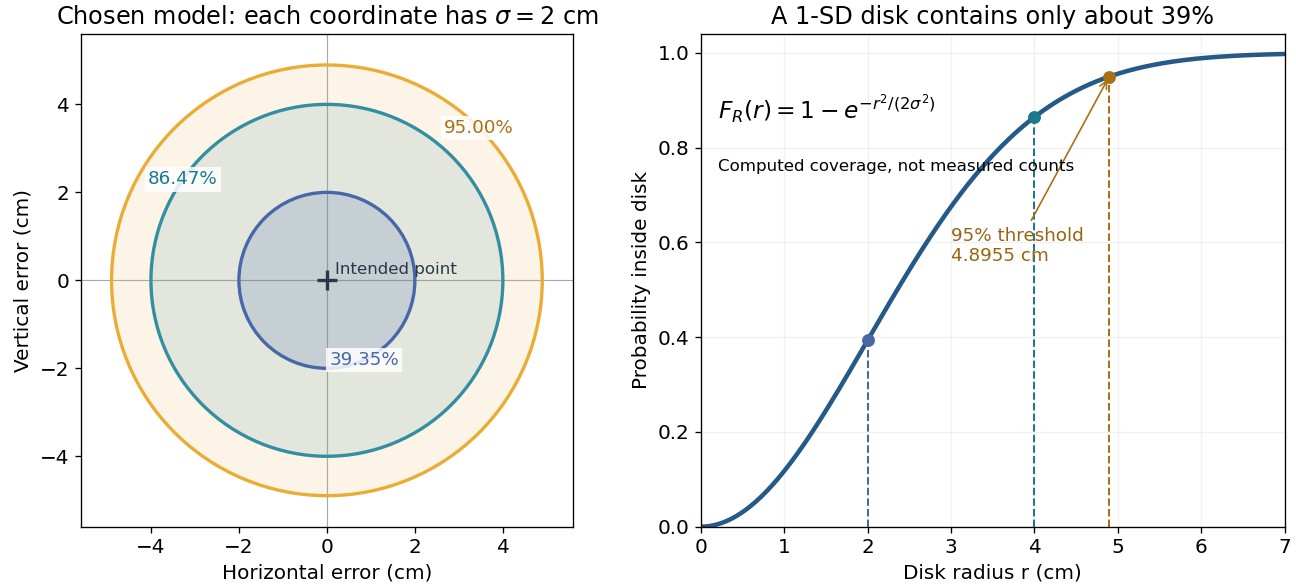
For the chosen positioning model ,The disk of radius one component standard deviation therefore contains about 39.35% of outcomes; the familiar one-dimensional normal interval percentage does not apply to a two-dimensional disk. The 95% and 99% radial thresholds areA circle defined by itself still has probability zero; its enclosed disk carries the stated probability.

The closed-form quantile function also gives inverse transform sampling: if has uniform distribution on , then has Rayleigh distribution. Using instead gives the same law. Endpoints are excluded so that the logarithm stays finite.
New to topics? Read the docs here!