For , integration gives the survival function and cumulative distribution functionSolving gives the quantile function[ref]
The Rayleigh Distribution. Random: Probability, Mathematical Statistics, Stochastic Processes by Kyle Siegrist; The General Rayleigh Distribution, Distribution Functions: CDF, quantile and survival functions
For the chosen positioning model ,The disk of radius one component standard deviation therefore contains about 39.35% of outcomes; the familiar one-dimensional normal interval percentage does not apply to a two-dimensional disk. The 95% and 99% radial thresholds areA circle defined by itself still has probability zero; its enclosed disk carries the stated probability.
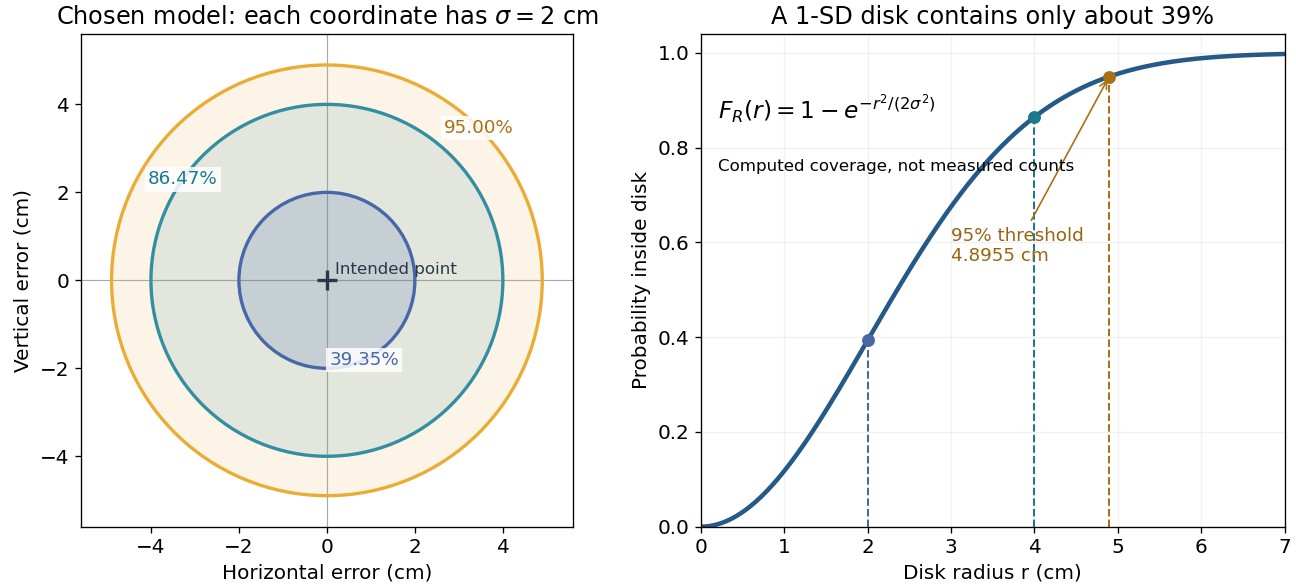

The closed-form quantile function also gives inverse transform sampling: if has uniform distribution on , then has Rayleigh distribution. Using instead gives the same law. Endpoints are excluded so that the logarithm stays finite.
Articles by others on the same topic
There are currently no matching articles.