
A power law responds to every fixed rescaling by the same factor . Regular variation keeps this scaling behaviour in the limit , while allowing departures from an exact power law. It is useful when the scaling exponent is stable but a smaller correction continues changing. The correction can even grow without bound.
An eventually positive measurable function has regular variation at infinity with index ifThe argument is in the domain of a function for sufficiently large . Each is held fixed as the limit is taken; allowing to change with is a different assertion. This is the scalar definition recalled by [ref]
https://people.orie.cornell.edu/sid/NewForLinking/papers/RegVarMeasFinal2.pdf. Filip Lindskog, Sidney I. Resnick and Joyjit Roy, Regularly varying measures on metric spaces: hidden regular variation and hidden jumps, §3.2, p. 12
. The index is unique: taking determines .For example, on the function hasThus has regular variation of index two. Yet : regular variation does not require asymptotic equivalence to a constant times a power law. Doubling gives . At this is approximately , respectively. The ratio approaches four slowly, even though the exponent is exactly two in the limiting scaling law.
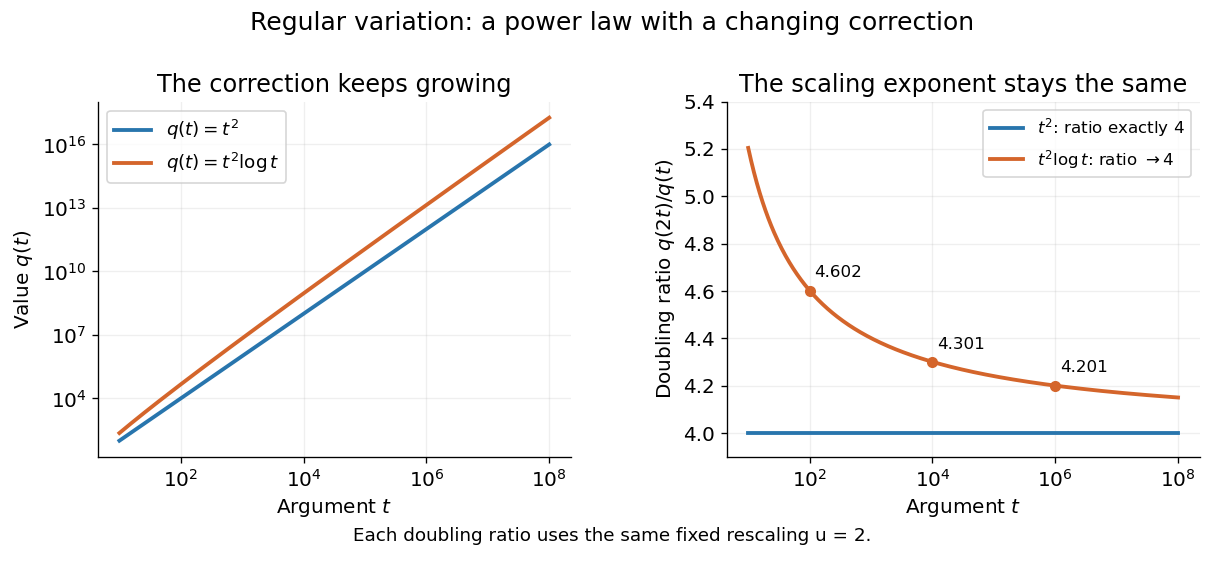
An exact power law has a fixed doubling ratio; a logarithmic correction approaches the same ratio without approaching a constant multiple of that power
. Details. 
The slowly varying function isolates this correction. Set . ThenConversely, multiplying a slowly varying function by gives regular variation of index . Hence the decomposition is exact on its eventual domain of a function; it is the scaling relation, rather than the decomposition itself, that is asymptotic.
A Pareto distribution gives a decreasing example with a direct interpretation. For , take the tail probability . Its regular variation index is . Doubling a threshold divides its tail probability by four, andFor a tail probability with regular variation of index , the same conditional probability tends to . An exponential distribution behaves differently: its corresponding conditional probability is . This comparison explains why scaling limits are useful in extreme value theory; it does not establish that an observed dataset follows a particular tail model. The role of regular variation in heavy-tailed distributions is discussed in Lindskog, Resnick and Roy, introduction, p. 1.
An exponential function is not regularly varying with any finite index: at , , rather than . Boundedness alone is also insufficient, as the oscillating counterexample in slowly varying function shows. Checking a few rescaling ratios at finite arguments can illustrate a proposed law, but cannot prove its limiting definition.
Jovan Karamata developed this theory in his 1930 paper and returned to its fundamental results in 1933. The opening of his 1933 paper identifies the earlier work; pp. 57–58 connect the rescaling limit with a power law and a slowly varying factor. See J. Karamata, Sur un mode de croissance régulière. Théorèmes fondamentaux, Bulletin de la Société Mathématique de France 61 (1933), 55–62. This gives a precise language for “almost a power” without discarding corrections that remain large.
New to topics? Read the docs here!