Sedimentation scale height
ID: sedimentation-scale-height

Take identical rigid spheres of radius , particle density and displaced liquid density , at uniform absolute temperature . Let increase upwards from a reference layer and write . The buoyancy correction gives the effective gravitational massThe actual grain mass is ; the displaced liquid subtracts from the effective gravitational mass. In a dilute, noninteracting particle suspension, the Boltzmann distribution therefore givesHere is number density and is the Boltzmann constant. Equivalently, the dilute osmotic pressure supports the grains above it: . Dividing by and integrating yields the same exponential function. No dynamic viscosity appears in this equilibrium argument. If , the population instead increases upwards; at equal densities this gravitational model predicts uniform .
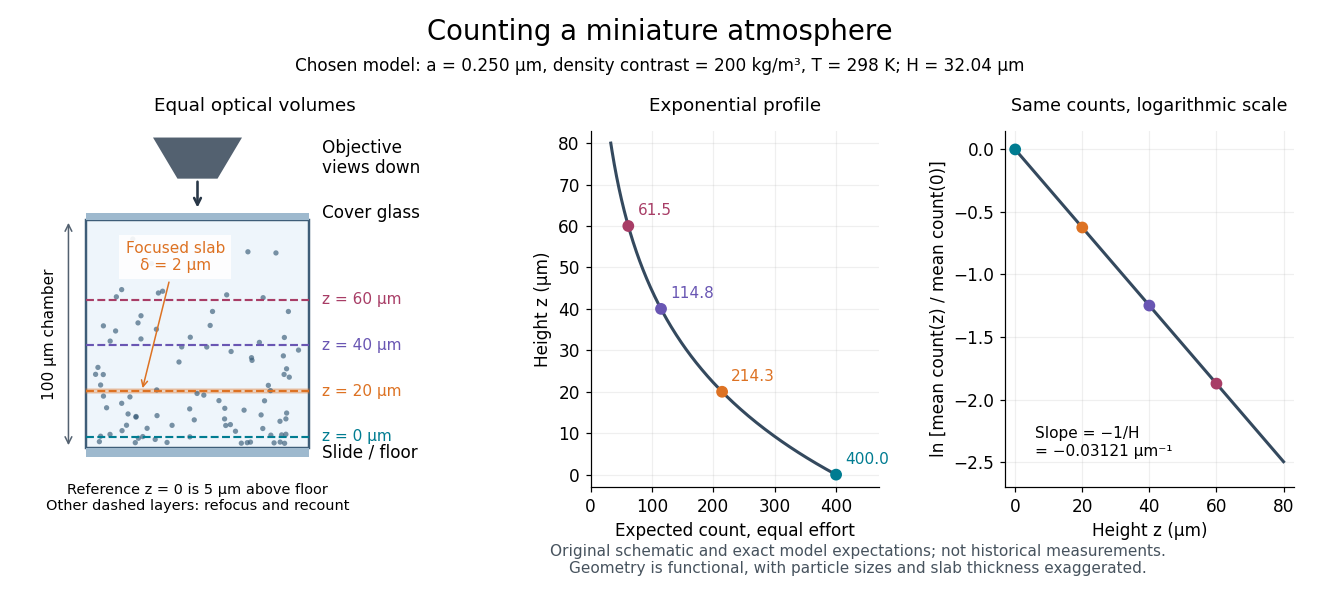
A microscope counts a finite optical slab, not an infinitesimal plane. For equal viewed area and slab thickness , an ideal uniform detection window centred at givesThus equal optical volumes preserve the exponential function count ratio exactly, even for finite , provided the windows lie wholly inside the accessible chamber and have the same detection response. Unequal depth response or overlapping a boundary can corrupt this inference. Repeated observations estimate the mean count; closely spaced visits need not be independent because grains remain in view.
For an original chosen model, set , , , and . These are illustrative inputs, not Jean Baptiste Perrin's measurements. Using givesIf equal observation effort gives expected count in the reference layer, the expected counts , and higher are approximately , and . Fractions describe expected values over observations, not fractional grains. Using the actual grain mass instead of its buoyancy-corrected value would make the inferred Avogadro constant six times too small for these chosen densities.

New to topics? Read the docs here!