
Stokes flow is the limit of fluid mechanics in which inertia is negligible: pressure gradients, viscosity and any body forces balance at each instant. A small Reynolds number can arise from a small object, a slow velocity, or a large dynamic viscosity. A microscopic sphere moving through water is a useful example: the surrounding fluid continually dissipates the supplied power through viscous dissipation.
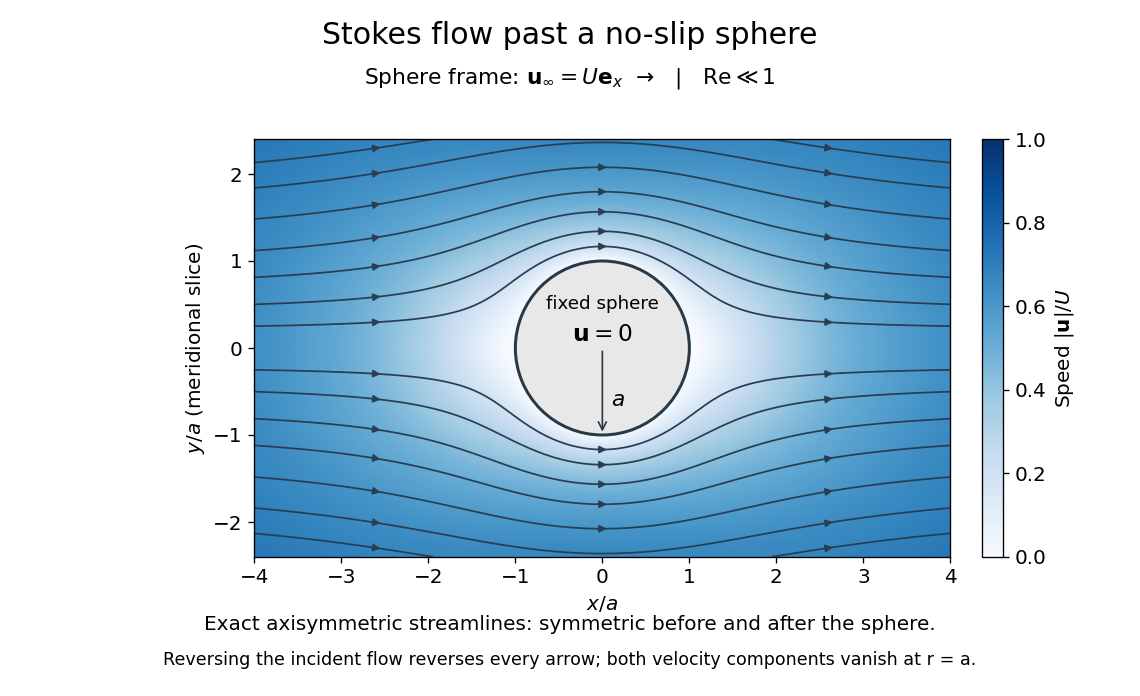
The picture is a meridional slice of the three-dimensional axisymmetric flow around a sphere, with the sphere held fixed and the distant fluid moving rightward at speed . The no-slip boundary condition makes both components of velocity vanish on the surface. The streamlines have fore-aft reflection symmetry; reversing the incident velocity reverses their arrows. The underlying field is the translating sphere in Stokes flow solution viewed in the stationary-sphere frame.
For an incompressible flow of a Newtonian fluid with constant dynamic viscosity , the steady Stokes equation isHere is pressure, is velocity, and is body force per unit volume. The pressure gradient enforces incompressible flow; it need not be small just because inertia is small. At speed and length , the motion-induced pressure gradient has typical scale , corresponding to a disturbance pressure difference of order . See Shreyas Mandre's fluid dynamics notes, sections 9.1.1–9.1.2.
The controlling Reynolds number iswhere is density and is kinematic viscosity. The condition suppresses advection of momentum on the length . Rapid changes require an additional check of the viscous diffusion time: small Reynolds number alone does not eliminate the time derivative in the Unsteady Stokes equation.
Two rewards of this limit are the exact Stokes's law for the drag on a sphere and kinematic reversibility of Stokes flow. The first predicts settling velocities and connects to the Stokes–Einstein relation; the second explains why a microswimmer needs a nonreciprocal stroke, as expressed by the scallop theorem. Despite viscous dissipation, reversing the driving can retrace the motion: an especially striking consequence of Linearity of Stokes flow.
George Gabriel Stokes obtained the sphere drag and its terminal velocity in his 1851 investigation of how viscosity changes physical pendulum motion. He also used the slow fall of small water droplets to discuss clouds. The paper was read on 9 December 1850; 1851 is its publication date. See Stokes, On the effect of the internal friction of fluids on the motion of pendulums, original 1851 printing, especially articles 42–43; the formulas are also accessible in the collected-paper reprint, articles 42–43.


Stokes flow refers to the flow of an incompressible viscous fluid at low Reynolds numbers, where inertial forces can be neglected in comparison to viscous forces. This type of flow is governed by the Stokes equations, which are simplified forms of the Navier-Stokes equations. These equations assume that the fluid is Newtonian, meaning its viscosity is constant and the stress is linearly proportional to the rate of strain.
New to topics? Read the docs here!