Virial theorem on a Kepler ellipse
ID: virial-theorem-on-a-kepler-ellipse

Consider the exact two-body problem with masses . In the inertial centre of mass frame, its internal kinetic energy is , where is their relative position, is the reduced mass, and with . Take a noncollision elliptic Kepler orbit with semi-major axis and orbital eccentricity . Write for eccentric anomaly, to avoid confusing it with total energy . With mean motion and orbital period , Kepler's equation and the orbit geometry giveThe time origin is periapsis. Since , the time average of over one orbital period is exactly . Therefore and , independently of orbital eccentricity. Equal steps in eccentric anomaly are not equal time steps; unweighted averaging of a drawing of the ellipse gives the wrong answer.
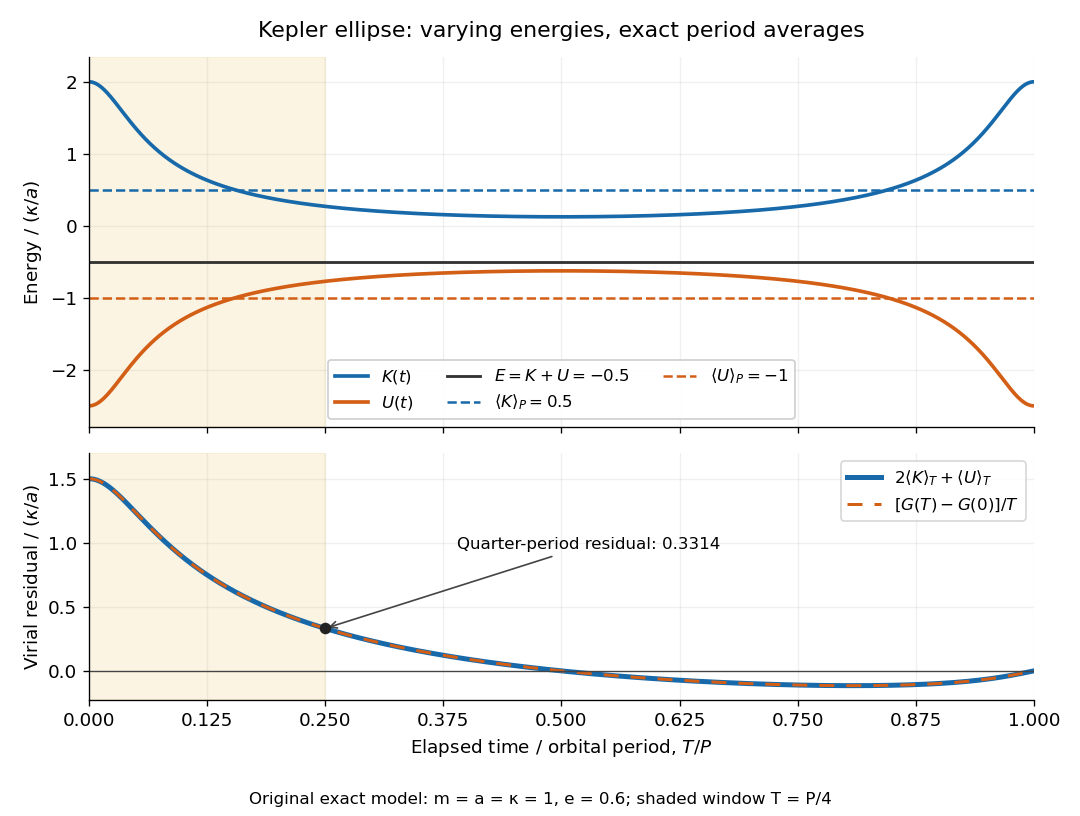
Instantaneous kinetic energy and potential energy, their orbital period averages, and the finite-window virial residual on an eccentric Kepler orbit
. Details. 
The original dimensionless example in both diagrams has and . At periapsis, , , ; at apoapsis, , , . Both have , but is respectively and . Only the orbital period averages are and . The instantaneous zero of occurs at , not at every point of the orbit.
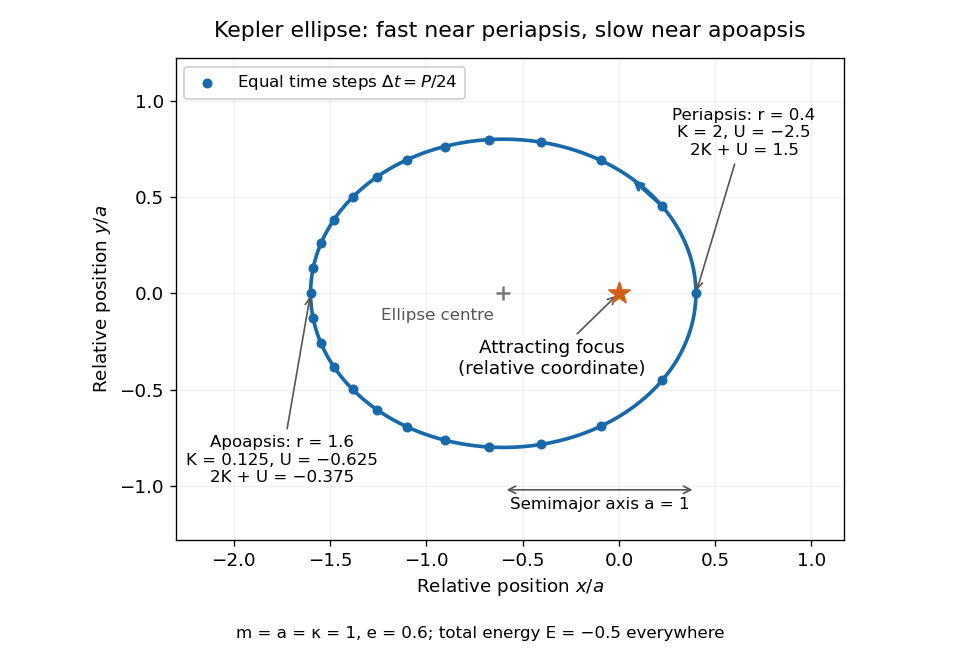
Relative orbit of the same two-body problem, with equal-time markers, the attracting focus, and periapsis and apoapsis energies
. Details. 
The endpoint term can also be evaluated exactly: . Starting at periapsis, a window ending at eccentric anomaly hasAt , Kepler's equation gives and a positive residual . At or , returns to zero and the residual vanishes exactly. The lower panel shows the running residual and its endpoint expression coinciding; the shaded quarter-orbital period window explains why a short observation need not satisfy the infinite-time theorem.
New to topics? Read the docs here!