Water mass to molecular count
ID: water-mass-to-molecular-count

Choose approximate atomic weights and , and use . The chemical formula then gives water molar massThese are deliberately chosen rounded inputs, not exact atomic weights or a universal value for every water sample. Different isotopic abundances, notably those in heavy water, change the mean molar mass; chemical formula alone does not specify them. Adding atomic weights also neglects the tiny mass change associated with chemical bond energies, immaterial at this rounding precision.
For an illustrative pure water sample of mass , this convention givesThe count refers to water molecules. Their hydrogen chemical atom count is approximately , and their oxygen chemical atom count is approximately . The mean mass per water molecule is . Extra displayed digits expose the arithmetic; they do not imply that the sample composition or mass was measured that precisely.
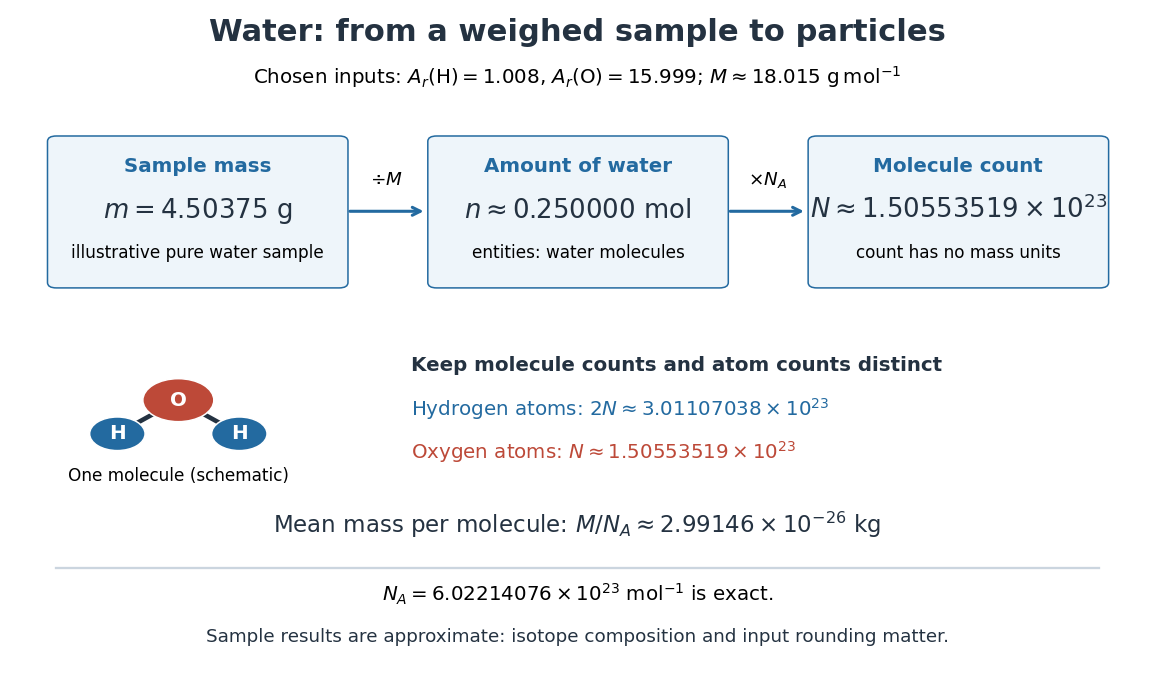
Mapping water mass through amount of substance to molecule and chemical atom counts using chosen approximate atomic weights
. Details. 
The same conversion makes stoichiometry a mass calculation. For the chemical equation , complete conversion of of molecular hydrogen and of molecular oxygen gives of water. With the chosen approximate atomic weights, the reactant masses are and , summing to . The ratio belongs to molecule counts and amount of substance, not to masses; this bookkeeping neglects the much smaller reaction energy contribution to mass.
New to topics? Read the docs here!