
Yeasts are fungi whose growth is predominantly unicellular, commonly through budding or division into two cells. The word describes a growth form across different fungal lineages, rather than one species or an exclusive clade; some fungi can switch between unicellular and filamentous growth. Thus Saccharomyces cerevisiae is a yeast, but yeast is not another name for that one species. See Kurtzman, Fell and Boekhout, The Yeasts, chapter 1 (2011): definition and classification.
A yeast cell has eukaryotic organization, including a cell nucleus, mitochondria and a cell wall. Small size and a unicellular lifestyle do not make it a member of bacteria. These compartments let an experimentally accessible biological cell retain much of the organization shared with other eukaryotes. See Clark, Douglas and Choi, Biology 2e, 24.1: fungal cells and yeast growth.
A motivating experiment: can fermentation continue without intact yeast cells? In 1897, Eduard Buchner ground brewers' yeast with quartz sand and diatomite, added water, and pressed out a liquid extract. Adding concentrated cane sugar produced carbon dioxide after 15–60 minutes. A cell-retaining filter still yielded an active filtrate: with sterilized cane sugar in an icebox, fermentation began after about a day. Saturated lactose gave no observed fermentation. These are reported observations, not invented control results. See Buchner, Alcoholic fermentation without yeast cells (1897), translated excerpt hosted by Carmen Giunta.
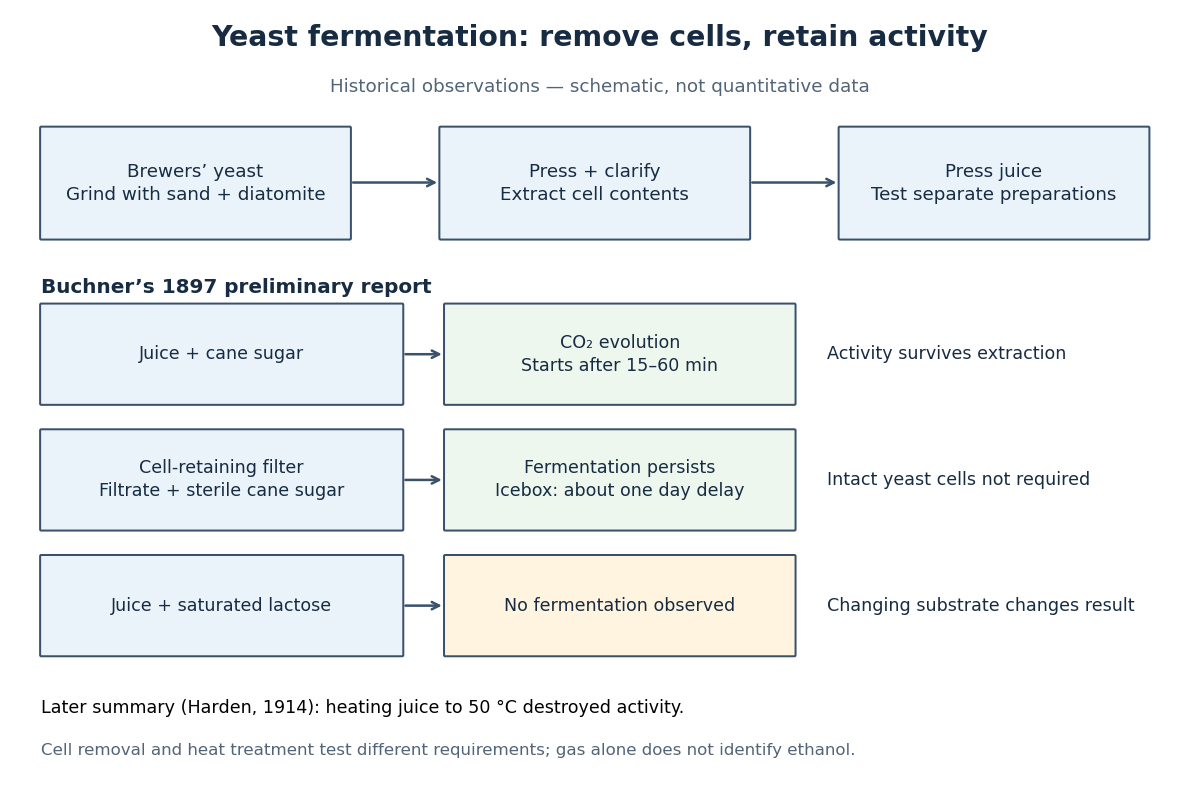
The filtration comparison addresses the objection that surviving intact yeast cells caused the activity. The lactose comparison tests substrate dependence; it is not a no-sugar blank, nor a comparison at matched sugar concentrations. A proposed modern follow-up would also compare the same extract with and without added sugar, accounting for material already in the extract. That is an experimental suggestion, not a result attributed to Buchner. His report specifies brewers' yeast; it does not identify the preparation here as a pure Saccharomyces cerevisiae strain.
Heat treatment asks a different question: does destroying activity in the extract stop fermentation? Buchner's preliminary report described weak or absent activity after heating and filtration, rather than one clean universal threshold. Harden's 1914 account of the subsequent work summarized loss of activity on heating the juice to . Harden also described requirements for both enzymes and coenzymes. Cell-free therefore means neither chemical-free nor a preparation containing one purified enzyme. See Arthur Harden, Alcoholic Fermentation (1914), chapters II and VI: cell-free activity and the fermenting complex.
The inference is that extracted cellular machinery can sustain these chemical reactions without an intact living biological cell. This does not show that the extract reproduces, grows or maintains itself like a yeast. Moreover, gas evolution alone does not identify ethanol: cellular respiration can also release carbon dioxide. Product identification is a separate measurement; Harden's account describes both ethanol and carbon dioxide as products of cell-free alcoholic fermentation. The beautiful separation is between the organism that produces and maintains the machinery and the machinery that catalyzes a particular transformation.


Does not appear to refer to any one specific phylogenetic level, it usually refers to either:
- Saccharomyces cerevisiae, the model eukaryote unicellular organism
- two phila of the fungus kingdom
New to topics? Read the docs here!