Articles by others on the same topic

Charge conservation says that the total signed electric charge of an isolated collection stays constant. More generally, a collection closed to electric charge exchange has constant total electric charge, even if energy crosses its boundary. This is the charge bookkeeping relevant to a closed system or an isolated system; isolation from energy exchange is not required. Positive and negative electric charge count with opposite signs. Creating or removing an electron and a Positron together is compatible with charge conservation, because their combined electric charge is zero. [ref]
https://www.feynmanlectures.caltech.edu/I_04.html#Ch4-S4. Feynman, Leighton and Sands, The Feynman Lectures on Physics, I.4.4: net charge conservation
.Imagine a fixed box initially containing electric charge . Stipulate incoming conventional current and outgoing conventional current throughout , with no other boundary transport. Since one ampere is one coulomb per second, the stored electric charge grows at :If instead the outgoing electric current also equals , the stored electric charge remains while electric charge passes through. These are stipulated transport examples; constant terminal electric currents alone do not guarantee a time-independent interior charge density.
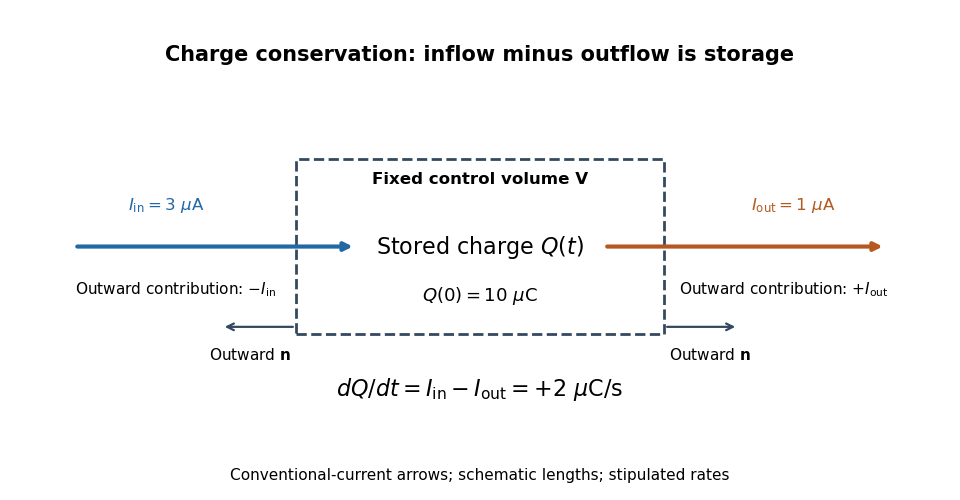

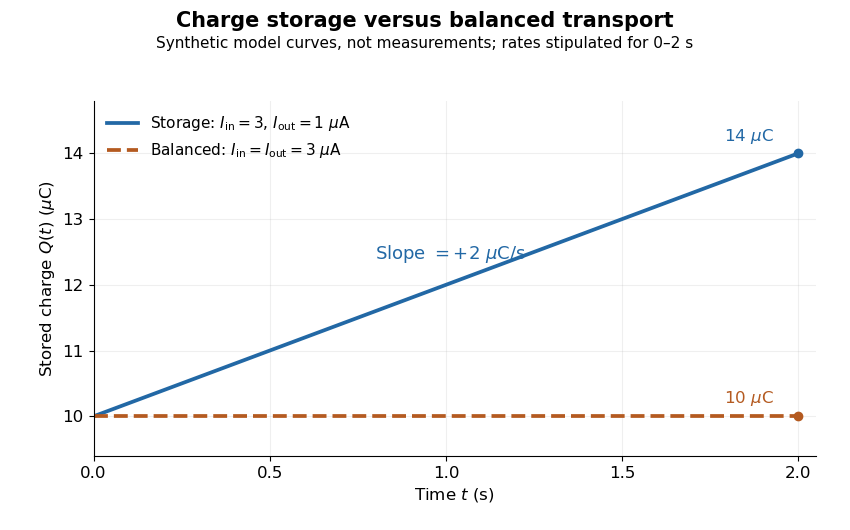
Stored electric charge with unequal and balanced terminal electric currents
. Synthetic curves from the stipulated rates over , with the same initial electric charge; these are not measurements. Balanced transport keeps total electric charge fixed, and is compatible with steady transport. Source. Details.
Locally, charge conservation is the charge continuity equation, an instance of the general continuity equation:Here is signed volume charge density and is current density. A positive divergence of current density means net outward transport from a small neighborhood, so its charge density decreases. For a fixed control volume with closed surface and outward unit normal , the equivalent integrated balance isThe surface integral is signed: incoming positive electric charge contributes negatively to outward electric current, and outgoing positive electric charge contributes positively. Integrate the charge continuity equation over fixed and apply the divergence theorem to obtain this balance. Zero net boundary transport gives constant ; the global and local statements describe the same conservation law at different scales. [ref]
https://www.feynmanlectures.caltech.edu/II_13.html#Ch13-S2. Feynman, Leighton and Sands, II.13.2: local and integrated charge conservation
.In a steady transport state, charge density and current density are time-independent, so the charge continuity equation reduces to . At an electrical circuit junction, choose each terminal electric current positive outward and assume the terminals account for all boundary transport. ThenKirchhoff's current law, , follows when accumulation of electric charge at the junction is negligible. During storage, retain the same balance with its nonzero derivative; charge conservation continues to hold. This makes charge conservation useful for checking electrical circuit models and for tracking the charging of a capacitor. [ref]
https://openstax.org/books/university-physics-volume-2/pages/10-3-kirchhoffs-rules. Ling, Sanny and Moebs, University Physics II, §10.3: Kirchhoff's junction rule
.The beautiful consistency with Maxwell equations is that the electric field and magnetic field already enforce this transport balance. For sufficiently smooth fields in vacuum SI, take the divergence of the Ampère-Maxwell equation, use that the divergence of a curl is zero, and substitute Gauss's law, . Constant vacuum permittivity givesThe displacement current term supplies the part needed when electric charge accumulates. Historically, Maxwell added that term to extend the steady-current equation; see the existing charge conservation from Maxwell equations for this connection. [ref]
https://www.feynmanlectures.caltech.edu/II_18.html#Ch18-S1. Feynman, Leighton and Sands, II.18.1: Maxwell's added term and charge conservation
.