Articles by others on the same topic

A codon is a three-nucleotide unit read in a specified reading frame during biological translation. For example, GCU specifies alanine in the standard genetic code. Its letters are read .
For an original example, choose the messenger RNA segment and stipulate initiation at the displayed AUG in a suitable eukaryotic context. Under the standard genetic code, its first three codons specify methionine, alanine and phenylalanine; the fourth is a stop codon. The resulting peptide before processing is N–methionine–alanine–phenylalanine–C. Twelve nucleotides therefore specify three amino acid residues and termination. The displayed segment omits the surrounding initiation signals; its nucleotide sequence alone is not a complete expression system.
A codon belongs to an oriented nucleotide sequence: GCU and UCG are different ordered triplets. Four possible nucleobases, adenine, cytosine, guanine and uracil, allow triplets because each position can be chosen independently when enumerating possible sequences. This is a counting argument, not a claim that nucleobases occur independently in real RNA. Sixty-one triplets are sense codons, meaning amino acid assignments, and UAA, UAG and UGA are stop codons in the standard genetic code.[ref]
Biology 2e by Mary Ann Clark and others. §15.1, The Genetic Code, Figure 15.4 and following paragraph: triplets and standard assignments
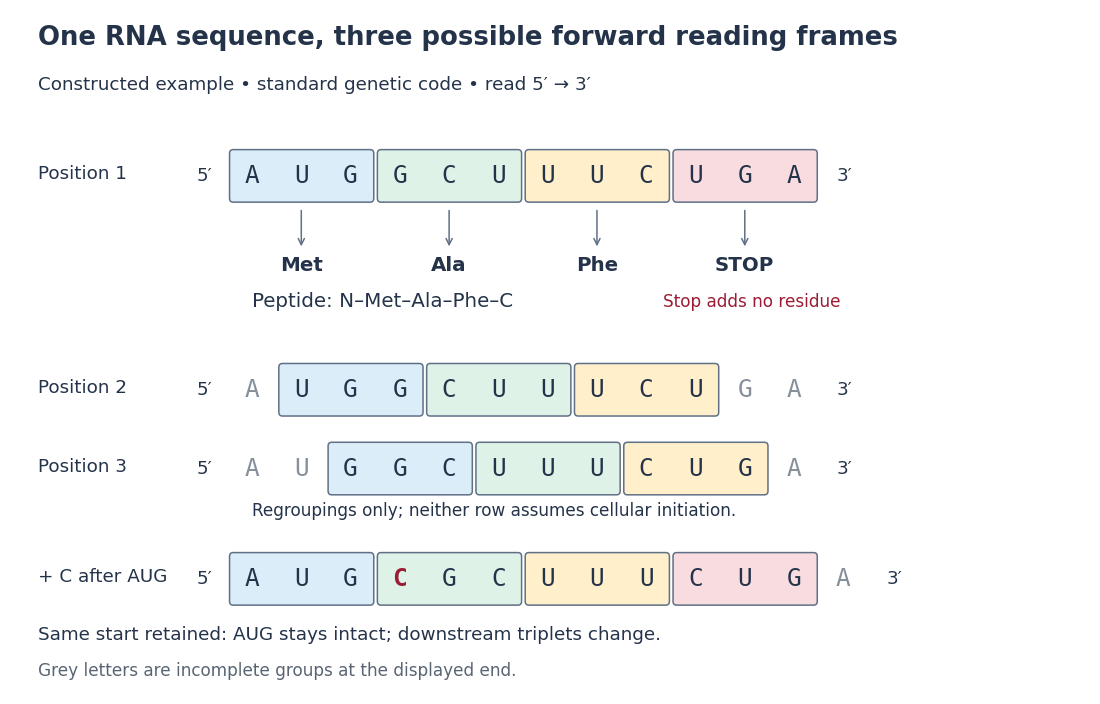

The useful unit is the ordered triplet together with its reading frame and genetic code, rather than three letters viewed in isolation. That combination lets DNA sequencing data support predictions about protein sequences after identifying the relevant messenger RNA. The Nirenberg and Matthaei experiment illustrates how the correspondence became experimentally accessible.