This is the possibly infinite dimensional version of a Hermitian matrix, since linear operators are the possibly infinite dimensional version of matrices.
There's a catch though: now we don't have explicit matrix indices here however in general, the generalized definition is shown at: en.wikipedia.org/w/index.php?title=Hermitian_adjoint&oldid=1032475701#Definition_for_bounded_operators_between_Hilbert_spaces
Articles by others on the same topic

A bounded operator on a real or complex Hilbert space is Hermitian, or self-adjoint, when . Equivalently,Its directional values are real, since this identity makes equal its complex conjugate. Reality allows either sign; a positive operator additionally requires nonnegative values in every direction.
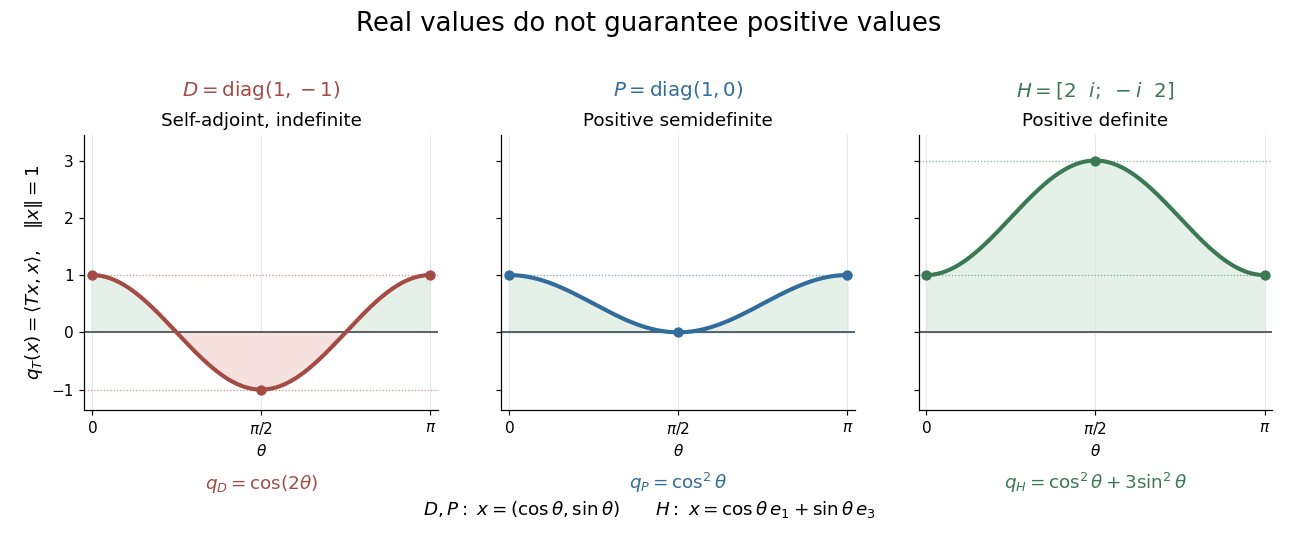
Self-adjoint directional values may change sign, touch zero, or stay strictly positive
. Details. 
The diagram compares Hermitian quadratic forms along paths of unit vectors. The Hermitian matrix takes the values and on the standard basis vectors; takes the values and ; andsatisfies and . These eigenvectors form an orthonormal basis, and every has . Thus is a positive operator, with eigenvalues and operator norm .
Three conditions describe different geometry. A Hermitian operator satisfies ; a normal operator satisfies ; a unitary operator satisfies , where is the identity operator. Every Hermitian operator and every unitary operator is a normal operator. Concrete matrices separate the conditions:
- The Hermitian matrix above is a normal operator and a positive operator, but not a unitary matrix, because .
- is a unitary matrix and normal matrix, but not a Hermitian matrix, since .
- is a normal matrix, but neither a Hermitian matrix nor a unitary matrix: its first standard basis vector doubles in norm.
- is not a normal matrix, since and .
The spectrum of a bounded Hermitian operator is real. In finite dimension, the spectral theorem supplies an orthonormal basis of eigenvectors, turning its action into independent real scalings. This makes the geometry easy to interpret: each eigenvalue records a signed response along an orthogonal direction. An arbitrary bounded Hermitian operator in infinite dimension need not have any eigenvectors; the general spectral theorem uses a projection-valued measure. MIT's lecture 21 develops the real spectrum and the orthogonality of eigenspaces.[ref]
https://ocw.mit.edu/courses/18-102-introduction-to-functional-analysis-spring-2021/345c4a5141559a4069aeb3105acd8ef3_MIT18_102s21_lec21.pdf. Rodriguez, notes by Andrew Lin, MIT 18.102, lecture 21, Theorems 223 and 227, 2021
A historical connection is the study of forms with conjugate variables. In his 1901 account of Charles Hermite's work, Camille Jordan describes these forms and emphasizes their role in reducing forms with real or complex coefficients. In today's notation, is the diagonal value of a Hermitian form; the conjugate variables make a real-valued expression possible even with complex coefficients.[ref]
https://www.numdam.org/item/JMPA_1901_5_7__91_0.pdf. Jordan, Notice sur M. Ch. Hermite, Journal de mathématiques pures et appliquées 7, pp. 92 and 95, 1901
For a densely defined operator outside this bounded setting, the displayed pairing identity alone defines a symmetric operator. A self-adjoint operator must also have the same operator domain as its adjoint operator.