
Past exam of the mathematics course of the University of Cambridge 2007 ii Paper 1 25J a Created 2026-09-24 Updated 2026-09-24
Past exam of the mathematics course of the University of Cambridge 2007 ii Paper 1 24H iii Created 2026-09-24 Updated 2026-09-24
Past exam of the mathematics course of the University of Cambridge 2007 ii Paper 1 24H ii Created 2026-09-24 Updated 2026-09-24
Past exam of the mathematics course of the University of Cambridge 2007 ii Paper 1 24H i Created 2026-09-24 Updated 2026-09-24
Past exam of the mathematics course of the University of Cambridge 2007 ii Paper 1 23F Solution Created 2026-09-24 Updated 2026-10-14
Use stereographic projection charts away from the north pole and away from the south pole. On their overlap , a holomorphic transition function, defining the Riemann sphere.
Where avoids the north pole, is an ordinary holomorphic function exactly when is holomorphic. Near a north-pole value, the other chart gives ; a zero of this holomorphic coordinate becomes a pole of . This proves the correspondence with meromorphic functions. On a disconnected domain one must also allow components mapped constantly to infinity, or state the correspondence on each nonconstant component. Applying the same reciprocal charts at source and target infinity shows that every nonconstant rational function defines a holomorphic sphere map.
The multiplicity of the value at infinity is the zero order at of when is finite, and of when . For coprime polynomials , the degree of a rational map of the Riemann sphere is , also its total number of poles with multiplicities.
The quotient rule gives the upper bound . Each finite pole of order contributes order to . If , infinity contributes an additional order when this is positive. Counting gives the degree bounds for the derivative of a rational functionThe lower bound is attained by ; the upper by , whose simple finite poles become double poles. Product degrees are not additive: and both have degree one, but also has degree one because the zero and pole cancel.
Past exam of the mathematics course of the University of Cambridge 2007 ii Paper 1 22G Solution Created 2026-09-24 Updated 2026-10-14
The continuous dual space consists of bounded linear functionals with operator norm . For an operator-norm Cauchy sequence , each is Cauchy in . Define . It is linear, and bounded because the Cauchy sequence has uniformly bounded norms. Passing to the pointwise limit in gives . Thus is a Banach space, even when is incomplete.
The canonical map is linear and satisfies . For , the norm-one functional on its span extends by the Hahn-Banach theorem to a norm-one functional on . Hence , proving that is an isometry and therefore injective.
For a nonsurjective example take with the supremum norm. It is complete as a closed subspace of . Every functional is given by an sequence: finite-coordinate sign tests give summability of its coefficients, and truncation of each vector gives the series representation. Conversely any sequence defines such a bounded functional. Similarly , so . The canonical image is the null sequences; the constant sequence one is outside it. Thus is a nonreflexive Banach space.
Past exam of the mathematics course of the University of Cambridge 2007 ii Paper 1 21H ii Created 2026-09-24 Updated 2026-09-24
Past exam of the mathematics course of the University of Cambridge 2007 ii Paper 1 21H i Created 2026-09-24 Updated 2026-09-24
Past exam of the mathematics course of the University of Cambridge 2007 ii Paper 1 20H c Created 2026-09-24 Updated 2026-09-24
Past exam of the mathematics course of the University of Cambridge 2007 ii Paper 1 20H b Created 2026-09-24 Updated 2026-09-24
Past exam of the mathematics course of the University of Cambridge 2007 ii Paper 1 20H a Created 2026-09-24 Updated 2026-09-24
Past exam of the mathematics course of the University of Cambridge 2007 ii Paper 1 1F Solution Created 2026-09-24 Updated 2026-10-14
The Prime number theorem says as . Bertrand's postulate says that for every integer there is a prime number strictly between and .
To count S-smooth numbers, split each prime exponent into its parity and an even part. This gives the unique expression , where is a squarefree product of a subset of . There are possible , while whenever . The squarefree-part bound for smooth numbers therefore gives .
For an integer , take to be all prime numbers at most . Every positive integer at most is then S-smooth, so . Taking logarithms yields
Past exam of the mathematics course of the University of Cambridge 2007 ii Paper 1 19H Solution Created 2026-09-24 Updated 2026-10-14
Put . The character orthogonality for the five supplied rows say . Solving these linear equations givesFor example orthogonality of the two degree-four rows gives , and their norms give ; the remaining row products determine the other weights. Since , , so and the class sizes are the displayed numerators.
Tensoring the fifth irreducible representation with the second, one-dimensional one gives another irreducible character, with row . It differs from all five known rows. There are seven conjugacy classes, hence seven irreducible characters. The sum of squared degrees is , so the final degree is .
The regular representation has character zero off the identity and is the sum of irreducible characters weighted by their degrees. Applying this column by column determines the last row. The completed character table, in the supplied class order, isNo identification of the group with a familiar group is needed.
Past exam of the mathematics course of the University of Cambridge 2007 ii Paper 1 18F Solution Created 2026-09-24 Updated 2026-10-14
The degree of a field extension is the dimension of a vector space of over . If is an -basis of and a -basis of , then spans over . An -linear relation among these products, regrouped by , first vanishes coefficientwise by independence of the , and then by independence of the . This proves the tower law , including cardinal dimensions.
A finite field has prime characteristic and is a finite-dimensional vector space over its prime field . Thus its size is . A subfield of size forces by the tower law. Conversely, if , the polynomial divides ; all its distinct roots therefore lie in . They are closed under addition, multiplication and inverses by the Finite-field Frobenius automorphism, forming the required subfield.
For an irreducible polynomial of degree over , a root generates . Its conjugates are , so this field is already the splitting field. The automorphism cycles these roots and has order . Consequently
Past exam of the mathematics course of the University of Cambridge 2007 ii Paper 1 17H Solution Created 2026-09-24 Updated 2026-10-14
Label four face colors by . Give each edge the sum of its two adjacent face labels. This is nonzero because adjacent faces differ. At a cubic vertex the three face labels are pairwise distinct, so their three edge sums are the three different nonzero elements. This is a Tait coloring.
Conversely, label the three edge colors by the nonzero elements of , whose sum is zero. Choose a base face with label zero and label any other face by summing crossed edge labels along a path in the dual graph. The result is independent of the path: a simple closed dual path encloses vertices, and summing the zero incident sums at these vertices leaves exactly its crossed boundary edges, since interior edges occur twice. General closed paths decompose into such cycles. Adjacent labels differ by a nonzero edge label, giving a four-color face coloring. The assumption that every edge borders distinct faces excludes bridges in a graph and ensures this map coloring is the relevant one.
The equivalence fails on a torus. Use the Heawood torus map. On seven vertices indexed modulo seven, take the triangles and . Each edge of occurs in exactly two oppositely oriented triangles; each vertex link is a six-cycle, for example at zero. This is a connected closed orientable surface with Euler characteristic , hence a torus.
Its dual graph is cubic, with adjacent to . The three offsets partition its edges into perfect matchings, giving a Tait coloring. Its seven faces are discs and their adjacency graph is , so they need seven colors. The obstruction to the planar proof is a possible nonzero edge-label sum around a noncontractible cycle.
Past exam of the mathematics course of the University of Cambridge 2007 ii Paper 1 16G Solution Created 2026-09-24 Updated 2026-10-14
A complete lattice has every join, hence every directed and finite join. Conversely, if a partially ordered set is directed-complete and has finite joins including the empty join, then for any subset the set of joins of its finite subsets is nonempty and directed. Its least upper bound is . Including the empty join supplies a bottom element and handles .
For a directed set of partial functions from to , their union is a function: any two functions have a common extension, so they agree wherever their domains overlap. This union is exactly their least upper bound in the extension order, proving directed completeness.
Write for the intersection of all sets containing and closed under and directed joins. Then means . Reflexivity is immediate, and transitivity follows because any closed set containing must contain and then every with . The upper set is closed: is inflationary, and a directed join of elements above is above . Thus implies , proving antisymmetry.
If , then , so . Moreover by monotonicity, and by inflationarity. This proves that is directed. Define . Pointwise monotonicity of every implies monotonicity of . Since and is closed under directed joins, ; hence .
The original map belongs to by the definition of closedness, so and by the definition of the join. Inflationarity gives the reverse inequality. Finally, if and , the lower set is closed by monotonicity of and the join property. Thus every is at most , and so is . This proves the least fixed point from a directed family of maps: is the least fixed point above .
Past exam of the mathematics course of the University of Cambridge 2007 ii Paper 1 15A Solution Created 2026-09-24 Updated 2026-10-14
Differentiate the Friedmann equation and use the cosmological continuity equation to obtain . The relation extends to turning points by continuity. Radiation obeys , while dark energy with has constant density. Substitution at gives , and at arbitrary givesPut . For , the upward-opening polynomial has roots , with . The expanding Big Bang branch reaches in finite time. There but , so expansion turns to contraction; it returns to in finite time, a Big Crunch. A sketch of has the forbidden negative interval between the roots, while is a line crossing zero at two.
For , . The branch starting at zero has , givingAt small , , the radiation-dominated scale factor. At large , . It approaches an Einstein static universe with equal radiation and dark-energy densities, rather than recollapsing or entering unbounded expansion.
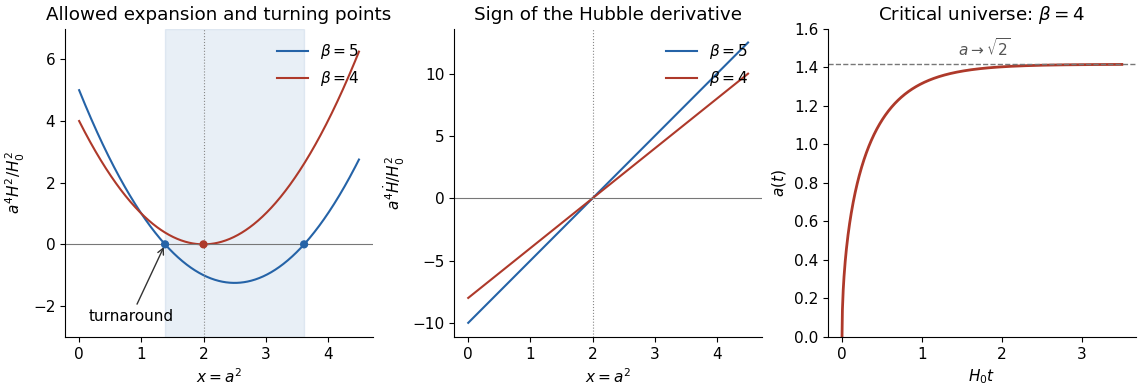
Radiation–Lambda turning points and the critical scale factor
. Details. 
Past exam of the mathematics course of the University of Cambridge 2007 ii Paper 1 14B iii Created 2026-09-24 Updated 2026-09-24
Past exam of the mathematics course of the University of Cambridge 2007 ii Paper 1 14B ii Created 2026-09-24 Updated 2026-09-24
Past exam of the mathematics course of the University of Cambridge 2007 ii Paper 1 14B i Created 2026-09-24 Updated 2026-09-24
There are unlisted articles, also show them or only show them.