
The diagonalization gives and hence : the intervening factors cancel. The diagonal matrix power has entries . Since and ,Reading the second component gives the Binet formulaThe derivation includes , and the expression gives , consistent with the specified indexing.
The initial vector records both initial Fibonacci numbers: . For ,Conversely this vector recurrence forces the second component to be the preceding first component and forces their sum to be the next first component, recovering the scalar recurrence and its initial conditions. Iterating, or using mathematical induction, yields for every .
The characteristic polynomial is . Its distinct eigenvalues are and . For either eigenvalue , the vector is an eigenvector, since .
ChooseThe determinant of is , soIts columns being eigenvectors gives , and left multiplication by proves .
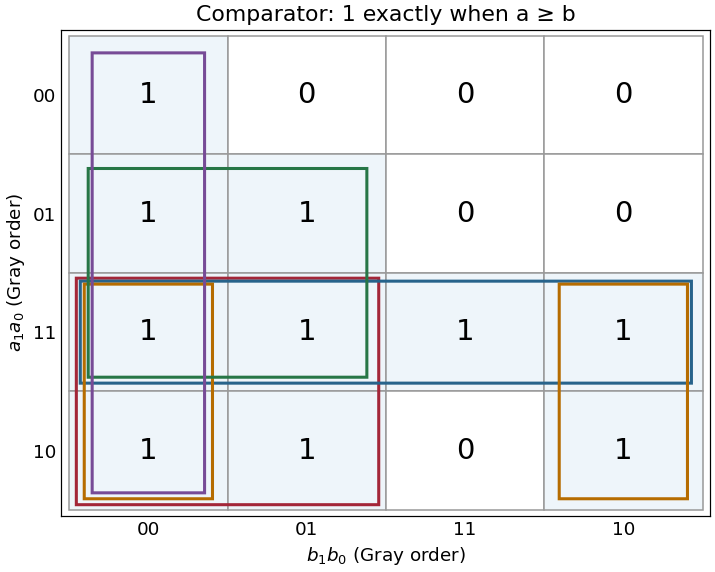
The five maximal four-cell groups give the disjunctive normal formFor example, the group wraps between columns and in the bottom two rows. No group of eight cells is entirely one. The five terms are precisely the prime implicants, and each is essential: respectively, the cells are covered by no other prime implicant. Any disjunctive normal form can have its terms enlarged to prime implicants without increasing its size. Therefore all five displayed terms are necessary, proving minimality in number of products; each needs two literals, also giving ten literals in a minimal cover.
For an implementation with AND gates and NOT gates, call these five products . Form the shared complements , calculate each with an AND gate, invert every , and useA five-input conjunction can be replaced by four two-input AND gates. This direct implementation uses nine two-input AND gates and eight NOT gates. That is a valid realization of the minimal disjunctive normal form, rather than a claim that this particular gate count is globally optimal among all factored circuits.
Write the inputs as and . Each row compares the represented value of with all four values of . In Gray code order along both axes, the Karnaugh map isThe equality cases lie on the diagonal and are all one. A complete row of ones at and a complete column at provide useful checks. The outlined groups are used in the next part.

The minority Boolean function is one at input assignments . Put on the rows and in Gray code order on the columns. The Karnaugh map has rows and . Pair the cell with each of its three one-cell neighbours; the horizontal pair across the two map edges is valid because those columns are adjacent.
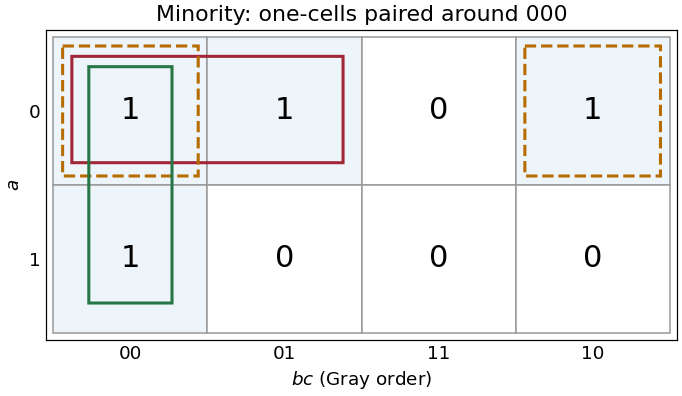
Three essential pairs in the three-input minority Karnaugh map
. Details. 
The pairs giveGenerate with three NOT gates. Then useDe Morgan laws show that the final NAND gate computes the required disjunction of the three products. This uses three two-input NAND gates and one three-input NAND gate, besides the input inverters. If only two-input NAND gates are available, replace the final three-input gate by , , .
The three pairs are essential: the one-input assignments each have only as an adjacent one-cell, so no pair can be omitted from this disjunctive normal form.
Every AND gate and OR gate is a monotone Boolean function: changing an input from zero to one while leaving all other inputs unchanged cannot change the output from one to zero. By structural induction over a Boolean circuit, a composition of these gates is also a monotone Boolean function. Constant inputs do not alter that conclusion.
Logical negation cannot be implemented, since it sends to and to , violating the defining order property. Hence these two gate types alone cannot implement every Boolean function.
Compute the two complements with the two NOT gates, then form and with the two AND gates. Feed those outputs to the OR gate:Exactly one product is one when the inputs differ; both products are zero when the inputs agree. This uses precisely the allowed two inverters, two two-input AND gates and one two-input OR gate.
More processor registers can reduce register spills and the associated loads and stores. A richer instruction set may also replace several old machine instructions by one new operation. Both effects can decrease the number of instructions in a compiled program, although a particular program might obtain no benefit.
Wider instruction encodings increase the bytes per instruction. Consequently the total machine-code size can increase or decrease: approximately, it is instruction count times average encoded instruction width, with alignment and padding also relevant. There is no universal net direction without the program and revised encoding. The length of assembly language source text is a separate matter and is not determined by instruction bit widths.
On the same primary-opcode expansion interpretation, opcode: 9 bits; each register field: 8 bits. The printed
rd is a naming slip: a conventional MIPS I-type instruction has fields rs and rt, with the latter sometimes serving as the destination. There is no separate rd field.Keeping the original 16-bit immediate requires bits per instruction. If the instruction encoding were held at 32 bits, only seven bits would remain for the immediate, reducing immediate arithmetic and addressing ranges. A uniform encoding for both enlarged formats would have to accommodate the longer R-type case too; any padding or revised format policy must be specified separately. Register count and instruction width do not determine data-word width.
There are unlisted articles, also show them or only show them.