
A register file with 256 entries needs bits per register index. Under the intended assumption that eight times as many instructions are obtained by expanding the primary opcode field, its width grows from six to bits. Thus opcode: 9 bits; rs, rt and rd: 8 bits each.
Use the conventional integer calling convention:
$a0 holds the argument and $v0 holds the result. The function is recursive, so every call must preserve its own return address and original argument. The first recursive result must also survive the second call; a caller-saved register alone would not protect it.This implementation reserves a 32-byte stack frame, keeping the stack pointer eight-byte aligned. Offsets 0–15 are available as the outgoing argument area, 16 stores the original argument, 20 stores the first result, 24 is padding, and 28 stores the return address. It changes no callee-saved register. Assemble in classic MIPS delayed-branch mode with instruction reordering disabled, such as
.set noreorder.foo:
addiu $sp,$sp,-32 # allocate 32-byte aligned frame
sw $ra,28($sp) # save caller return address
sw $a0,16($sp) # save original n
beq $a0,$zero,foo_base
sll $zero,$zero,0
addiu $t0,$zero,1
beq $a0,$t0,foo_base
sll $zero,$zero,0
addiu $t0,$zero,2
beq $a0,$t0,foo_base
sll $zero,$zero,0
addiu $a0,$a0,-1
jal foo
sll $zero,$zero,0
sw $v0,20($sp) # preserve foo(n-1) across next call
lw $a0,16($sp) # recover original n
sll $zero,$zero,0
addiu $a0,$a0,-3
jal foo
sll $zero,$zero,0
lw $t0,20($sp)
sll $zero,$zero,0
addu $v0,$v0,$t0 # combine the two recursive results
beq $zero,$zero,foo_return
sll $zero,$zero,0
foo_base:
addu $v0,$a0,$zero # base case result is n
foo_return:
lw $ra,28($sp)
sll $zero,$zero,0
addiu $sp,$sp,32 # release the frame
jr $ra
sll $zero,$zero,0All displayed operation mnemonics denote single machine instructions. In particular,
sll $zero,$zero,0 is the actual harmless shift encoding often abbreviated by the pseudoinstruction nop; addu $v0,$a0,$zero performs a copy without the move pseudoinstruction. Each branch or jump has an explicit harmless branch delay slot, and harmless shifts also separate loads from their subsequent uses. The base cases return the original argument; other calls return the sum of the two recursive values. Every return restores the saved return address and exactly undoes the stack allocation.[ref]MIPS32 Architecture For Programmers Volume II by MIPS Technologies. Revision 2.00, ADDIU and ADDU, pp. 37–38; JAL and JR, pp. 139 and 144
The shifts multiply the original array indices by four, and the following additions form byte memory addresses. The load into
$s0 changes the variable itself, but the address of the next element of A has already been saved. The complete effect isi = x
x = A[i]
B[y] = x + A[i + 1]Here
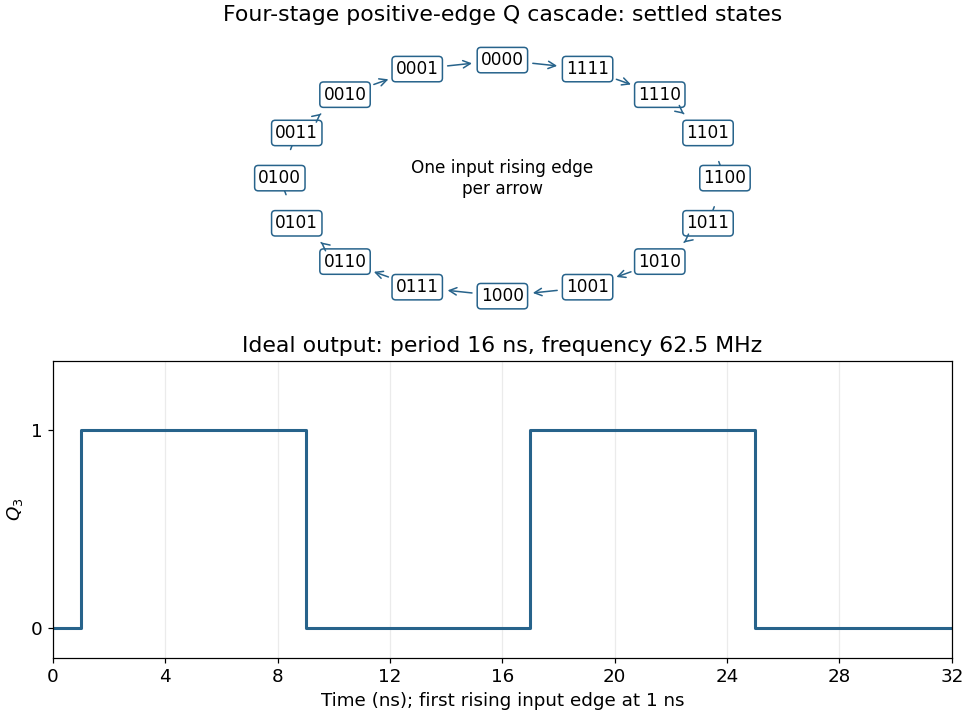
i is a fresh temporary. Both the assignment to and the assignment to matter. Writing only would omit the observable change to . The interpretation assumes four-byte array elements, valid aligned addresses, and arithmetic within range; the source uses trapping signed additions. The address of is computed before changes.Connect the fourth JK flip-flop with and clock it from , retaining the source's positive-edge convention. Read the four-bit state as . Its state-transition diagram is a single cyclewith one input rising clock edge per arrow; the figure displays every state explicitly.
Each stage halves the preceding triggering frequency. is an ideal square wave with a 50-percent duty cycle at , with wave period and high and low intervals of . Its initial phase depends on the starting state. The figure chooses initial state and a first input rising clock edge at . Actual ripple propagation shifts edge times and creates intermediate transient codes; no device delays were supplied, so the waveform describes settled ideal logic.

The inclusive range contains distinct states. An -bit binary counter has states, so 31 JK flip-flops in total are necessary and sufficient for the required capacity: add 28 to the three shown.
This is a capacity calculation. The printed positive-edge, uncomplemented-output cascade visits these codes in descending order. To obtain increasing numerical order one must change the cascade clock polarity, for example clocking each positive-edge stage from the preceding complemented output.
Each stage has and therefore toggles. The printed clock symbols have no inversion bubble, so they are positive-edge triggered; each later clock is driven by the previous uncomplemented output. Consequently the circuit is a ripple counter that counts down modulo eight. A zero least significant bit rises to one and propagates the transition; a one falls to zero and stops it. For example, the settled transition from is , whereas is followed by .
With , a JK flip-flop obeys at its positive clock edge: holds its old state and sets it. Thus each original stage is a sticky record of a previously sampled high input until Start clears it. A D flip-flop instead obeys , so a later sample of zero can clear the output.
Connect each replacement D input where the corresponding J input was connected, preserving the clocks and asynchronous clear. The first valid sequence after Start still sets both outputs. Afterwards, let fall and apply another rising clock edge to . The D version clears ; the JK version retains . A subsequent rising clock edge of can therefore clear only in the D version. Neither circuit continuously tracks its data input between clock edges.
The initial input levels do not initialize the stored bits. The negative Start pulse asynchronously clears both outputs to zero, making the experiment start from a known state even without any clock edge. Once Start is released, the circuit can recognize a fresh sequence. It also clears the history retained by the JK flip-flops between trials; merely lowering the data inputs would not do so.
After asserting and releasing the active-low Start pulse, a valid sequence is , then , then , with each input held high through the relevant sampling interval. The first JK flip-flop has and is clocked by , so the rising clock edge of samples and sets . Once that output has settled, a rising clock edge of clocks the second JK flip-flop with , setting .
The essential conditions concern sampled levels: must be high at a rising clock edge of , and must then be high at a rising clock edge of . Separate edges with adequate setup and hold time avoid an ambiguous simultaneous transition.
Inside the supplied The invariant is that
MainFrame, after both buttons and the label are defined, add:private var clickCount = BigInt(0)
listenTo(button1, button2)
reactions += {
case ButtonClicked(source) if (source eq button1) || (source eq button2) =>
clickCount += 1
label.text = "Total button clicks: " + clickCount.toString
}clickCount equals the total number of handled click events from the two buttons. It starts at zero; each matching event increments it exactly once and refreshes the label. The buttons' existing self-listeners can still change their own text independently. Listening to both publishers is necessary: their listenTo(this) calls subscribe each button to itself, not the frame to both buttons. Updating the label is not another button click, so it does not recursively increment the counter. An arbitrary-precision integer keeps the count exact without a lifetime overflow bound.[ref]Scala Swing event-system documentation. Publisher/Reactor subscriptions, listenTo, and reactions; ButtonClicked source event
The supplied layout already contains the label, so no additional component is needed. Before any click it retains its initial zero-click message; afterwards it displays the cumulative count across both buttons.
The Observer pattern lets interested observers subscribe through a common interface to a subject's events or state changes. The subject notifies registered observers, which perform their own reactions; subscriptions can later be removed. A document model can thereby update multiple editor views without containing explicit knowledge of each view class.
It avoids tightly coupling the subject to every concrete consumer. Adding another view does not require adding a new view-specific call inside core model logic. Notifications should expose a coherent updated state, and unused observers should unsubscribe. The pattern does not itself prevent feedback cycles: observers that update each other's sources can still cause repeated or reentrant notifications. The supplied buttons and containing frame use this subscription-and-reaction design through Scala Swing.
A code smell is an easily noticed feature that suggests a deeper design problem worth investigating. It is neither a proven bug nor an automatic instruction to rewrite the code. Context determines whether the symptom is troublesome.[ref]
Code Smell by Martin Fowler. 9 February 2006: surface indication, investigation rather than automatic condemnation; long-method example
Duplicate code can indicate that the same knowledge has several maintenance sites: a correction made to one copy may be forgotten in the other. If the copies represent the same responsibility, extract that responsibility into one shared operation or component. Merely looking similar is insufficient; accidentally similar code with independent purposes should not necessarily be coupled.
Feature envy occurs when an operation depends mainly on another object's data rather than the responsibilities of its own class. For example, an editor view might implement a text-policy decision by repeatedly inspecting document internals. Move that decision to the document, or extract and move the relevant part, so behavior sits with the data and responsibility it actually uses. Duplication suggests consolidating repeated knowledge; feature envy suggests moving a responsibility between objects. These are different design actions, and both can be refactorings that preserve observable behavior.[ref]
Move Function in the Refactoring catalog. Move Function, called Move Method in the first edition: move behavior to a better-suited context
Test-driven development uses a short cycle: write a test for the next behavior and observe its failure, implement enough to pass it, then refactor without changing the tested behavior. In a conventional implementation-then-test workflow, tests primarily assess code after it has been written; in TDD they also guide each small design increment. Tests accumulate into a regression suite, but passing them is not a universal correctness proof.[ref]
Test-driven development in the Agile Alliance glossary. Definition: interleaved unit tests, implementation and refactoring
A good candidate is a deterministic priority queue operation with a precise contract. Before implementation, test that inserting two equal values permits two minimum deletions and only then leaves an empty queue. The expected result is objective, cheap to check and useful for finding the duplicate-loss bug in a set-based representation.
An exploratory decision about whether an editor's toolbar feels usable is a poor candidate for TDD alone: the desired behavior and human evaluation criteria may not yet be settled, and an executable assertion does not replace user observation. Prototypes and usability evaluation can establish the design before stable behavioral properties are tested automatically. The distinction is the availability of a useful repeatable test oracle, not a claim that interface software is inherently untestable.
Use object composition: a logging wrapper owns a private
ResizableFrame and delegates dimension operations to it, rather than being its subclass. The wrapper takes the before/after area around each public operation. Its own flip calls the component's whole flip once, compares only the completed states, and therefore records no increase. The component must be exclusively owned or defensively copied, so clients cannot bypass the wrapper's accounting.The component's internal calls cannot dynamically dispatch into the separate wrapper. This prevents the setter-based
flip implementation change from creating false log entries and reduces dependence on undocumented superclass internals. The wrapper can also choose a smaller interface. Costs include forwarding code and the loss of automatic ResizableFrame subtyping: code requiring that concrete superclass cannot necessarily accept the wrapper. A shared abstract frame interface can recover substitutability while keeping implementation reuse based on composition. Composition improves this dependency boundary; it does not remove the need for a clear mutation and ownership contract. There are unlisted articles, also show them or only show them.