
For the natural logarithm, , , , and . The quadratic Taylor polynomial therefore givesThe Taylor remainder is with . It is positive, so the approximation is an underestimate. Moreover,Thus is a valid upper bound on the absolute error.
Taylor's theorem gives a finite Taylor polynomial of degree , consisting of the first terms, and a remainder:In the Taylor theorem with Lagrange remainder form, assuming the required derivatives exist on an interval containing and ,for some strictly between and when ; at the remainder is zero. In particular, if on that segment, then . This is a finite expansion; it does not assume equality with an infinite Taylor series.
The scaling relation says that is a homogeneous function of degree . Fix and differentiate the identity with respect to the positive parameter . The chain rule givesSetting proves the Euler theorem for homogeneous functions identityDifferentiate once more with respect to , using equality of the mixed partial derivatives for the assumed twice continuously differentiable function:At this is the second-order Euler identity for homogeneous functions:The repeated parameter differentiation accounts for the factor , rather than .
Put . Apply implicit differentiation with respect to and , using the chain rule:ConsequentlyAt a point where the assumed differentiable function exists, the first equation forces . Combining the equations therefore givesThe assertion is understood on such differentiable branches of the implicit function; arbitrary parameter choices need not produce one everywhere.
The Pythagorean theorem gives . Taking a total differential gives , soThe area of the right triangle is , so the product rule gives andThe prescribed small changes therefore give : the area decreases by approximately . For comparison, retaining the product of the two finite percentage changes gives , an exact decrease of ; the total differential retains only the first-order terms.
On an interval with , the equation is a separable differential equation. For ,Taking antiderivatives gives . Renaming the constant, the explicit general nonzero solution isIt is defined on any interval avoiding and zeros of its denominator. The separation divided by , so the additional solution must be included.
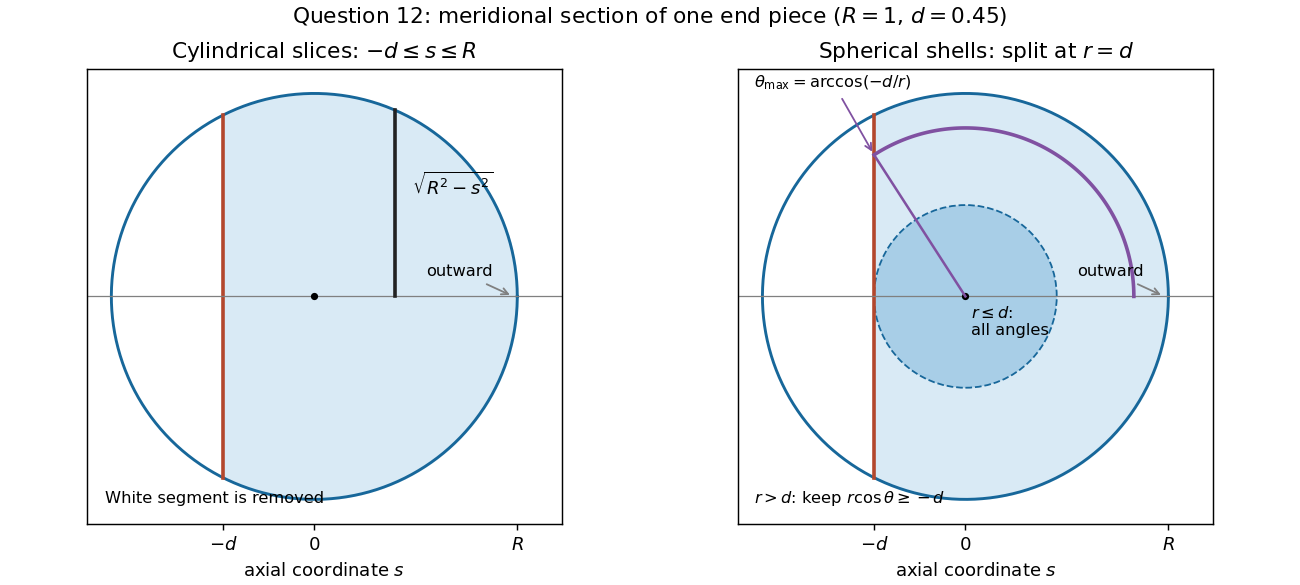
Use spherical coordinates centred on the right-hand sphere, with polar axis pointing outwards along . The Jacobian determinant is , and the retained region is with .
For , every polar angle is allowed. For , the cut requires . Splitting the volume integral at therefore givesSubstitution of and reproduces the mass in part (c). The radial split avoids integrating over a polar angle range independent of , which would incorrectly include part of the removed spherical cap.
Centre cylindrical coordinates on the right-hand sphere, with the axial coordinate positive outwards. Using and , the retained solid satisfiesIn particular, it contains more than a hemisphere; it is the small cap on the inward side that has been removed. The volume integral for its mass, including the Jacobian determinant , isThus each end piece has massEquivalently this is the volume of a spherical cap with height , multiplied by the uniform mass density.

There are unlisted articles, also show them or only show them.