
The Hessian matrix isAt each nonzero stationary point, its diagonal entries are and the off-diagonal entries are . Its eigenvalues are and , both positive. Thus the Hessian matrix is positive definite, and the second-derivative test proves thatTheir common value is . In fact they are global minima: with , the arithmetic-geometric mean inequality gives , soThe last one-variable polynomial attains its minimum at , and equality in the first bound requires , precisely the four points above.
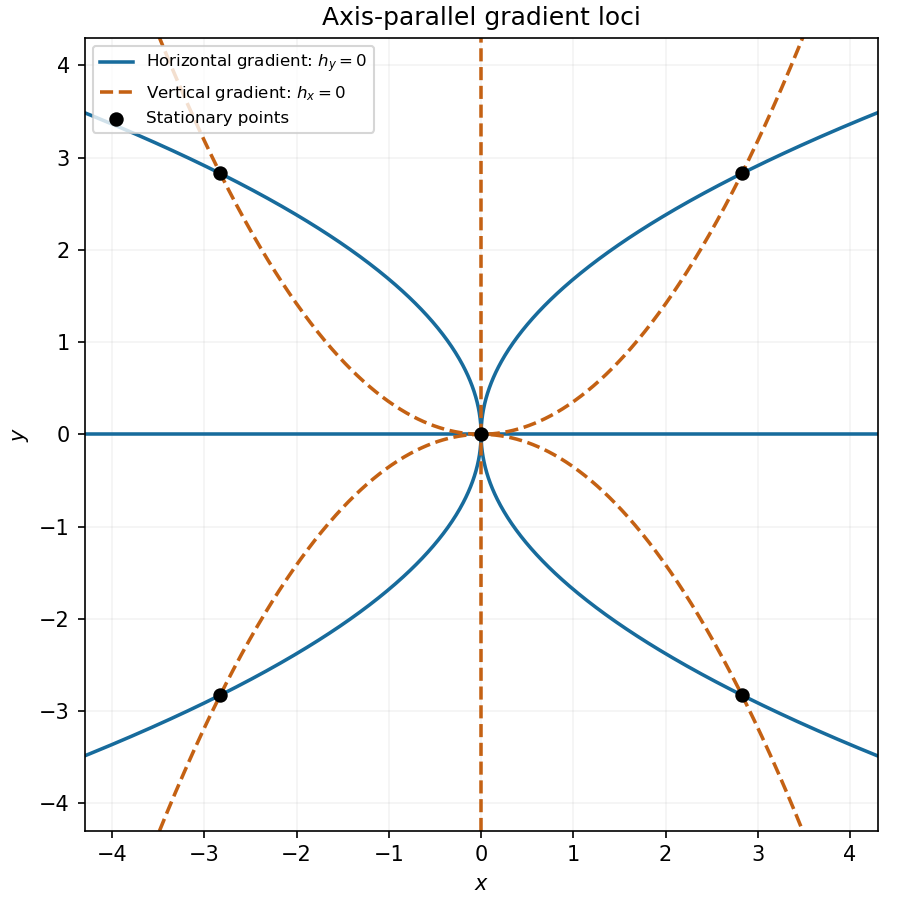
A stationary point must satisfy both factored equations from part (a). If either coordinate is zero, the other equation forces the other coordinate to vanish. This gives .
Otherwise and . With and , these become and . Dividing gives , so . Then forces . Hence all five stationary points are
The gradient is horizontal when and vertical when . Factoring those partial derivatives gives the two loci:Thus each locus consists of an axis and two parabolas. Their common points are the five stationary points found below. At those points the gradient is zero and has no direction, so they are included in both algebraic zero-component conditions but excluded if “parallel” is required to mean a nonzero directed vector.

A necessary compatibility condition is , because a cross product with is perpendicular to it. If this condition fails, there is no solution.
If it holds, take the equation and use the vector triple product identity:Thus the perpendicular orthogonal projection is fixed and the parallel component is free:Conversely, under the compatibility condition, so every displayed vector solves the equation. The solution set is a straight line, including the line through the origin when .
The straight line consists of , with . Since the endpoints are distinct, the direction vector can be normalized. ChoosePutting gives the required parametric equation of a straight line . Other choices of on the same straight line, or the opposite direction for , give equivalent descriptions.
The two orthogonal projections are complementary, givingThey split a vector into its components parallel and perpendicular to .
The scalar is the signed scalar projection along the unit vector . Multiplying by that unit vector makes the orthogonal projection of onto its span.
For the other expression, the vector triple product identity givesThis is the orthogonal projection onto a plane perpendicular to through the origin. Its dot product with is zero, while the difference from is parallel to .
Equating vector components givesThe third component first forces , then the second forces , and the first gives . ThusEquivalently, the nonzero scalar triple product proves that these three vectors are linearly independent.
Substitution for reduces the two simultaneous equations toThe remaining quadratic factor is positive for all real , since . Thus there are exactly .
The geometric series converges because the absolute value of its common ratio is below one. Its sum is
The terms form an arithmetic progression with common difference . There are terms. The arithmetic series formula gives
There are unlisted articles, also show them or only show them.