
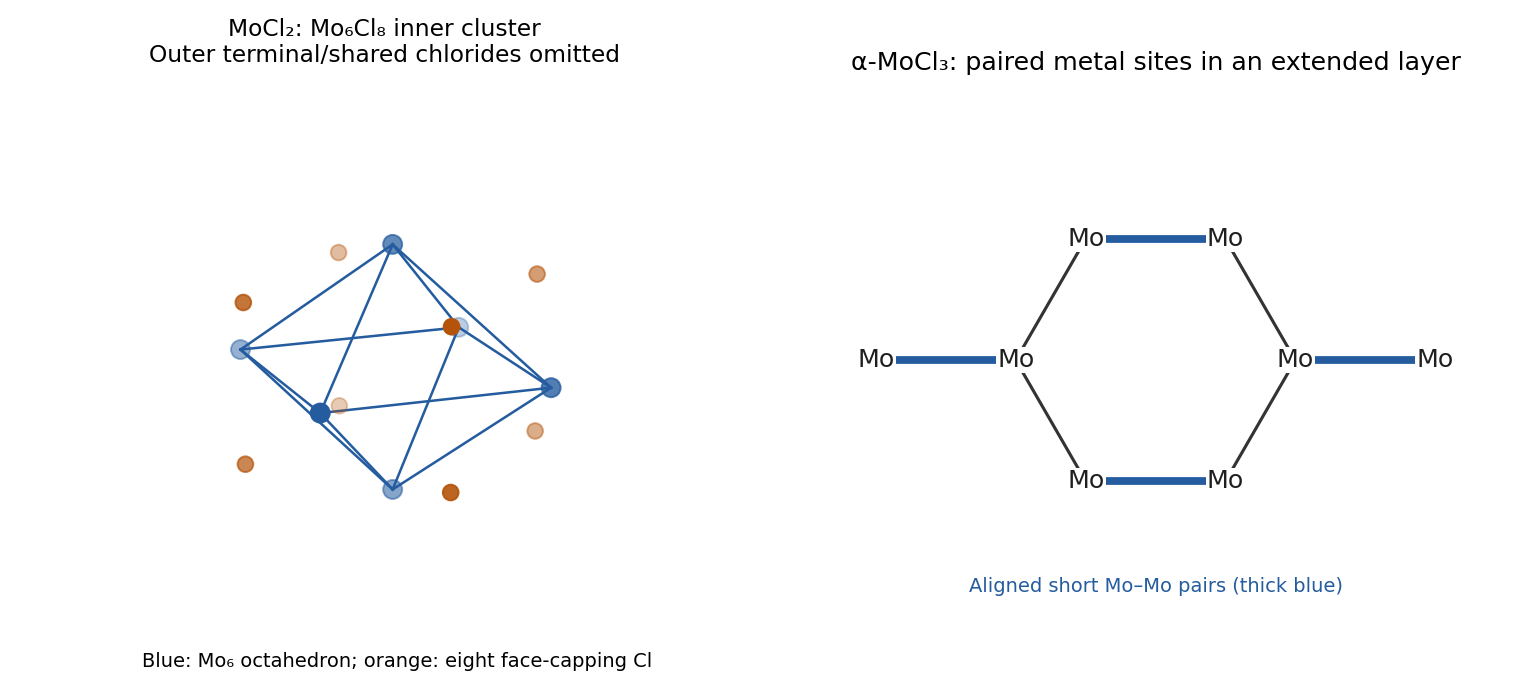
Solid contains octahedral clusters, while - has paired molybdenum centres in a layered chloride lattice. The first material is better represented by than by isolated bent or linear molecules. Eight inner chlorides cap the triangular faces of an octahedral metal core, giving . Outer chloride coordination completes the solid: one useful connectivity notation is , with two terminal outer chlorides and four intercluster-shared outer chlorides per octahedron. The empirical total is chlorides for six metals.
Each Mo(II) is formally , giving 24 metal-based electrons. These support extensive Mo–Mo bonding along the 12 octahedral edges; they are not localized as four free spins on each molybdenum. In -, Mo(III) is in edge-sharing octahedral layers. The metal honeycomb distorts into short Mo–Mo pairs. A localized dimer picture uses the six d electrons to fill one sigma and two pi bonding combinations, producing a formal triple bond and pairing the spins. The bulk crystal remains an extended chloride lattice, rather than a collection of unconnected molecules.
By comparison, has predominantly localized high-spin Cr(II), , in Jahn–Teller-distorted chloride octahedra; has layered Cr(III), , with three locally unpaired electrons. Their magnetic exchange is not evidence for the same strong short multiple bonds as in the molybdenum solids. The greater radial extent of Mo orbitals enables larger metal–metal overlap than the more contracted Cr orbitals. Real structure and magnetism still depend on ligand geometry and phase, so the orbital comparison is a trend rather than a prohibition of chromium–chromium bonds in other compounds. Diffraction and magnetic/spectroscopic studies directly distinguish the dimerized - lattice from .[ref]
Structural and Magnetic Transitions Caused by Dimer Formation in the CrCl3–MoCl3 Solid Solution by Samuel Froeschke and others. Introduction and spectroscopic discussion: paired Mo centres, localized Cr spins and diffraction/magnetic evidence
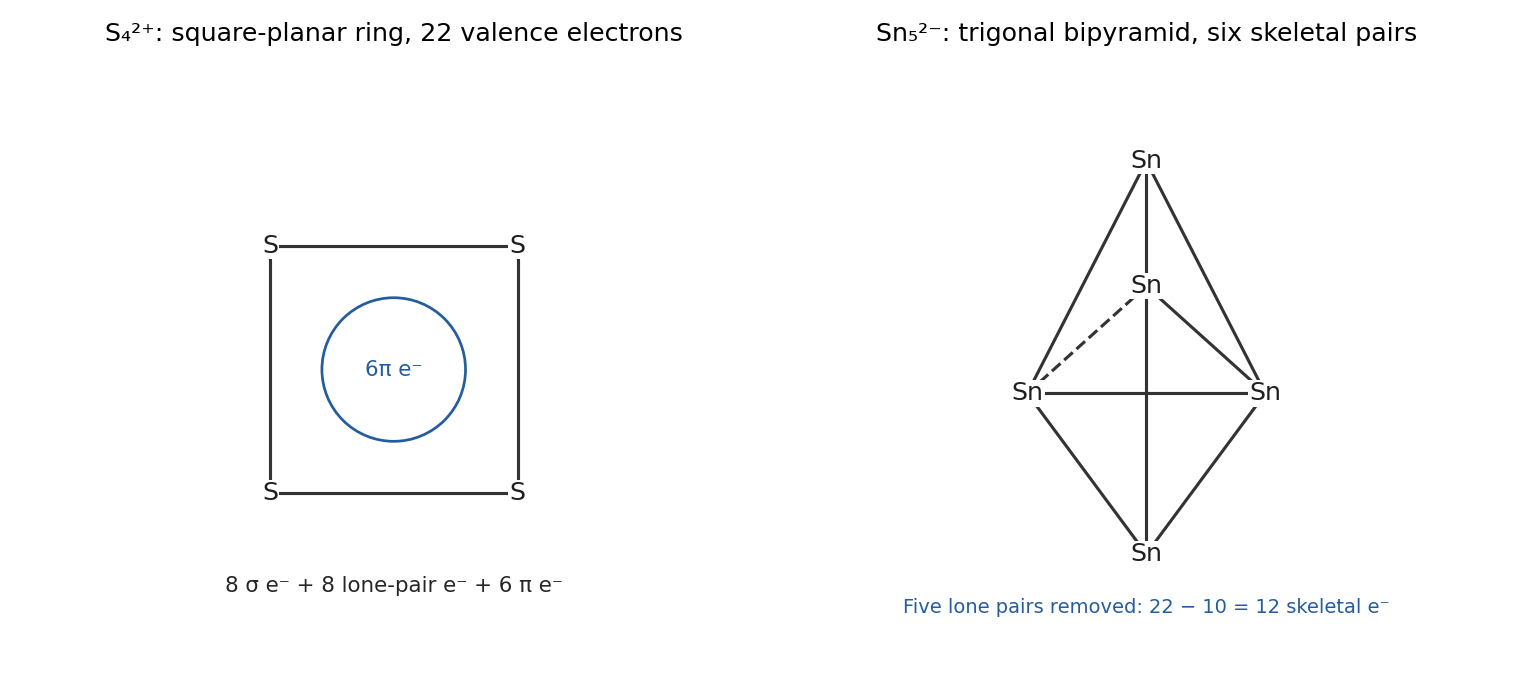
is approximately square planar; is a closo trigonal bipyramid. Both have 22 valence electrons, and , but their different local orbital requirements prevent inferring identical shapes from this total alone.
For the sulfur ring, four S–S sigma bonds use eight electrons and four in-plane lone pairs use another eight, leaving six electrons in the perpendicular cyclic pi system. The resulting filled bonding and degenerate nonbonding pi levels give a six-pi-electron aromatic description of a four-membered ring, consistent with equivalent S–S links in the ideal square. The out-of-plane p orbitals are retained; this is not a tetrahedral four-vertex closo cage.
For tin, allocate one mainly s-rich lone pair to each atom. The remaining electrons form six skeletal pairs, exactly for . Wade's rules therefore predict a trigonal bipyramid, with three equatorial vertices and two axial vertices. The axial pair is not joined by a polyhedral edge; its bonding is part of the delocalized three-dimensional framework. The contrast is a planar aromatic sigma/pi ring versus a three-dimensional multicentre-bonded Zintl cluster, rather than cationic charge alone imposing planarity or anionic charge alone imposing a polyhedron.


There are unlisted articles, also show them or only show them.