For clamped nuclei and SI units, the many-electron electronic Hamiltonian isThe terms are electron kinetic energy, electron–nucleus attraction, and electron–electron repulsion. The nuclear kinetic operator is omitted in the Born-Oppenheimer approximation. The nuclear repulsionis a constant at fixed separation and is added to electronic energies to form the total potential curve. Some conventions include it in as a constant; the electronic-energy convention used below excludes it so that the two one-electron energies can be compared without double-counting nuclear repulsion.
An effective one-electron Hückel method operator may be writtenThe first term is one-electron kinetic energy. The effective site potentials represent attraction to the nuclei and any averaged screening implicit in the chosen parametrization. They replace the explicit many-electron interaction; they do not contain a coordinate-dependent two-electron operator .
For normalized hydrogen-centred orbitals, symmetry givesThe Hückel Coulomb parameter is an on-site one-electron energy, not the electron–electron Coulomb repulsion integral. The Hückel resonance integral couples the sites; with the usual same-phase atomic-orbital convention it is negative and stabilizes the bonding combination. For zero overlap, the two energies are .
A doubly occupied spatial orbital gives a spin-singlet Slater determinant:Equivalently, . The spatial factor is symmetric, and the normalized antisymmetric spin factor enforces the Pauli exclusion principle. Here includes position and spin.
Let be real, with each atomic orbital normalized. ThenTogether with orthonormal spin functions, this also normalizes the Slater determinant: its norm squared is . Under the subsequent zero-overlap assumption,using the specified nonnegative branch for .
The physical curve has its bonding minimum near , with ionic endpoints at . Use electronic energies excluding the fixed . Define , , and . The one-electron contribution isThe Coulomb energy of the doubly occupied orbital isso . For localized orthogonal orbitals, a transparent illustrative approximation neglects integrals involving the product and retains the on-site repulsion and intersite direct repulsion :Since normally , spreading the occupied orbital over both atoms reduces the repulsion. At equilibrium the bonding one-electron term favours , so the minimum represents the Restricted Hartree-Fock method approximation to . At or , both electrons occupy one atom, giving the same ionic energy . At the orbital is antibonding and the one-electron contribution is raised.
The diagram below uses an illustrative set of integrals to show these landmarks; it is not a numerical calculation for the molecule. Zero orbital overlap alone does not force every exchange or three-index Coulomb integral to vanish, so the simplified expression is an explicit sketching approximation, not a consequence of orthogonality.
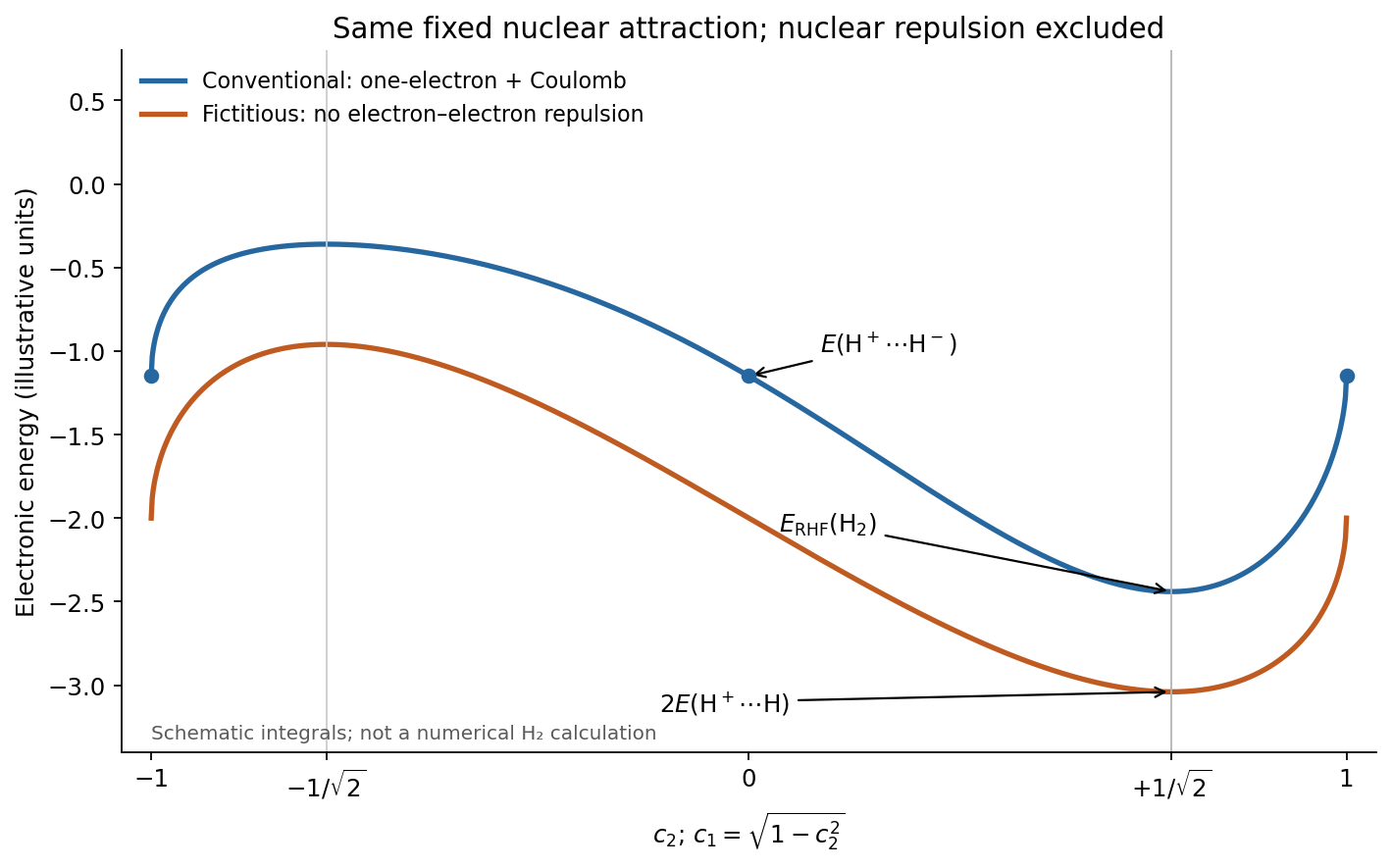
Removing electron–electron repulsion lowers the entire curve and exaggerates the bonding stabilization. In the same fixed-orbital notation and electronic-energy convention,Its minima and maxima occur at and , respectively; all three localized points have energy . The physical curve lies above it by the positive Coulomb expectation .
For the one-electron problem, the bonding energy is . Two noninteracting opposite-spin electrons may both occupy that orbital, so the lower curve's bonding minimum isThis is the third requested energy label in the common graph. If total molecular energies include nuclear repulsion, the corresponding identity is , because the two-electron molecule contains only one nuclear pair. An effective one-electron potential re-fitted after removing repulsion would be a different comparison; here the same kinetic and nuclear-attraction operators are retained.
Restricted Hartree–Fock incorrectly retains ionic configurations when a homonuclear bond dissociates. As overlap vanishes, its symmetry-preserving occupied orbital approaches . The doubly occupied spatial product containsThe first and last terms place both electrons on one separated atom. Their combined probability remains one half, while the correct neutral singlet has one electron on each atom. The resulting spurious Coulomb repulsion raises the restricted dissociation limit. This is missing static electron correlation, not a failure of the Born-Oppenheimer approximation.
A two-configuration expansion using both and can cancel the ionic terms and recover the Heitler–London separated-atom singlet. Configuration interaction in the appropriate active space or a multiconfigurational self-consistent treatment supplies this remedy. The Unrestricted Hartree-Fock method can instead localize opposite spins on different atoms and give the correct separated-atom energy, but its single determinant breaks spin symmetry and is not the pure singlet at intermediate separation. The distinction between restricted and symmetry-broken descriptions of stretched hydrogen is treated in the original analysis of Coulson and Fischer.[ref]
XXXIV. Notes on the molecular orbital treatment of the hydrogen molecule by Charles Alfred Coulson and Inga Fischer-Hjalmars. Philosophical Magazine 40 (1949), 386–393, molecular-orbital treatment of hydrogen and its dissociation
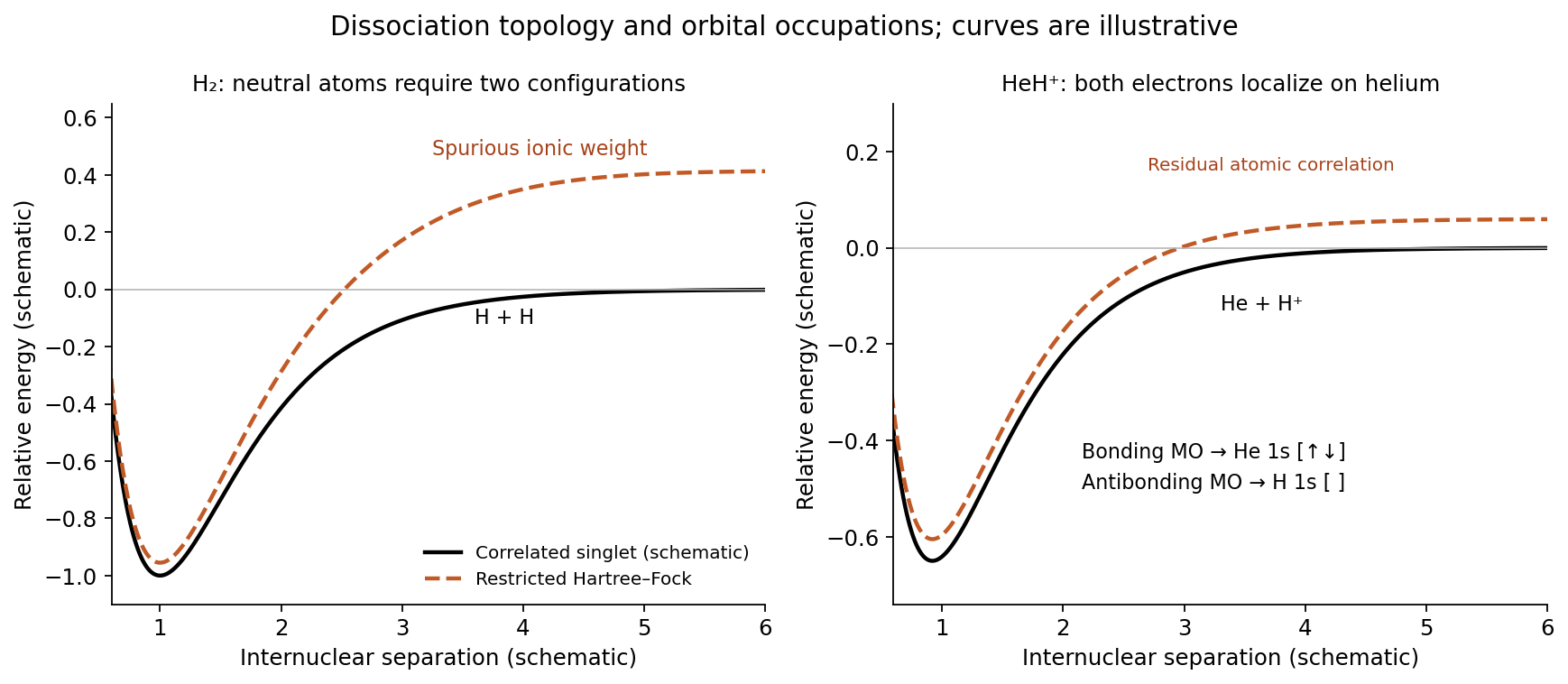


No: the lowest dissociation channel is , which a doubly occupied helium-centred orbital can describe. In the heteronuclear molecular orbital diagram the helium site lies below the hydrogen site. As separation grows, the bonding orbital tends to helium , the antibonding orbital tends to hydrogen , and the two ground-state electrons remain in the lower orbital.
There is therefore no symmetry requirement to keep both sites equally occupied and no compulsory half-weight mixture of wrong ionic configurations at dissociation. The physical asymptote is already a closed-shell atom plus a bare proton. The alternative limit lies higher. A Restricted Hartree-Fock method curve approaches the Hartree–Fock helium energy rather than the exact correlated helium energy, so ordinary dynamic electron correlation is still missing, but this is not the homonuclear static-correlation catastrophe. In the preceding two-panel sketch, the helium hydride curves have the same qualitative dissociation channel with a small residual correlation offset, whereas the hydrogen restricted curve reaches a qualitatively wrong high limit.
Articles by others on the same topic
There are currently no matching articles.