
Disconnect the tertiary amide into cyclohex-3-ene-1-carboxylic acid and the secondary amine . The acid-derived ring is an immediate Diels–Alder disconnection: buta-1,3-diene plus the indicated methyl acrylate gives methyl cyclohex-3-ene-1-carboxylate. Heating, or suitable Lewis-acid activation of the dienophile, forms the two new sigma bonds and leaves the diene's internal double bond as the ring alkene.
Hydrolyse this ester to the acid. Convert it to its acid chloride with oxalyl chloride or thionyl chloride, and react with the secondary amine in the presence of a base to capture HCl. The tertiary amide now contains the complete cyclohexene acyl fragment; direct conjugate addition of the amine to methyl acrylate before ring construction would give the wrong connectivity.
Prepare the amine by reductive amination of 4-phenylbutan-2-one, , with ethylamine, using sodium triacetoxyborohydride or another iminium-selective reducing system. This places nitrogen on , not on a terminal methylene. If a route from simpler carbon compounds is wanted, crossed aldol condensation of acetone with benzaldehyde gives , and selective C=C reduction gives the required ketone before reductive amination.
The acid branch retains the acrylic carbonyl as the amide carbonyl; the amine branch supplies both N-ethyl and N-(4-phenylbutan-2-yl) substituents. The unlabelled stereogenic centres may be racemic mixture. This sequence separates ring formation from amide formation and avoids invoking uncontrolled alkylation of a tertiary amide nitrogen.
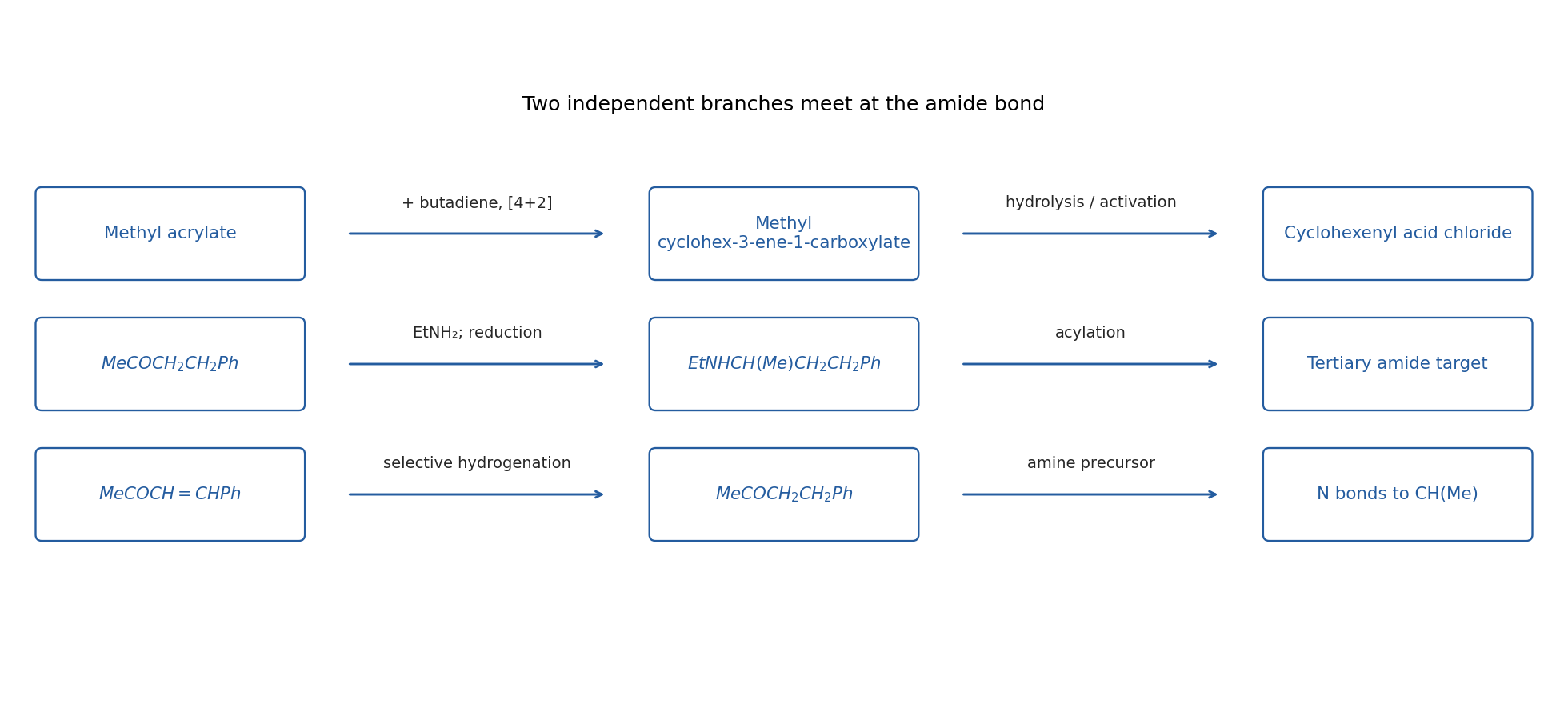
Original two-branch synthesis combining a Diels–Alder acid fragment with a reductively aminated secondary amine
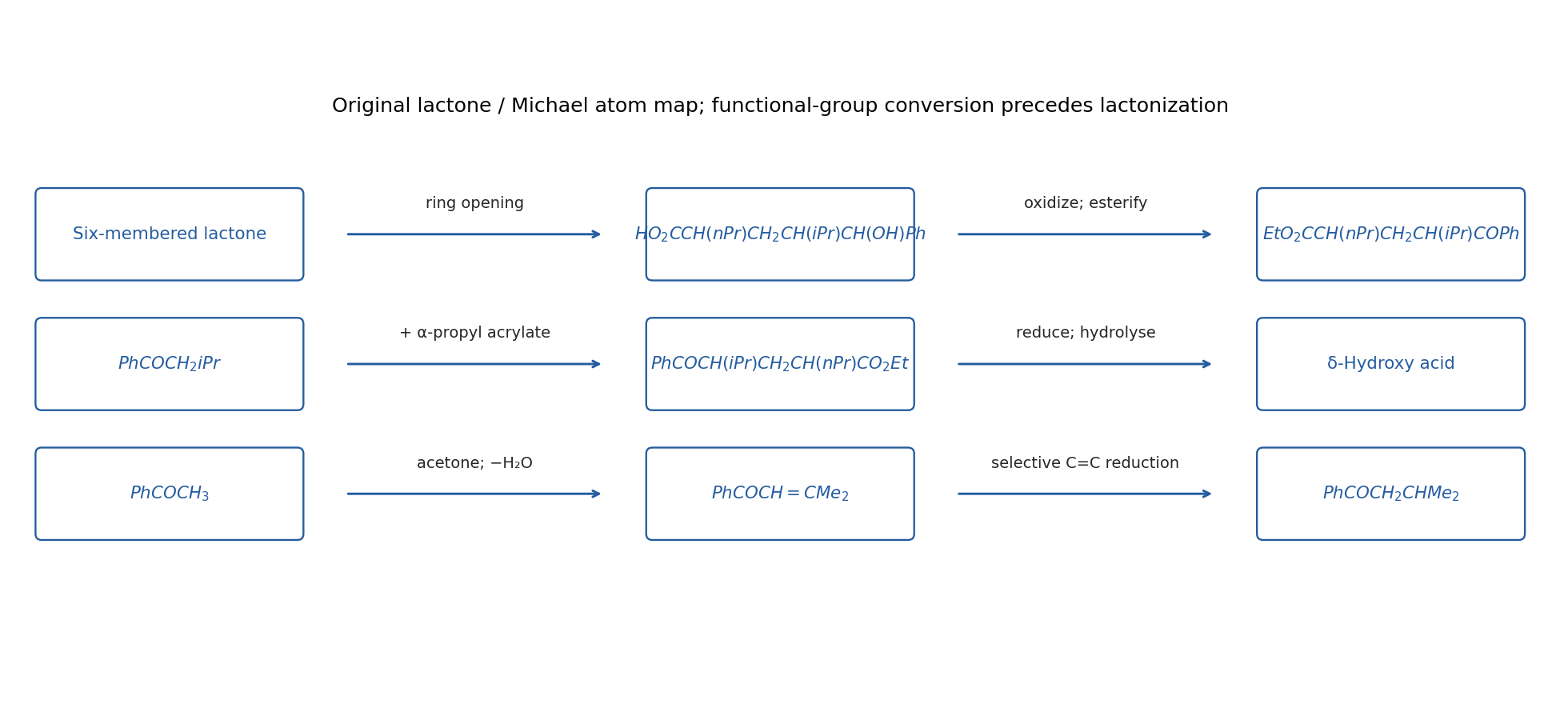
. Details. Open the cyclic ester at its acyl–oxygen bond. The resulting delta-hydroxy acid isOxidation-state reversal at the benzylic alcohol gives . This identifies the key Michael disconnection between the central and groups:The nucleophile is the enolate or enamine of the phenyl ketone. The electrophile's propyl substituent must be alpha to its ester carbonyl; using a beta-propyl acrylate would move the substituent to the wrong ring position.
Disconnect further to the indicated acetophenone. Crossed aldol addition to acetone followed by dehydration gives ; selective conjugate reduction or controlled alkene hydrogenation then gives . This avoids requiring an efficient SN2 alkylation with a secondary isopropyl halide. The alpha-propyl acrylate can be obtained by alpha-hydroxymethylation/dehydration of ethyl pentanoate, , using formaldehyde.
In the forward direction, perform the Michael coupling, reduce the phenyl ketone selectively with sodium borohydride while retaining the ordinary ester, hydrolyse the ester, and cyclize the delta-hydroxy acid by controlled acid-catalysed lactonization or an activated-acid coupling. The six-membered ring then has the order carbonyl–––––O. This atom order checks all three substituent positions. No relative configuration is specified, so the scheme does not imply a single diastereomer from the Michael addition or reduction.
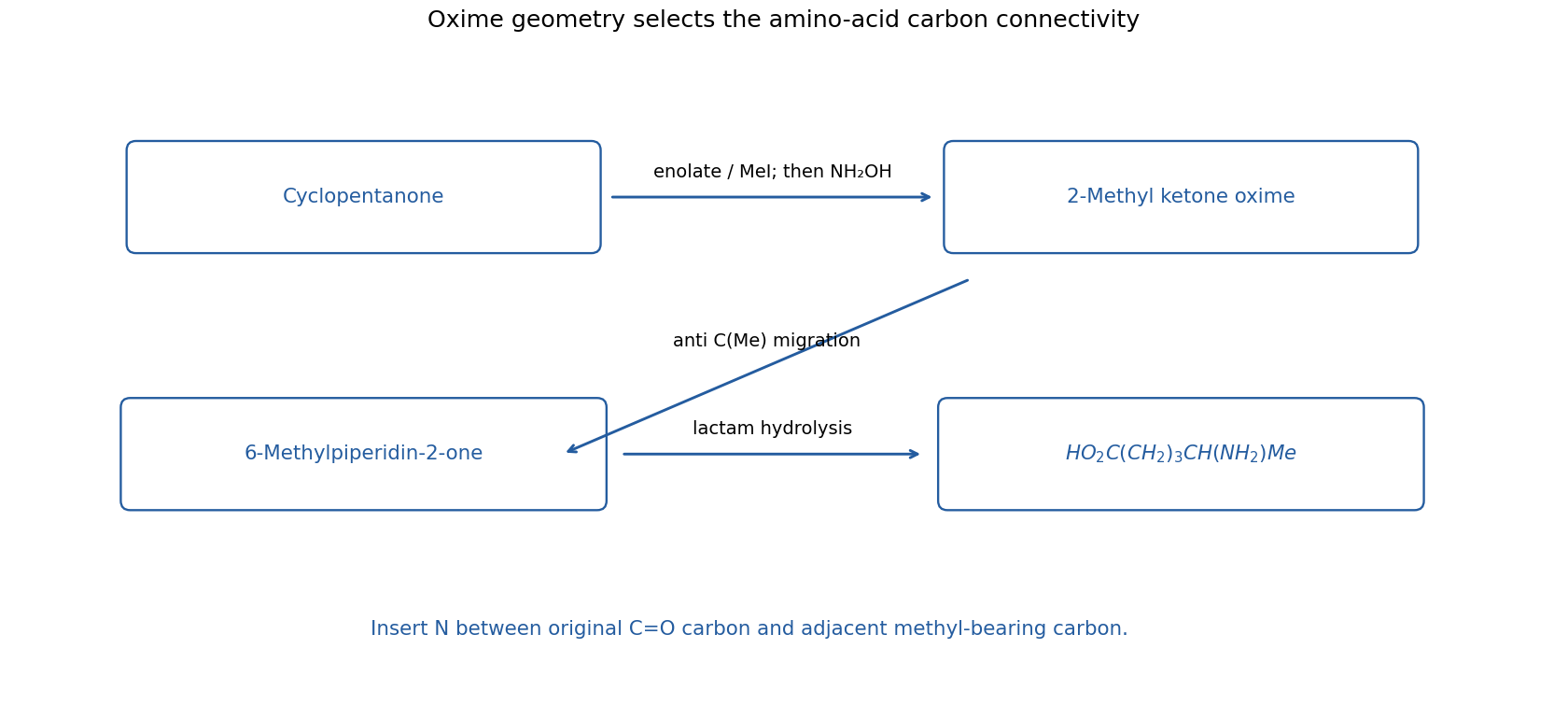
The target is 5-Aminohexanoic acid, . Disconnect its terminal amine/carboxylic-acid relationship through hydrolysis of 6-methylpiperidin-2-one. This six-membered lactam follows from a regioselected Beckmann ring expansion of 2-methylcyclopentanone oxime.
Start with cyclopentanone. Form its enolate with lithium diisopropylamide in dry THF at low temperature, add methyl iodide, then quench to obtain 2-methylcyclopentanone. Control the methyl iodide/base stoichiometry to suppress a second alkylation. React the ketone with hydroxylamine to form its oxime and select the geometrical oxime isomer in which the bond to the methyl-substituted adjacent ring carbon is anti to the departing oxime oxygen group.
Activate the oxime, for example under appropriate acid-promoted Beckmann conditions. The anti methyl-bearing C–C bond migrates onto nitrogen as the N–O-derived leaving group departs, inserting nitrogen between the original carbonyl carbon and the methyl-substituted ring carbon. Hydration/tautomerization gives 6-methylpiperidin-2-one. The opposite oxime geometry would insert nitrogen on the other side and ultimately place methyl at a different position in the amino acid; oxime geometry is therefore an essential part of this proposal.
Hydrolyse the lactam with aqueous acid and heat, then adjust the work-up to the desired acid/ammonium form. Cleavage of its acyl–nitrogen bond opens the ring to after suitable neutralization. All five original cyclopentanone carbons are retained, and the one methyl carbon comes from methyl iodide. A racemic mixture product is appropriate to the stereochemically unspecified target. The reaction sequence is an organic ring-expansion synthesis and requires no biological transformation.
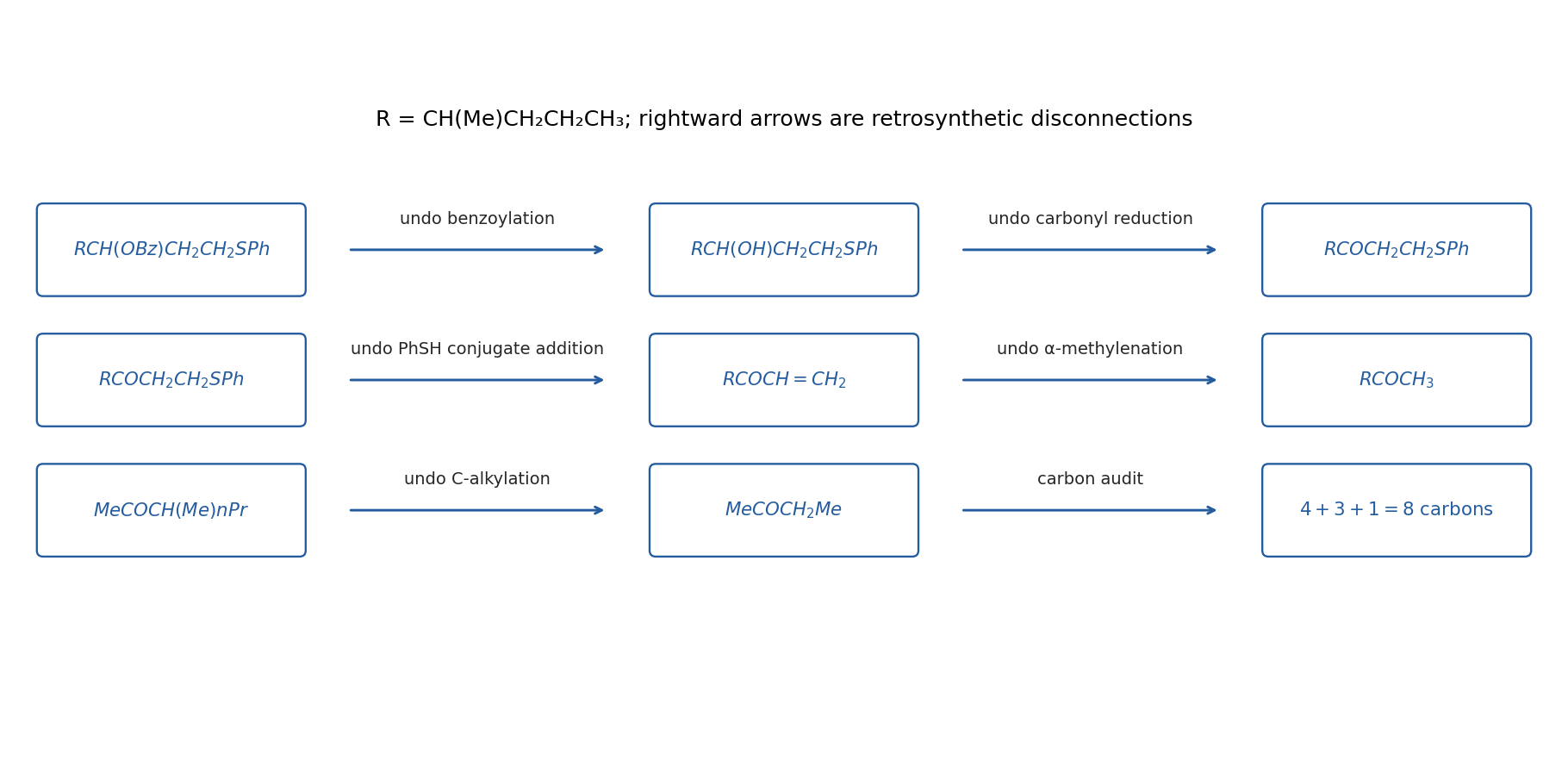
Let . The useful disconnections are benzoate formation, carbonyl reduction and thiol conjugate addition:The sulfur-bearing carbon is the enone beta carbon, so this is a Michael disconnection, not attack of thiophenol on the alcohol-derived central carbon. Reduce the saturated ketone with sodium borohydride after installing SPh, then benzoylate the alcohol with benzoyl chloride and pyridine or a tertiary amine.
Disconnect the enone to and formaldehyde. Kinetic deprotonation on the methyl side of the hindered unsymmetrical ketone, trapping with formaldehyde, and dehydration gives . This order leaves the substituted side unchanged. An alpha-methylenation/Mannich-base-elimination variant is an equivalent way of installing the terminal enone.
Finally, disconnects by alpha alkylation to butan-2-one and 1-iodopropane. Use the more substituted, ethyl-side enolate of butan-2-one for this step, rather than its usual methyl-side kinetic enolate; an equilibrated/regioisomerically selected enolate or enol derivative is required, and the desired monoalkylated ketone should be isolated. Three carbons from propyl iodide and one from formaldehyde increase the original four-carbon ketone to the required eight-carbon alcohol/thioether skeleton. Choosing ethyl iodide here would leave the target short by one carbon.
This is a constitutional synthesis: the target drawing specifies no configuration at either newly formed stereogenic site, so no unproved stereoselective reduction or alkylation is needed. Regioisomeric enolate alkylation and competing overalkylation are the practical selectivity issues to control, rather than something that follows from writing “base”.


There are unlisted articles, also show them or only show them.