
The isolobal analogy compares fragments through their frontier molecular orbitals: their number, approximate energies, shapes, symmetries and electron occupancies should correspond. It does not require the fragments to have the same total number of electrons or the same constituent elements. If the orbitals available for forming new bonds correspond, analogous ways of joining the fragments become plausible.
For example, and are isolobal. The methyl radical has one singly occupied approximately outward-pointing orbital; removing one carbonyl ligand from an octahedral molecular geometry leaves an analogous frontier orbital on the 17-electron fragment. Joining two such fragments pairs the two electrons: the organic example is the C–C bond of ethane, and the organometallic example is the Mn–Mn bond of . The analogy predicts a bonding pattern, rather than equality of bond energies or reaction rates.[ref]
Building Bridges Between Inorganic and Organic Chemistry (Nobel Lecture) by Roald Hoffmann. 1982, discussion of the methyl and metal-carbonyl fragment analogy
The remaining fraction is . Using the tabulated value rather than replacing it by the fitted value, the constant ozone concentration makes nitrogen dioxide loss a pseudo-first-order reaction:Integrating with initial concentration and givesThis uses the nitrate-radical quasi-steady-state approximation over the interval, constant temperature and ozone concentration, and no extra nitrogen dioxide sources or sinks. The stated and units cancel directly; no factor of is needed.
Adding the initiation step to the net forward trapping step cancels the nitrate-radical reaction intermediate:The net stoichiometry agrees with under the quasi-steady-state approximation.
Nitrogen dioxide is consumed in reactions 1 and 2 and regenerated in reaction , soUsing from the nitrate-radical quasi-steady-state approximation givesThe factor of two is essential: an initiating event uses one nitrogen dioxide molecule, and the ensuing net radical-trapping event uses a second one. The exact nitrogen balance before making this approximation is .
The quasi-steady-state approximation for the nitrate radical balances its formation against its removal:Equivalently,The net dinitrogen pentoxide production is . Substituting the steady-state balance givesThe reverse rate has been retained throughout and cancels algebraically. The approximation requires sufficiently rapid radical adjustment and fails if, for example, nitrogen dioxide becomes too scarce to sustain the presumed trapping rate. It does not assume that the radical concentration is zero.
This labelled part introduces the reversible reaction pair without a separate calculation to perform. For the following derivations, define its forward and reverse elementary reaction rates asand the initiating rate as . The law of mass action gives bimolecular units and first-order units. Reversibility does not require while the complete network is reacting: that equality would impose chemical equilibrium on the pair, an extra assumption not needed here.
An unweighted least-squares Arrhenius plot using all five data points gives . Define the dimensionless ordinate with , and set . The model isFor increasing temperatures, the five ordinates are , , , , and . The linear regression slope and intercept areConsequently . The corresponding fitted . A two-point calculation using just the endpoints gives approximately ; the difference reflects the rounded, imperfectly collinear data rather than a unit conversion.
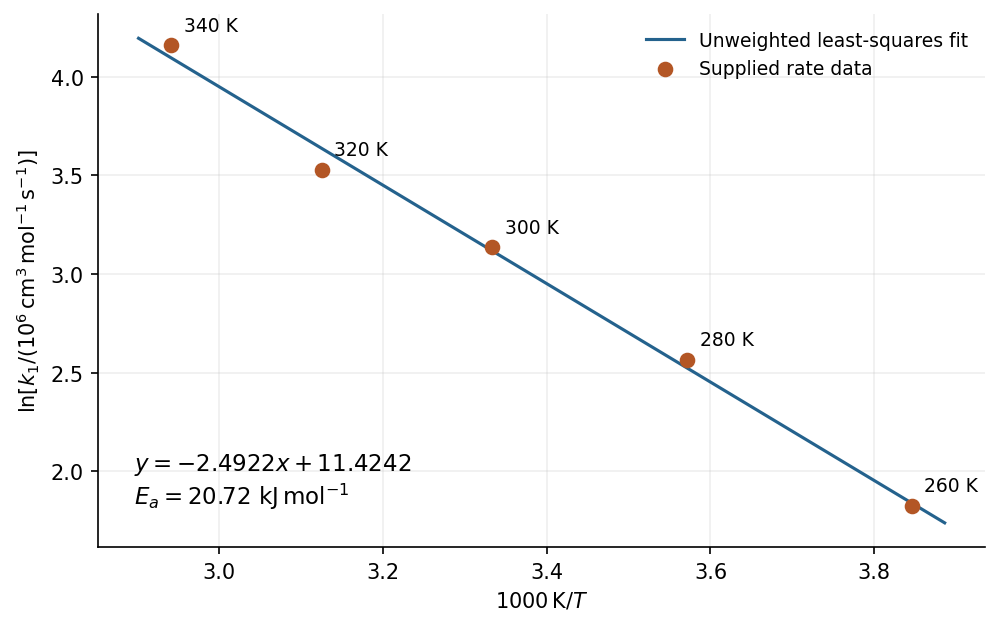

The Arrhenius equation isHere is the molar activation energy, the molar gas constant, the absolute temperature, and the pre-exponential factor, taken approximately constant over the measured range. For this bimolecular elementary reaction, and both have units .
There are unlisted articles, also show them or only show them.