
The Second law of thermodynamics states that total entropy of an isolated composite system cannot decrease. For a cyclic heat engine exchanging heat only with reservoirs at , it gives . Since ,The bound is attained by a reversible heat engine: no friction, no finite-temperature-difference heat exchange and no other entropy production. A Carnot cycle provides an implementation with two reversible isotherms and two reversible adiabats. All temperatures in these ratios are absolute.
Let be the fixed gas amount, , , and let denote the heat capacity of the whole sample. First take the unregenerated Stirling cycle, so that heat rejected during isochoric cooling is not stored and returned during isochoric heating. The reversible quasistatic gas work iswhile the heat inputs are and . HenceThe strict inequality follows because adds heat input without additional work. Quasistatic motion alone does not make heat exchange with a single hot or cold reservoir reversible while the gas temperature changes on an isochore. Indeed, using those two reservoirs gives total external entropy production per cycle.
The strict comparison requires the no-regeneration assumption. A perfect reversible regenerator stores during and returns it during ; only the isothermal heat transfers then enter the external heat budget, giving exactly. For example, perfect regeneration with , and gives . Thus the four gas paths by themselves do not enforce an efficiency strictly below the Carnot bound.
For the gas itself, the four entropy changes areExpansion increases the available positional states; compression reverses that change. Isochoric cooling reduces thermal populations and isochoric heating restores them. The sum is zero because entropy is a state function. This does not imply zero total entropy production in the gas plus external reservoirs.
Taking as reference, the isotherms are horizontal on a – diagram. The isochore through state 1 obeys , and the isochore through state 2 is shifted right by . For the internally reversible quasistatic gas paths, , soThe enclosed area is the net work per engine cycle, with a clockwise orientation. It is not the total heat input.
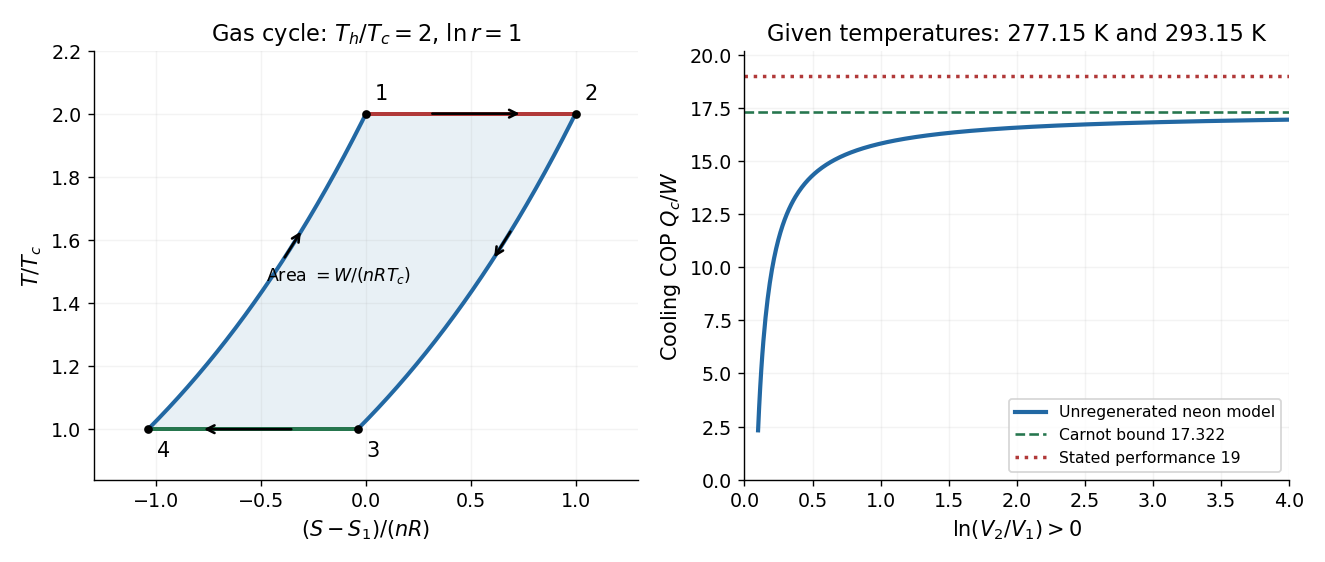

For the refrigerator, the stated rates give the cooling coefficient of performance . But the absolute reservoir temperatures are and , so Carnot's theorem requiresAt input the largest allowed cooling rate is only . Equivalently the stated heat rejection gives the reservoir entropy ratea direct violation of the Second law of thermodynamics for this cyclic two-reservoir device.
The unregenerated neon model makes the algebraic obstruction explicit. With , reversing the cycle givesSetting this to 19 produces , or , contradicting the required expansion ratio . Perfect regeneration can raise performance only to the Carnot bound and does not fix the problem. There is no physically admissible for the stated data.
There are unlisted articles, also show them or only show them.