
Nonlocal quantum clock 2026-10-06
A nonlocal quantum clock records quantum circuit time in an abstract dimensional register. A binary encoding uses logarithmically many qubits, but transitions need not have bounded qubit locality. Extra diagonal penalties may exclude unused binary labels. A unary quantum clock provides a different encoding for fixed-locality constructions.
Feynman-Kitaev Hamiltonian 2026-10-06
A Feynman-Kitaev Hamiltonian penalizes incorrect input initialization, disagreement between successive quantum circuit steps and clock labels, and optionally a rejecting output. Its propagation quadratic form is a sum of . Without output penalty, its zero-energy space consists of correctly initialized computational history states. A nonlocal quantum clock makes the propagation formula simple but does not supply fixed qubit locality by itself.
Composite operator mixing 2026-10-06
Renormalization can relate bare operators to a matrix of renormalized operators, . The corresponding anomalous dimension matrix acts on each insertion slot in the Callan-Symanzik equation.
Contact term in a correlation function 2026-10-06
A contact term is a distribution supported where insertion points coincide. Its Fourier transform is local in momentum, typically polynomial. Renormalizing an operator product can require additive contact counterterms even if each operator has zero anomalous dimension.
Complex modulus 2026-10-06
The complex modulus of is . It is the Euclidean norm of in the complex plane, and satisfies and the triangle inequality.
Polar form of a complex number Created 2026-10-06 Updated 2026-10-20
A nonzero complex number has polar formwhere is its modulus and is an argument. The equality uses Euler's formula; sine and cosine recover the imaginary part and real part from polar coordinates. For , take and radians, so and .
If , thenThus multiplication multiplies moduli and adds arguments modulo ; division divides moduli and subtracts arguments modulo . Since , multiplying by gives , of modulus and argument radians. One formula simultaneously describes its new size and direction.
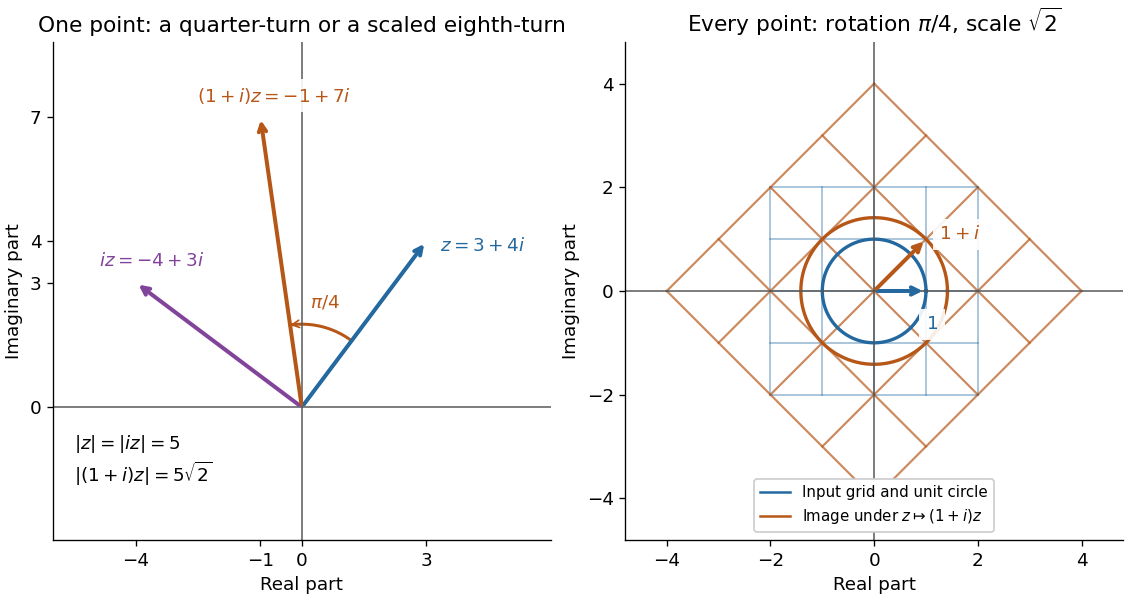
Complex multiplication rotates every direction and scales every length equally
. Details. 
Repeated multiplication now becomes especially simple: for a positive integer . This explains the evenly spaced arguments of the roots of a complex number. For example, has modulus and principal argument radians. The Cartesian calculation and the polar form provide independent checks on both its location and its size. Choose polar form when the task concerns multiplication, division, or repeated turns; use real parts and imaginary parts for addition.
Compact operators send weak convergence to norm convergence Created 2026-10-06 Updated 2026-10-14
For a bounded operator between Hilbert spaces, compactness is equivalent to implying in norm. The Uniform boundedness principle bounds a weakly convergent sequence. Relative compactness of its images and the unique possible weak limit then give norm convergence. Conversely, every bounded domain sequence has a weakly convergent subsequence, so the image of the unit ball is relatively compact.
Comoving volume Created 2026-10-06 Updated 2026-10-14
A comoving volume has fixed boundaries in comoving coordinates. Its physical volume grows as the cube of the scale factor. In a homogeneous adiabatic gas, cosmological entropy conservation makes constant.
Collision cross-section 2026-10-06
Collision Created 2026-10-06 Updated 2026-10-14
A collision is an interaction between approaching bodies or particles that changes their motion. Momentum conservation and conservation of energy constrain the outcomes; inelastic collisions can transfer mechanical energy into internal degrees of freedom.
The conjugate momentum to a periodic internal soliton angle generates shifts of that angle. Single-valued wavefunctions, or Bohr-Sommerfeld quantization with zero Maslov index, quantize this canonical momentum. A theta term can shift the relation between canonical momentum and mechanical charge without changing integer canonical labels.
Colexicographic initial segment 2026-10-06
The first sets of a fixed size in colexicographic order form a colexicographic initial segment. Its lower shadow is again a colexicographic initial segment at the next smaller size.
Cohomology group 2026-10-06
A degree- cohomology group is the quotient of degree- cocycles by coboundaries in a cochain complex. Topological cohomology groups arise from singular or cellular cochains. Their direct sum carries the cohomology ring structure when equipped with the cup product.
Equivariant cohomology 2026-10-06
The Borel version of equivariant cohomology is the ordinary cohomology of the Borel construction. It retains information about both the space and its group action. For a point it is the cohomology of the classifying space; for a free action with the usual bundle hypotheses it is the cohomology of the orbit space.
Reduced cohomology 2026-10-06
For a based space, reduced cohomology removes the coefficient-ring summand coming from the basepoint. In nonnegative degrees it is the kernel of restriction . It agrees with ordinary cohomology in positive degrees and admits the suspension isomorphism and exact sequences for based cofibrations.
Cohomology operation 2026-10-06
A cohomology operation is a natural transformation between cohomology functors. Thus for every continuous map , its pullback commutes with the operation: . This makes operations additional invariants of homotopy equivalence, beyond the additive groups and their cup products.
Singular cohomology Created 2026-10-06 Updated 2026-10-14
For a topological space and abelian group , singular cohomology is the cohomology of the cochain complex , where is the singular chain group. Its differential is dual to the singular boundary. This theory has relative cohomology, long exact sequences and the Excision theorem. On spaces that are not locally contractible it can differ from Čech cohomology.
Coherent-state thermal boundary conditions Created 2026-10-06 Updated 2026-10-20
The thermal trace closes bosonic coherent-state paths periodically and fermionic coherent-state paths antiperiodically: and , with for bosons and for fermions. The minus sign follows from the fermionic coherent-state trace, not from choosing a different Hamiltonian. These boundary conditions determine the allowed Matsubara frequencies.
A quantum channel on the receiving system cannot increase coherent information: . Dilate the channel to a linear isometry of Hilbert spaces . The difference is of the dilated state, nonnegative by Strong subadditivity of Von Neumann entropy.
Purify the input on and dilate a channel by . The joint state is pure, so complementary entropies obey and . Therefore coherent information is . The positive environment conditional entropy and negative receiving-system conditional entropy are two equivalent forms.
There are unlisted articles, also show them or only show them.