
Seasonal difference operator 2026-10-06
For an integer period , uses the backshift operator as . It annihilates a deterministic period- mean. If with and strong white noise, the result is the stationary moving average .
Scalar matrix Created 2026-10-06 Updated 2026-10-25
A scalar matrix is a scalar multiple of the identity matrix, equivalently a diagonal matrix with all diagonal entries equal. It commutes with every square matrix of the same size. In , the nonzero scalar matrices form the central subgroup removed to define the projective linear group.
Single-spin density of states Created 2026-10-06 Updated 2026-10-07
The single-spin density of states counts momentum states for one spin species. For degenerate up and down species, the spin-summed density of states is twice this value. Specify separately whether the density is per unit volume or extensive. In the BCS gap equation, the momentum sum labels opposite-spin pairs once and therefore uses the single-spin density per volume when the interaction has normalization .
Hyperplane density increment for cap sets 2026-10-06
If a cap set has subset density and , some affine subspace of codimension one has relative subset density at least . The zero-sum count and the Parseval identity on a finite group give a nonzero finite abelian Fourier coefficient of magnitude at least . The three slice densities are , where is this finite abelian Fourier coefficient and a primitive cube root of unity; one slice has increment at least . Translation preserves the zero-sum condition because the characteristic is three.
Smoothed matter density variance 2026-10-06
The smoothed matter density variance measures the root-mean-square linear density contrast after applying a window corresponding to a Lagrangian mass scale. For a homogeneous isotropic field it is . The variance convention, growth epoch and smoothing mass-density relation must agree with the collapse barrier used in a halo abundance calculation.
Newtonian-gauge matter density from a constant gravitational potential Created 2026-10-06 Updated 2026-10-14
In matter domination with the constant growing potential, the full Newtonian-gauge energy constraint gives the stated density contrast. The second term dominates inside the Hubble radius and grows as , because . Outside the Hubble radius, the constant term dominates and is gauge dependent. The comoving density combination cancels it for , leaving the cosmological Poisson equation relation. Matter-spectrum power laws must specify whether they refer to this comoving density or to subhorizon Newtonian-gauge density.
Rational Dehn surgery 2026-10-06
For a null-homologous knot, choose a meridian of a knot and Seifert longitude . Rational surgery with relatively prime numerator and denominator fills the knot exterior along . A negative continued fraction for replaces this operation by integer surgery on a chain of meridians, using slam-dunk moves.
Fiber-curve surgery Created 2026-10-06 Updated 2026-10-14
Let a knot lie in a fiber of a mapping torus of an oriented topological surface. Surgery with coefficient relative to its surface framing replaces the monodromy by its composition with a right-handed Dehn twist. Coefficient gives the inverse twist. The composition side depends on the choice of seam and time orientation; the existence of the new fiber bundle does not.
Average degree of a graph Created 2026-10-06 Updated 2026-10-14
The average vertex degree of a graph is the sum of its vertex degrees divided by its order. Double counting edge endpoints gives . It lies between the minimum degree of a graph and the maximum degree of a graph.
Genus bound for a nonplanar degree-five curve Created 2026-10-06 Updated 2026-10-14
The embedding line bundle has at least four independent global sections. If it is nonspecial, the Riemann-Roch theorem gives , so . If it is special, the Clifford inequality for curves gives , a contradiction. The smooth projective curve need not span its full ambient projective space.
Lorentz-invariant phase space 2026-10-06
For two outgoing particles the Lorentz-invariant phase space is . With massless daughters in their center-of-mass frame, and . This fixes normalization factors in decay widths and scattering rates.
Massless semileptonic pseudoscalar decay rate Created 2026-10-06 Updated 2026-10-07
For a pseudoscalar meson of mass decaying into a pseudoscalar meson of mass and two massless leptons through a weak charged current, the transverse massless leptonic current selects . With hadronic current normalized as and flavour coefficient ,The Källén function has mass dimension four, and the coefficient has mass dimension . This decay rate assumes the stated form-factor normalization and no additional isospin factor. It follows by the integrated massless leptonic tensor and the pion momentum change of variable in the parent's centre-of-momentum frame.
Screened sinusoidal surface-charge mode Created 2026-10-06 Updated 2026-10-18
A lateral sinusoidal surface charge density with wave number in the Debye–Hückel approximation generates vertical exponential or hyperbolic functions with inverse length . In a homogeneous electrolyte filling all space, an isolated sheet at produces . Boundary conditions determine the normalization when the electrolyte occupies only a gap.
Halo abundance mass-budget bound Created 2026-10-06 Updated 2026-10-14
A population of distinct, nonoverlapping dark matter halos cannot contain more total mass per comoving volume than the cosmic mean matter density. A narrow mass population therefore obeys . Do not sum subhalo masses and their inclusive host masses in the same bound, because that double-counts material. This check can reveal incompatible inferred absorption incidence, object size and halo-mass assumptions.
Darcy dissipation Created 2026-10-06 Updated 2026-10-07
A Darcy velocity driven by pressure in a stationary porous skeleton dissipates mechanical power per bulk volume. It follows by dotting Darcy law with the discharge: . Its contribution to a heat equation can be neglected only when it is small relative to the relevant thermal-energy transfer.
Energy dissipation of a damped pendulum Created 2026-10-06 Updated 2026-10-14
For the normalized damped pendulum, the sum of kinetic energy and gravitational potential energy, divided by , isThe chain rule and the full nonlinear equation give this identity exactly, without a small-angle approximation. Here as in damped pendulum. In physical units the mechanical energy and the power of the resisting torque areThe pendulum's lost mechanical energy is transferred to the damper and surroundings; it does not violate conservation of energy. In an ideal viscous dashpot this loss is frictional heating. The exact cumulative balance is particularly useful for checking a numerical solution:
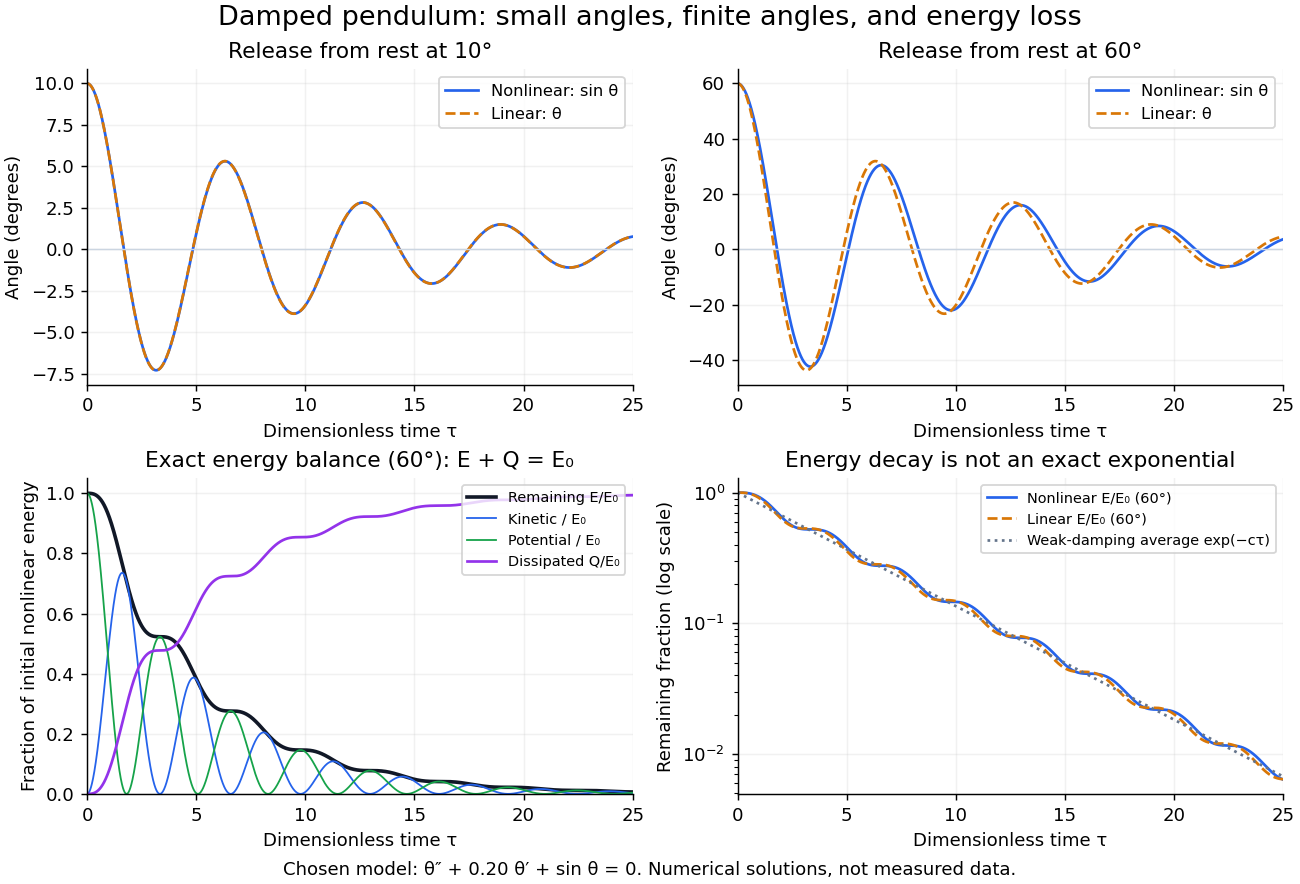
Illustrative nonlinear and linear damped pendulum solutions at 10 and 60 degrees, with exact mechanical energy transfer and loss; no measured data
. Details. 
The figure uses and release from rest. Over , the largest angular discrepancy between the nonlinear solution and the damped harmonic oscillator solution is approximately () for a release, but () for a release. Their nonlinear initial energies are and , respectively. At the remaining fractions are approximately and . These are illustrative calculations from specified initial conditions, not observations. The generator uses a Runge-Kutta method and integrates alongside the motion; halving its step and independently integrating checks the result.
For and , the first three nonlinear same-side swing intervals after a release are approximately , , and . They approach the linear-model oscillation period as the amplitude shrinks. After a release the corresponding intervals are already about , , and . This makes the experiment's period drift a quantitative test of the small-angle approximation, rather than an automatic reason to change the damping coefficient.
At a turning point, and even though the swing is losing mechanical energy over the cycle. Its potential energy there is , so measured turning angles give successive energies without estimating angular velocity. In the proposed decay experiment, multiply these values by to obtain energies in joules, then subtract adjacent same-side energies to estimate the loss over each full swing. Only for small amplitudes is . In the linear underdamped model, same-side peak energies consequently satisfy , the square of the angular amplitude ratio. For the illustrative parameters above this energy ratio is approximately . Between turning points, kinetic energy and potential energy continue to exchange while their sum decreases; the energy slope vanishes briefly at each extremum and is negative whenever the bob moves.
It is therefore inaccurate to replace the exact identity by . Even for the linear model, has . For weak damping and small angles, cycle averaging gives , so the averaged energy approximately follows while angular amplitude follows . This exponential decay is an approximation to the energy trace; the same-side peak ratio is exact within the linear model. The figure distinguishes the actual energy curves from this averaging approximation.
The energy identity also gives a global conclusion without solving the nonlinear equation. If were constant on a positive-length interval, then would vanish throughout it; the equation would force , making the entire trajectory an equilibrium. Every nonstationary trajectory therefore loses mechanical energy over every positive-length interval, even though its instantaneous derivative can vanish at a turning point. A nonconstant periodic motion would have to return to its initial mechanical energy, so it is impossible for this undriven damped pendulum. Oscillations near a stable focus are successive, shrinking swings, not a repeating cycle. Moreover, if , the angle cannot reach an upright equilibrium, whose potential energy is ; such motion stays within its original potential well. This is the usefulness of the energy description: one scalar balance controls both the observed decay and which nonlinear motions remain accessible.
Weak topology of a CW complex 2026-10-06
The weak topology of a CW complex is determined by its closed cells: a subset is closed if and only if its inverse image under every characteristic map from a closed cell is closed. A map out of the complex is continuous when its restrictions along those characteristic maps are continuous. This is distinct from the weak topology of a vector space. Taking the product with a locally finite CW complex, such as a closed interval with its finite cell structure, retains the corresponding CW weak topology.
Cell attachment 2026-10-06
Attaching a -cell along forms the quotient of identifying each boundary point with its image under . A constant attaching map gives . An attaching map can affect the cohomology ring even when it does not change the additive cohomology groups.
CW pair Created 2026-10-06 Updated 2026-10-14
A CW pair consists of a CW complex and a subcomplex . Its inclusion is a cofibration, so homotopies on extend across . The relative lifting property of a Serre fibration for such pairs allows specified boundary lifts to be retained while lifting a homotopy.
Gomory fractional cut 2026-10-06
For an all-integer dictionary row with nonnegative variables, this cut follows because is an integer and . Consequently that integer is at most . Negative coefficients use the usual fractional part , so . Normalize a resulting inequality sensibly before introducing a new integer-valued slack variable.
There are unlisted articles, also show them or only show them.