
Continuous image of a connected space Created 2026-09-24 Updated 2026-10-14
If is a continuous map and is a connected space, then its image , with the subspace topology from , is a connected subset of . The whole codomain need not be connected; the assertion concerns the values actually attained. No injectivity is required.[ref]
For example, the continuous function maps the connected closed interval onto the connected closed interval , even though opposite inputs have the same output. The same continuous function maps the disconnected union onto . Thus a connected image does not imply a connected source: a continuous map can merge different connected components.
For a continuous function representing a continuous reading, and force some input with . Its image is a connected subset of the real line, hence a real interval containing both endpoint readings. For the synthetic model , the missing-value test is explicit: . A step reading equal to for and for skips , but fails continuity at .
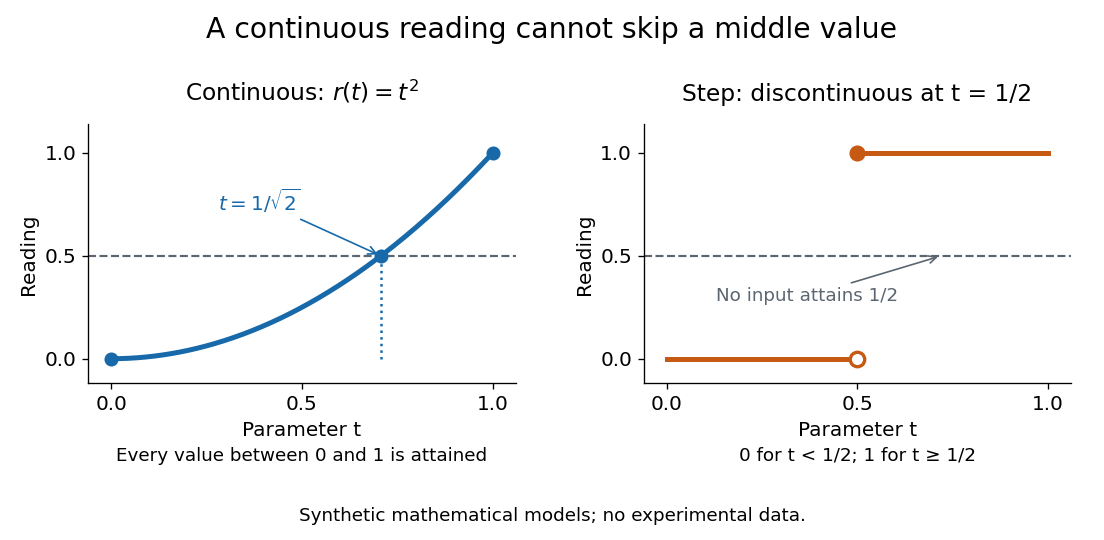

Proof outline: a separation of a topological space of into nonempty open subsets pulls back under to nonempty open subsets of . Their intersection is empty and their union is , contradicting connectedness. This also shows why a continuous map sends each connected component of its source into a single connected component of its target.
Connected component Created 2026-09-24 Updated 2026-10-14
A connected component of a topological space is a nonempty connected subset that is maximal under subset inclusion. If is a connected component and with a connected subset, then . Maximality means that no larger connected subset contains ; it does not mean largest cardinality among all connected subsets.
For example, the connected components of in the usual subspace topology of the real line are and . Each is a real interval, and no connected subset of the real line can meet both without containing the missing point . For the finite set in the same subspace topology, the three connected components are its singleton sets.
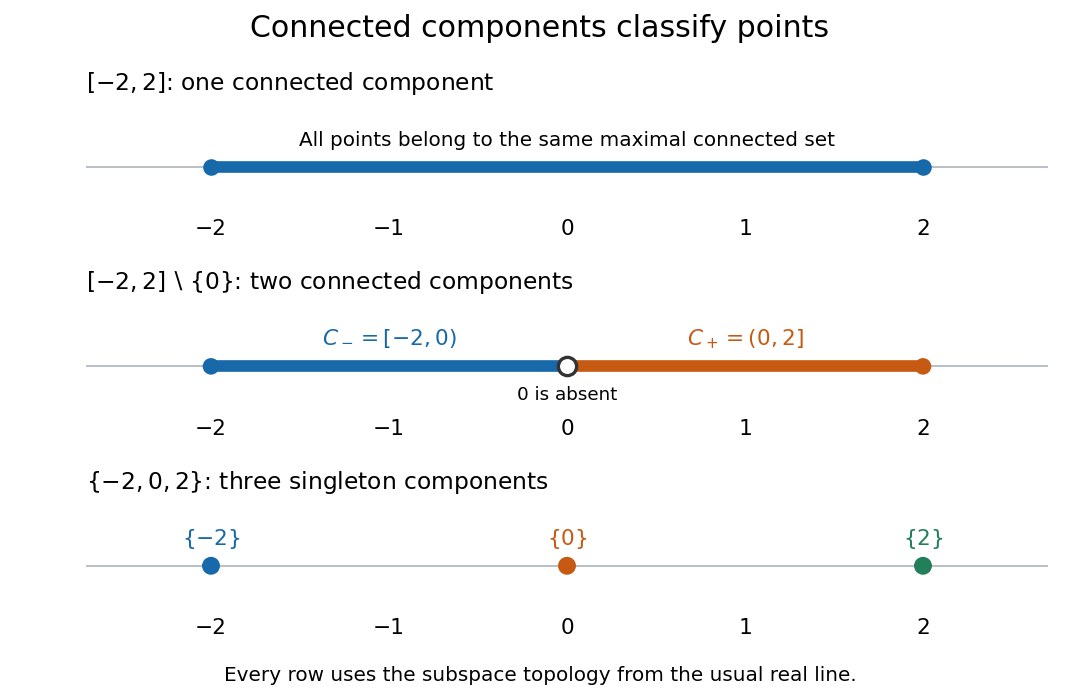
An intact real interval, an interval with an interior point removed, and a finite set have one, two, and three connected components in the usual subspace topology of the real line
. Details. 
Every point lies in exactly one connected component, constructed by taking the unionAll members contain , so their union is connected by connected union with a connected hub. The union includes every connected subset through , so it is maximal. Equivalently, defineThis is an equivalence relation: singleton sets give reflexivity, symmetry is immediate, and two connected subsets sharing the middle point have a connected union, giving transitivity. The equivalence classes are precisely the connected components. They form a partition of a set: they cover and any two are either equal or disjoint.[ref]
Chapter 3: Connected and compact spaces. Proposition 3.1.11, Definition 3.1.12 and Remark 3.1.16: maximal connected subsets and equivalence classes
Every nonempty connected subset lies within one connected component. Moreover, every connected component is closed in : closure of a connected set makes its closure connected, and maximality forces that closure to equal the original connected component. A connected component need not be open. For example, in with its usual subspace topology from the real line, all connected components are singleton sets, but is not open: every neighbourhood of in contains some .[ref]
Hyperbolic-cosine half-strip map Created 2026-09-24 Updated 2026-09-24
Holomorphic inverse function theorem Created 2026-09-24 Updated 2026-10-03
If a holomorphic function satisfies , then it has a holomorphic local inverse near and is conformal there. Its possible failures of local conformality are therefore its critical points.
Conformal equivalence Created 2026-09-24 Updated 2026-10-05
Two plane domains are conformally equivalent when there is a bijective holomorphic map between them whose inverse is holomorphic.
Past exam of the computer science course of the University of Cambridge Created 2026-09-24 Updated 2026-10-07
Simply typed lambda calculus Created 2026-09-24 Updated 2026-09-28
The simply typed lambda calculus assigns arrow types to variables, abstractions, and applications according to syntax-directed typing rules.
Recursively inseparable sets Created 2026-09-24 Updated 2026-10-03
Arithmetical hierarchy Created 2026-09-24 Updated 2026-10-14
The arithmetical hierarchy classifies sets by alternating blocks of number quantifiers over computable predicates.
Dovetailing Created 2026-09-24 Updated 2026-09-24
Dovetailing interleaves finite stages of multiple computations so that every computation that halts is eventually observed.
Padding lemma Created 2026-09-24 Updated 2026-10-14
The padding lemma produces infinitely many syntactically distinct program indices for the same computed function or language.
Index set Created 2026-09-24 Updated 2026-10-14
Many-one reduction Created 2026-09-24 Updated 2026-10-14
Recursively enumerable set Created 2026-09-24 Updated 2026-10-06
Diagonal argument Created 2026-09-24 Updated 2026-09-24
Primitive recursive function Created 2026-09-24 Updated 2026-10-06
Primitive recursive functions are generated by zero, successor, and projections under composition and primitive recursion.
Register machine Created 2026-09-24 Updated 2026-10-03
A register machine has finitely many states and finitely many addressed registers, together with instructions that inspect and modify register contents and change state. A computed partial function is defined by the contents at the halt state.
Normal shock wave Created 2026-09-24 Updated 2026-10-14
A normal shock is a discontinuity perpendicular to the flow direction across which mass, momentum, and total energy fluxes are conserved.
Property ratios for this discontinuity are tabulated in normal shock tables.
Riemann invariant Created 2026-09-24 Updated 2026-10-14
Analytic logarithm on the positive-axis slit plane Created 2026-09-24 Updated 2026-09-24
On , choose the argument in . Thenis an analytic logarithm. Locally this follows by scaling the convergent series
There are unlisted articles, also show them or only show them.