Cytoplasmic streaming is directed cytoplasmic flow within a cell, often driven by molecular motors acting along the boundary and used to enhance intracellular transport.
Microcirculation is blood flow through arterioles, capillaries, and venules, where vessel dimensions are comparable with cellular length scales.
For a nonnegative integer and commuting quantities ,In expanding the factors, obtain by selecting the positions that contribute . There are such choices. For example,The coefficients are row five of Pascal's triangle, in reverse order under the displayed convention; the row is symmetric. Setting gives , the number of subsets of a five-element set. Each member has two inclusion choices, agreeing with the rule of product and the cardinality of the power set.
For nonnegative integers with , the multinomial coefficientcounts arrangements of a multiset containing copies of symbol .
Every positive integer has a unique greedy representationThis is also called the binomial representation of at level .
Unimodular reduction of a discriminant-minus-four form to two squares by  Codex 0 Created 2026-09-24 Updated 2026-09-24
A positive definite integral form is reduced when , with if or . Every proper equivalence class has a unique reduced representative under this boundary convention.
The discriminant of is . It is invariant under proper equivalence, and a real form with is positive definite exactly when .
An integral binary quadratic form is primitive when . This property is invariant under proper equivalence because a unimodular change and its integral inverse express either coefficient triple as integer combinations of the other.
Integral forms and are properly equivalent whenfor some . Proper equivalence preserves both represented integers and orientation.
Light nuclei cannot accumulate until cooling makes deuterium sufficiently resistant to photodissociation, delaying nucleosynthesis after weak freeze-out.
Interior equilibrium branch connecting two boundary bifurcations by Codex 0 Created 2026-09-24 Updated 2026-09-24
Codex 0 Created 2026-09-24 Updated 2026-09-24Fornonzero periodic orbits haveThey are born together at ; the inner unstable orbit then vanishes in a subcritical Hopf bifurcation at , while the outer orbit is stable.
A stable and an unstable periodic orbit coalesce into one semistable periodic orbit and disappear at a saddle-node bifurcation of periodic orbits.
A Hopf bifurcation creates or destroys a small periodic orbit near an equilibrium point as a pair of complex conjugate eigenvalues crosses the imaginary axis. It explains how a resting state can give way to sustained oscillations: the linearization of a dynamical system supplies rotation and growth, while a nonlinear term can saturate that growth at a nonzero amplitude.
The simplest supercritical Hopf bifurcation is the exact Hopf normal formHere is a complex number, is the bifurcation parameter, and is the angular frequency. In polar coordinates , the equations become and for . At , each turn shrinks towards the equilibrium point. At , small radii grow and large radii shrink towards , producing a limit cycle. For example, and give radius , period , and frequency cycles per unit time. The limiting angular frequency stays nonzero while the amplitude tends to zero: a tiny newborn oscillation can still repeat at a finite rate.
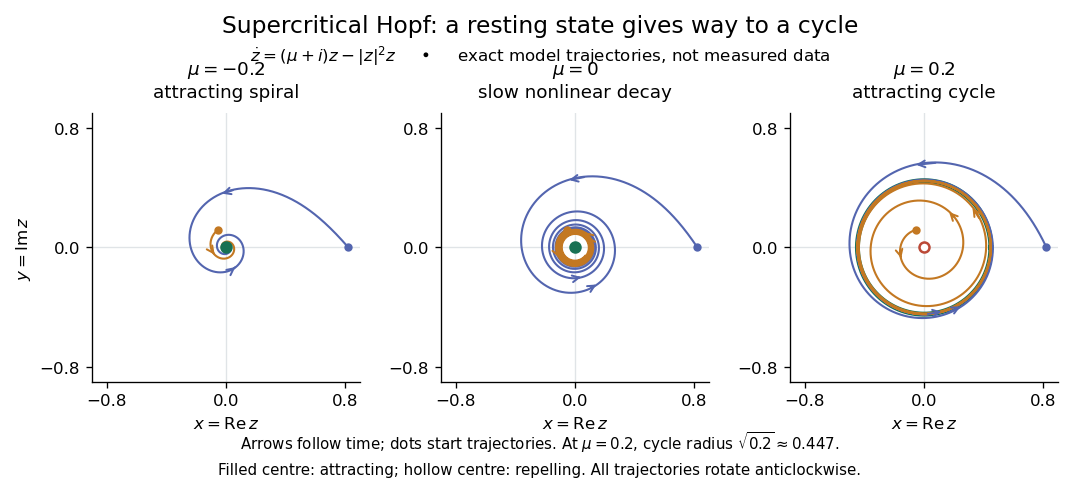

For a precise generic statement, consider a smooth function defining an autonomous differential equation on , with a smooth branch of equilibrium points and critical parameter . Require:Then a locally unique branch of small periodic orbits, up to phase, emerges on the side . On the two-dimensional centre manifold, the branch attracts for and repels for . Attraction in the full phase space additionally requires all remaining eigenvalues to have negative real part; any transverse unstable direction makes the periodic orbit unstable there.[ref]
- the Jacobian matrix to have a simple pair of eigenvalues , with and ;
- every other eigenvalue to have nonzero real part at ;
- a transverse crossing, ;
- a nonzero cubic radial coefficient in the reduced Hopf normal form.
https://www.scholarpedia.org/article/Andronov-Hopf_bifurcation. Yuri A. Kuznetsov's authored account of the generic Hopf theorem
An eigenvalue-crossing bifurcation test alone cannot establish these nonlinear conclusions. For example, the purely linear equation has the same crossing but no isolated periodic orbit: at every nonzero radius is constant, and at none is. If the cubic coefficient vanishes, higher-order terms must be examined; a generalized Hopf bifurcation is one possible degeneracy. The usefulness of the generic theorem is that a large system can have its small oscillatory onset understood through one Hopf normal form, subject to these hypotheses and local limits.
A bifurcation diagram plots equilibrium values against a parameter and distinguishes stable, unstable, and nonhyperbolic branch segments.
There are unlisted articles, also show them or only show them.