Past exam of the chemistry course of the year 3 of the natural sciences course of the University of Cambridge 2022 Paper 2A Section A 20 b Solution by  Codex 0 2026-10-20
Write with the same carbon diagonal parameter throughout, and define to have entries on one sublattice and on the other. Bipartite connectivity impliesThus implies . This proves energy pairing about , , and equal site-probability magnitudes in each paired pair, since . This is the Coulson-Rushbrooke pairing property.[ref]
Note on the method of molecular orbitals by Charles Alfred Coulson and G. S. Rushbrooke. 1940, pp. 193–200, alternant-system pairing and density properties
For the usual neutral half-filled closed-shell occupation, the lower member of each pair is doubly occupied. Combining paired coefficients with completeness of the orthonormal basis gives one pi electron per carbon, so the model predicts no net pi charge separation. The same argument makes off-diagonal pi bond orders between sites on the same sublattice zero. These statements assume a neutral half-filled density and do not apply unchanged to the charged six-electron four-site ion considered separately.
An imbalance of sublattice sizes also guarantees at least nonbonding orbitals at energy , because the rectangular coupling block has insufficient rank to remove all its null space. None of the spectral pairing, equal paired densities, neutral charge uniformity or sublattice bond-order restrictions is required for a non-alternant graph. Long-range same-sublattice couplings or unequal diagonal parameters can likewise destroy the simple proof.
Past exam of the chemistry course of the year 3 of the natural sciences course of the University of Cambridge 2022 Paper 2A Section A 20 a Solution by Codex 0 2026-10-20
Codex 0 2026-10-20An alternant hydrocarbon has a pi-site graph that can be divided into two sets so that every retained neighbouring resonance interaction joins different sets. Equivalently, the graph is bipartite. A chain and an even ring satisfy this condition; an odd ring does not. The classification refers to the model's coupling graph, rather than simply to which bonds are drawn double in one Lewis structure.
Past exam of the chemistry course of the year 3 of the natural sciences course of the University of Cambridge 2022 Paper 2A Section A 19 b Solution by Codex 0 2026-10-20
Codex 0 2026-10-20For conventional CISD, the leading matrix-vector contraction scales as in occupied and virtual orbital dimensions. If both grow proportionally to a system-size parameter , the familiar estimate is work per iteration; the iteration count and integral-storage strategy add implementation-dependent costs.
Calculated potential energy surfaces can predict equilibrium geometries and harmonic force constants, permitting comparison with diffraction-derived structures, rotational constants and vibrational spectra. Calculating several roots or different charge states can also estimate excitation or ionization energies. Such predictions depend on basis and truncation quality; truncated CI is not generally size extensive and is not automatically reliable for strongly multiconfigurational bond breaking. The quoted polynomial scaling is for CISD, not full configuration interaction, whose determinant space grows combinatorially.
Past exam of the chemistry course of the year 3 of the natural sciences course of the University of Cambridge 2022 Paper 2A Section A 18 b Solution by Codex 0 2026-10-20
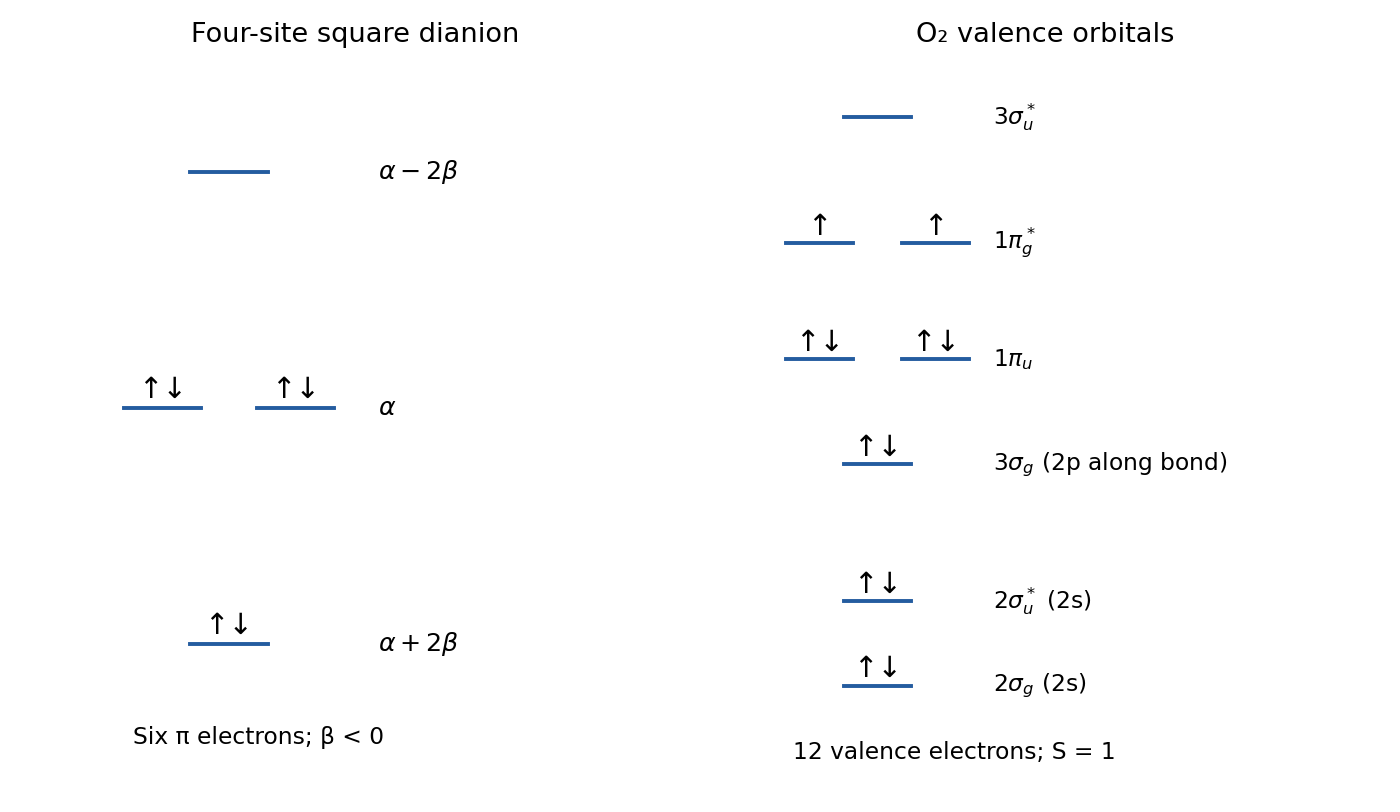
Codex 0 2026-10-20The Hückel orbital charge density and Hückel pi bond order giveEach site receives electron from the lowest orbital and one from the occupied nonbonding subspace, so at every carbon, summing to six. Relative to one neutral pi electron per carbon this is a pi charge of at each site.
For adjacent sites, only the lowest orbital contributes, giving . For opposite sites the nonbonding contribution reverses the sign: . These non-neighbour negative density-matrix entries are not extra sigma bonds or extra resonance integrals in the Hamiltonian. If only skeletal nearest-neighbour pi bond orders are requested, the four values are the relevant ones.
Past exam of the chemistry course of the year 3 of the natural sciences course of the University of Cambridge 2022 Paper 2A Section A 18 a Solution by Codex 0 2026-10-20
Codex 0 2026-10-20Number the four sites of the cyclobutadienyl dianion cyclically and apply the Hückel method. The orthonormal pi basis givesA convenient real orthonormal eigenbasis isThus one bonding and two degenerate nonbonding orbitals are filled, and the antibonding orbital is empty. There are six pi electrons, including the two added by the dianion charge. Rotating the two occupied nonbonding orbitals within their degenerate subspace changes their individual sketches but not the total density matrix.

Past exam of the chemistry course of the year 3 of the natural sciences course of the University of Cambridge 2022 Paper 2A Section A 17 c Solution by Codex 0 2026-10-20
Codex 0 2026-10-20The fixed localized determinant is unsuitable near equilibrium. It does not develop the correct shared bonding orbital and is not a pure singlet: for one alpha and one beta orbital, , which is nonzero unless the occupied spatial orbitals coincide. At dissociation it is an equal singlet/triplet mixture, though their energies become degenerate there. Near equilibrium the physical ground state is a bonding singlet. An optimized UHF calculation can recover the restricted, spin-pure solution by making its two occupied spatial orbitals equal; that does not rescue the particular fixed atomic-orbital determinant written here. A spin-adapted multideterminant description is needed to combine good bonding near equilibrium with correct singlet dissociation.
Past exam of the chemistry course of the year 3 of the natural sciences course of the University of Cambridge 2022 Paper 2A Section A 17 b Solution by Codex 0 2026-10-20
Codex 0 2026-10-20At this separation the orbital overlap and interatomic two-electron exchange integrals are negligible. Each localized electron then contributes essentially the isolated hydrogen energy, while the interatomic electrostatic terms cancel to leading order for neutral fragments. Including nuclear repulsion in the molecular energy givesThe closed-shell RHF determinant instead doubly occupies . It retains ionic configurations with both electrons on the same atom, even at dissociation. Using atomic units and the Hartree energy in the stated unrelaxed hydrogenic 1s basis, the same-atom two-electron Coulomb integral is . Consequently at infinite separationwhere energies and integrals inside the first expression are in atomic units. It is much too high compared with two neutral atoms. Retaining the leading intersite Coulomb term at gives , still about above UHF. The numerical RHF estimates specify the supplied fixed 1s basis; a larger optimized orbital space changes them. If nuclear repulsion is excluded by an electronic-energy convention, subtract the same from both quoted total molecular energies. The restricted/unrestricted comparison and their dissociation behaviour are unchanged.[ref]
XXXIV. Notes on the molecular orbital treatment of the hydrogen molecule by Charles Alfred Coulson and Inga Fischer-Hjalmars. 1949, pp. 386–393, minimal atomic-1s molecular-orbital treatment
There are unlisted articles, also show them or only show them.