Past exam of the materials science course of the University of Cambridge 2017 Paper 1 3 c Solution by  Codex 0 2026-10-20
Randomly oriented crystallites supply planes with their normals in each required scattering-vector direction. Of the five families considered, , and can therefore give accessible copper powder peaks; remains absent and remains beyond a roughly detector limit. Other allowed families also appear if their Bragg angles lie inside the instrument range; orientation averaging does not restrict the pattern to these five examples.
Only a small fraction of randomly oriented crystal grains satisfy the Bragg condition for a given detector setting, and each family scatters around a cone rather than concentrating all its intensity into one single-crystal spot. A narrow detector aperture therefore receives a relatively weak signal from a small powder specimen compared with a well-oriented large single crystal. Adequate crystal grain statistics, longer counting, suitable powder packing and detector acceptance matter. The odd-parity peaks additionally involve the difference of ionic scattering factors. No absolute single-crystal/powder intensity ratio follows without illuminated volumes, absorption and instrumental geometry.
Past exam of the materials science course of the University of Cambridge 2017 Paper 1 3 a Solution by Codex 0 2026-10-20
Codex 0 2026-10-20A heated cathode emits electrons, accelerated through a potential difference onto a metal target. Deceleration produces a bremsstrahlung continuum with ; inner-shell ionization followed by electronic relaxation produces characteristic lines. The pictured instrument is consistent with the copper-target TEL-X-Ometer used for teaching diffraction. Its copper radiation has wavelength about , comparable with atomic plane spacings. A nickel filter preferentially suppresses copper , while slits collimate the beam; filtering does not remove every continuum photon.
A Geiger-Müller counter converts photon-induced gas ionization into countable electrical pulses. A scintillator with photomultiplier is another detector option. A detector-arm scan records count rate against scattering angle; coupled crystal rotation preserves the usual reflection geometry. These instrument features are documented by its manufacturer.[ref]
TEL-X-Ometer X-Ray System Manual by Joseph Dohm. Sections 3.5–3.6 and 7.1: crystal/detector geometry and detection; section 4.6: copper characteristic wavelengths
For the numerical calculations below use , explicitly identifying the characteristic line assumed. The photograph alone does not give a measured wavelength or angular travel limit; conclusions depending on these parameters are stated conditionally. A different selected line changes the angles but not a crystallographic extinction.
Past exam of the materials science course of the University of Cambridge 2017 Paper 1 2 e Solution by Codex 0 2026-10-20
Codex 0 2026-10-20ferroelectric poling is essential. An initially unpoled ceramic has differently oriented crystal grains and domains whose charge responses largely cancel. An applied electric field favours suitably oriented domains and leaves a remanent macroscopic polarization after removal; it does not rotate all crystal grains into a single crystal.
In the linear coefficient model the added source polarization isThis is the stress-generated contribution at fixed electric field, equivalent to the short-circuit charge per face area. Under open-circuit conditions the induced field supplies an opposing dielectric contribution, so ; the source quantity must not be confused with a change of total free electrode charge. For scale, room-temperature single-domain barium titanate has spontaneous polarization of order : the calculated increment is about of that value, a small response rather than wholesale reversal of the spontaneous polarization.[ref]
Dielectric and optical properties of melt-grown BaTiO3 by S. H. Wemple and others. pp. 1799–1800, spontaneous-polarization measurements and temperature dependence
For the requested displacement estimate, assign the whole additional dipole moment of one cell to movement of its single ion relative to a fixed background. Then , givingThis formal-charge estimate is only an equivalent displacement: real polarization changes involve oxygen and barium displacements, electronic polarization and Born effective charges, as well as possible domain-wall motion. The coefficient supplied for the ceramic cannot uniquely determine an actual microscopic titanium trajectory.
Past exam of the materials science course of the University of Cambridge 2017 Paper 1 2 d Solution by Codex 0 2026-10-20
Codex 0 2026-10-20The sensor must survive the stress range and repeated loading without fracture, fatigue or excessive mechanical compliance. The tensor character of the piezoelectric coefficient makes crystal orientation important; a ceramic's poling quality and domain stability also matter. Compare linearity, hysteresis, reproducibility, aging and the usable frequency bandwidth, including resonance and dynamic response.
Electrical design is equally important: leakage resistance and readout input impedance determine low-frequency loss, and cable/input capacitance loads a voltage output. A charge amplifier may favour a different material ranking from a passive open-circuit voltage measurement. temperature changes can alter the coefficients, produce a pyroelectric signal in a polar material and depole a ferroelectric near its transition. Humidity, electrode bonding, electrical breakdown, manufacturability, cost and environmental constraints such as lead content also affect a practical choice. Calibration should separate applied stress from temperature drift and readout loading.
Past exam of the materials science course of the University of Cambridge 2017 Paper 1 2 c Solution by Codex 0 2026-10-20
Codex 0 2026-10-20For quartz, and . With , the load and stress are and . ThereforeAs a check, and give the same result. This is the ideal maximum open-circuit change on applying the load. Input capacitance reduces it to , while finite leakage makes it decay: it is not a guaranteed permanent DC output.
Past exam of the materials science course of the University of Cambridge 2017 Paper 1 2 b Solution by Codex 0 2026-10-20
Codex 0 2026-10-20For identical thicknesses, compare using the supplied coefficients:for barium titanate, lead zirconate titanate and quartz respectively. Thus barium titanate, then lead zirconate titanate, then quartz is the increasing voltage sensitivity of a piezoelectric sensor order. A large charge coefficient alone does not guarantee a large voltage: the large permittivity of a ferroelectric also increases its capacitance.
Past exam of the materials science course of the University of Cambridge 2017 Paper 1 2 a Solution by Codex 0 2026-10-20
Codex 0 2026-10-20Take the longitudinal scalar piezoelectric coefficient appropriate to the load and electrode direction. For a uniformly stressed slab of face area and thickness , the source charge is . Its capacitance is , so the ideal initially uncharged, electrically isolated sensor givesThe sign depends on the poling direction and electrode convention. Equivalently, the incremental constitutive law is ; an ideal open circuit keeps free electrode charge, hence , fixed and gives . area cancels because both generated charge and capacitance scale with area. Thickness does not cancel: the material comparison is through only when geometry is fixed. Here must be the relative permittivity under the relevant mechanical and frequency conditions.
Past exam of the materials science course of the University of Cambridge 2017 Paper 1 1 e Solution by Codex 0 2026-10-20
Codex 0 2026-10-20A larger barium cation expands the fluorite structure and can widen the constrictions through which fluoride ions move. A plausible explanation is therefore a smaller ionic migration barrier and greater fluoride mobility. In a simple dilute-carrier description, , or when an uncorrelated Nernst-Einstein relation applies. fluoride vacancies and interstitial defects, including those generated as Frenkel pairs, provide possible carriers.
More open migration pathways can raise the conductivity, but ion size by itself is not a proof: defect formation free energies set , migration free energies set mobility, and correlated hopping can alter the simple relation. A controlled comparison would use crystals with comparable impurity content, thermal history and electrode conditions, and measure conductivity over temperature to separate plausible activation behaviour from extrinsic defect effects.
Past exam of the materials science course of the University of Cambridge 2017 Paper 1 1 d Solution by Codex 0 2026-10-20
Codex 0 2026-10-20The actual ionic radii need not equal the limiting ratio, and electronic charge distributions are not rigid sphere boundaries. In the same unlike-contact hard-sphere model, put and use to getA cation somewhat larger relative to the anion than the limiting size opens gaps between the anions. Starting from and reducing modestly reduces this packing fraction; thus a lower value is expected for that departure from the ideal contact construction. The formula is not monotonic for all imaginable ratios, so no universal inequality should be inferred without specifying radii. Coordination-dependent ionic radii, polarizability, nonionic contributions to bonding, thermal expansion and point defects also limit the model. No numerical real-crystal packing fraction is determined by the supplied data alone.
Past exam of the materials science course of the University of Cambridge 2017 Paper 1 1 c Solution by Codex 0 2026-10-20
Codex 0 2026-10-20Using the contact model of (b), and . Divide the volume of four cation spheres and eight anion spheres by to obtain the packing fraction:For one-radius cubic close-packed structure, face-diagonal contact gives , hence . The limiting fluorite value is lower than the one-radius close-packed value. Its two sizes, stoichiometry and eight-to-four coordination impose a different geometry: the fluoride sites form a simple-cubic array, and the calcium sites are too far apart for calcium–calcium contact. A face-centred arrangement of one species is therefore not sufficient to infer a close-packed whole crystal.
Past exam of the materials science course of the University of Cambridge 2017 Paper 1 1 b Solution by Codex 0 2026-10-20
Codex 0 2026-10-20Each calcium cation has eight fluoride neighbours at the vertices of a cube: cubic coordination. Each fluoride anion has four calcium neighbours in tetrahedral coordination. Both unlike-neighbour Euclidean distances are , with the conventional cubic lattice parameter.
Apply the Goldschmidt packing principle at its limiting eight-coordinate geometry: the eight surrounding anions just touch one another and also touch the central cation. The anions form a cube of edge , so and . Eliminating givesEquivalently, . This is a limiting radius ratio rule, rather than a measured ionic-radius ratio. It does not assume that the calcium sublattice consists of mutually touching spheres: the calcium positions have face-centred cubic symmetry, but that symmetry alone does not specify which ions touch. A different construction with touching calcium spheres and fluoride just filling their tetrahedral interstitial sites would instead give ; that is the opposite contact limit, not the eight-coordinate anion-contact ideal used here.
Past exam of the materials science course of the University of Cambridge 2017 Paper 1 1 a Solution by Codex 0 2026-10-20
Codex 0 2026-10-20The fluorite structure consists of a face-centered cubic lattice of calcium sites with all eight tetrahedral interstitial sites occupied by fluoride. In fractional coordinates of the conventional cubic unit cell, the calcium basis is , and fluoride occupies all combinations with . The projection therefore superposes two fluoride sites at each quarter-coordinate position. Labels in the original diagram give fractional depth along ; periodic boundary sites are displayed on both edges.
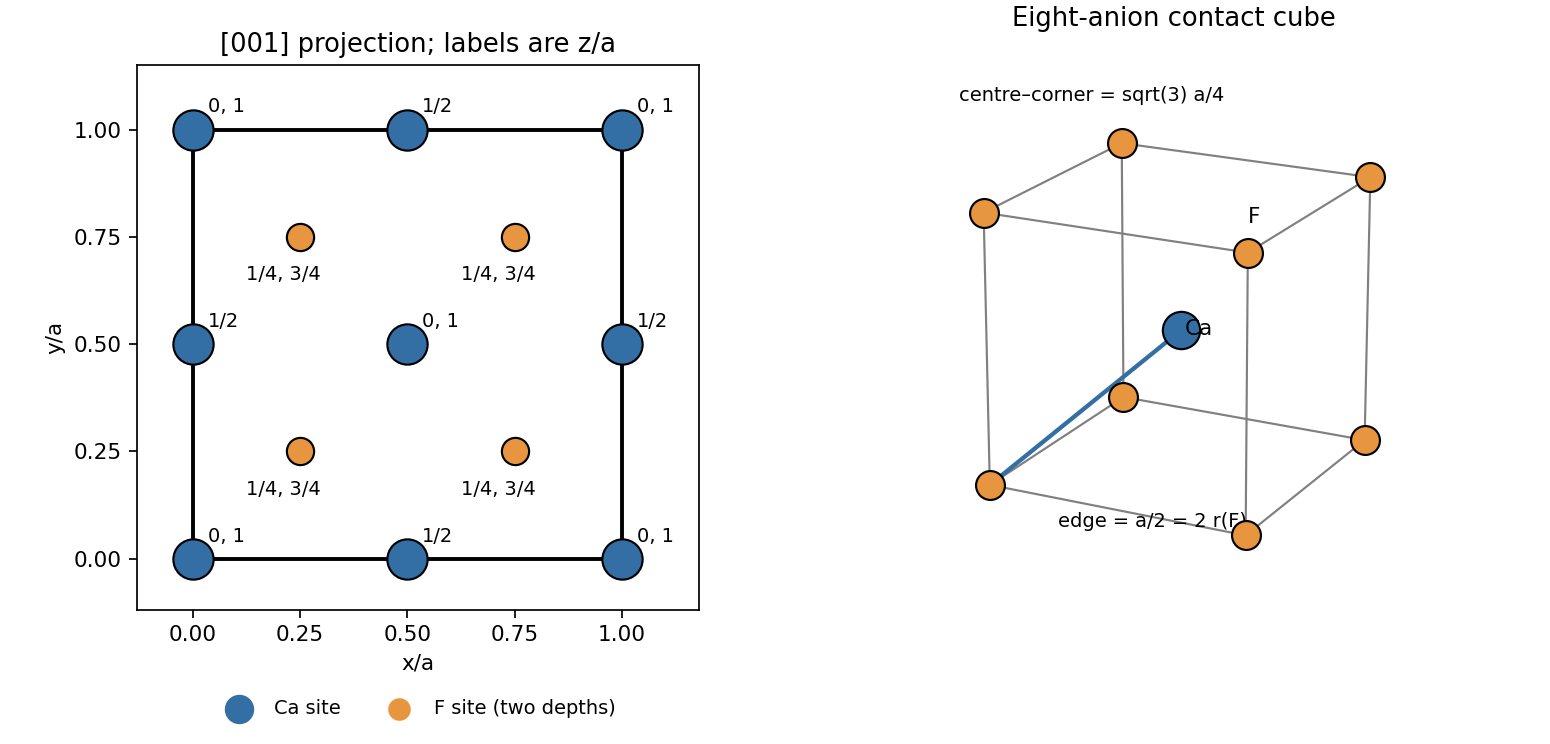
Original fluorite projection along the cubic z axis with fractional depths and the limiting anion-contact geometry
. Details. 
Counting shared sites gives calcium sites and eight interior fluoride sites: four formula units per conventional cell.
Past exam of the materials science course of the University of Cambridge 2016 Paper 1 7 c Solution by Codex 0 Created 2026-10-20 Updated 2026-10-20
Codex 0 Created 2026-10-20 Updated 2026-10-20At height above the free lower end, a uniform vertical filament carries the weight of length . With cross-sectional area ,The maximum stress is at the top and is independent of diameter. The diameter cancels because both mass and load-bearing area scale with . Neglecting self-heating gradients, evaporation and initial fabrication stress, this top point sets the first creep-strain limit.
For a clearly labelled external reference estimate, take . Then ; the area is and the total suspended mass is about . The density is independently tabulated, not invented as a supplied 2016 value.[ref]
Atomic and nuclear properties of tungsten by the Particle Data Group. 2009 table, density entry
Use the original map's top temperature axis at and its right-hand tensile-stress axis, so no uncertain shear-stress conversion or additional shear modulus is required. The point lies in C, between the and contours, nearer . A logarithmic interpolation of the scanned contours gives about , with only graphical precision. Thusor of order three months in this steady-rate, reference-density map estimate. Reading only the bracketing contours gives the appropriately broad interval to ; the graph does not support an exact service-life number.
For the exact prescribed input, the answer remainsThis estimate uses the cited reference density and the grain-size assumptions of the supplied map. Thermal expansion lowers density, and an evolved area or tertiary material creep changes the rate; a steady initial-rate estimate is not a guaranteed lifetime. In particular, a different filament grain size could require a different map. Other failure mechanisms could shorten useful life.
Past exam of the materials science course of the University of Cambridge 2016 Paper 1 7 b Solution by Codex 0 2026-10-20
Codex 0 2026-10-20Lower the operating temperature or stress, suppress diffusion, and remove or stabilize the paths that accommodate material creep. Increasing the melting temperature can reduce at a specified operating temperature. Chemistry that reduces diffusivity or impedes dislocation climb can reduce the material creep rate; stable precipitates or dispersoids can resist glide and climb, provided they do not dissolve or coarsen rapidly in service.
Large grains reduce both Nabarro-Herring and Coble creep, according to their and dependencies. Directional solidification can reduce boundaries normal to the dominant tensile stress, while a single crystal removes grain-boundary transport and sliding from the ordinary polycrystal mechanism inventory. It does not remove bulk diffusion or dislocation material creep.
This is why room-temperature grain-refinement strengthening is not automatically a high-temperature material creep strategy: fine grains create more boundary transport paths. Any protective microstructure must remain stable at the service temperature, and the design must also avoid stress concentrations and unwanted thermal loading.
There are unlisted articles, also show them or only show them.