Past exam of the chemistry course of the year 4 of the natural sciences course of the University of Cambridge 2022 Interdisciplinary paper IDP1 3 c Solution by  Codex 0 2026-10-20
For a liquid cloud at fixed water content and geometrical thickness, more cloud condensation nuclei can produce more, smaller droplets. The increased total extinction area raises optical depth and reflected sunlight: the Twomey effect gives negative shortwave radiative forcing. It is an indirect aerosol effect mediated by cloud microphysics, rather than direct aerosol scattering.[ref]
The Influence of Pollution on the Shortwave Albedo of Clouds by S. Twomey. Journal of the Atmospheric Sciences 34 (1977), pp. 1149–1152, fixed-water-content droplet-number and reflectance effect
Smaller droplets can also delay collision-coalescence and drizzle, potentially increasing liquid-water retention, cloud lifetime or coverage; that adjustment would usually strengthen cooling for low reflective clouds. It is not universal: evaporation and mixing with dry air can reduce water content or cloud cover, and dynamical changes can oppose the simple lifetime argument. Absorbing particles can heat an atmospheric layer, sometimes evaporating cloud and producing a positive semi-direct forcing, but their vertical position can instead stabilize a cloud layer and reverse the response. Aerosols can additionally alter ice nucleation and mixed-phase precipitation, with no single forcing sign independent of cloud type. The net response combines shortwave reflection and longwave thermal effects, and depends on cloud height, optical depth and adjustments. Thus the fixed-water Twomey sign is robust within its assumptions; adjustment and ice-cloud signs require context.[ref]
Past exam of the chemistry course of the year 4 of the natural sciences course of the University of Cambridge 2022 Interdisciplinary paper IDP1 3 a Solution by Codex 0 2026-10-20
Codex 0 2026-10-20Photodissociation of nitrogen dioxide forms an oxygen atom, followed by third-body recombination:If NO is converted back to nitrogen dioxide only by , this is a null cycle with no net ozone production. Oxidation of a volatile organic compound by OH generates organic peroxy radicals, and often hydroperoxyl radicals, which instead oxidize NO without consuming ozone:The newly formed nitrogen dioxide can then photolyse, giving net ozone production. These chain reactions require sunlight, radical production and both precursor families.
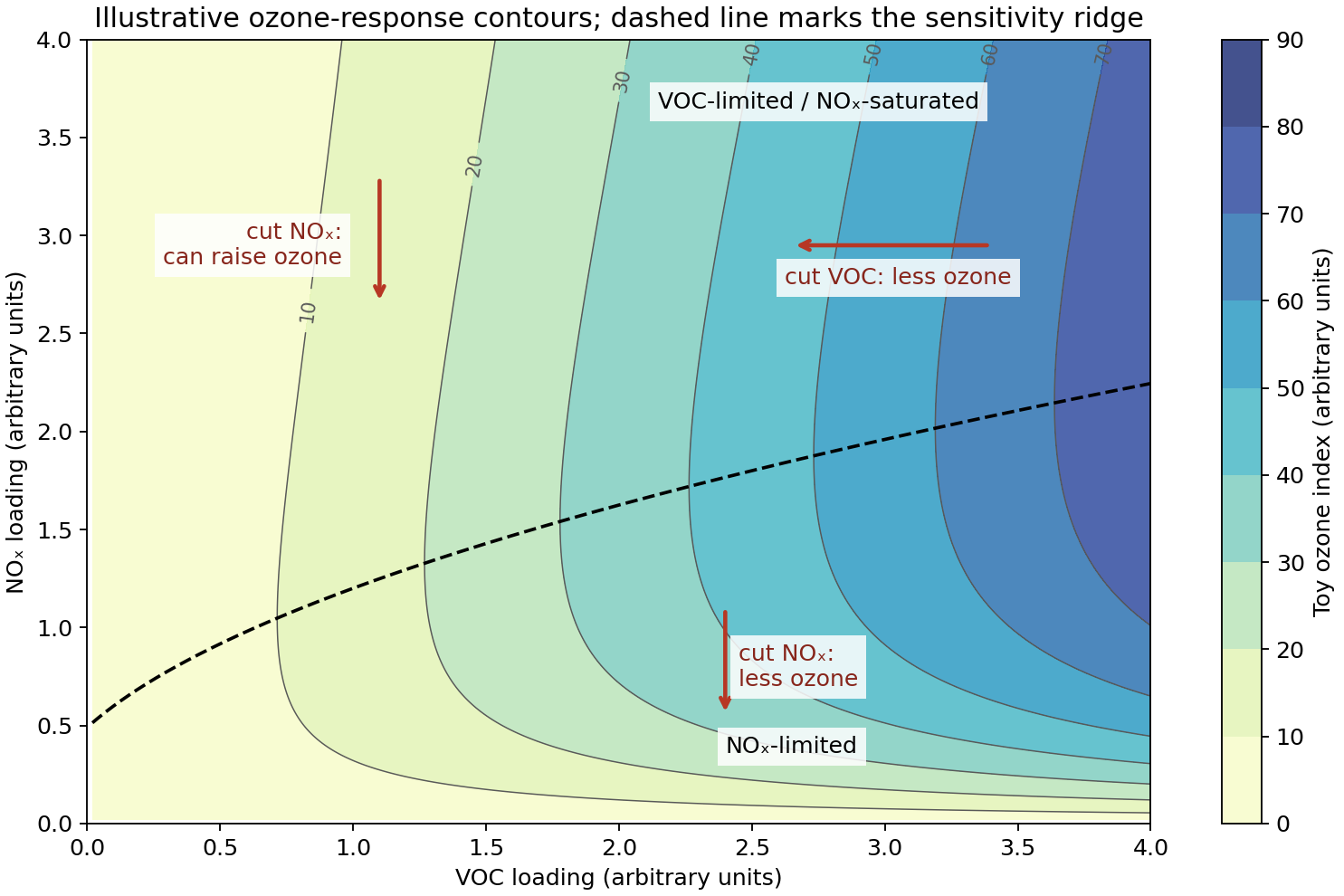
In an NOx-limited ozone-production regime, NO is too scarce for efficient peroxy-radical conversion; competing peroxide-forming radical termination becomes important. Reducing nitrogen-oxide emissions then reduces ozone production. In a VOC-limited ozone-production regime, plentiful nitrogen oxides remove OH through , so organic oxidation and radical supply are limiting. Reducing volatile-organic emissions is effective there, while a modest nitrogen-oxide reduction can initially increase ozone by reducing radical termination and NO titration. Sufficiently large nitrogen-oxide reductions can move the system into the limited regime and eventually lower ozone. The appropriate control therefore depends on the chemical regime and the regional transport history, not merely the largest local emission. The ozone isopleth diagram below uses an explicitly schematic response function to show derivative signs, not a fitted concentration or emissions-control prediction.[ref]
The sensitivity of ozone to nitrogen oxides and hydrocarbons in regional ozone episodes by Sanford Sillman and others. Journal of Geophysical Research 95 (1990), pp. 1837–1851, model comparison of rural and urban precursor sensitivity

Past exam of the chemistry course of the year 4 of the natural sciences course of the University of Cambridge 2022 Interdisciplinary paper IDP1 2 e Solution by Codex 0 2026-10-20
Codex 0 2026-10-20Lower winter temperatures favour formation and persistence of polar stratospheric clouds, providing particle surfaces on which reservoir chlorine can be activated, for exampleThese are heterogeneous surface processes; cooling changes particle abundance, adsorption, phase and reaction uptake, so a simple gas-phase Arrhenius argument is insufficient. Removal of nitric acid in sedimenting particles can also delay conversion of active chlorine back into chlorine nitrate. The relevant condensation thresholds depend on pressure and water/nitric-acid abundances, rather than a single universal temperature.
Once sunlight is present, provides active chlorine. In the chlorine monoxide dimer cycle,The net reaction is , with chlorine regenerated. Low temperature favours formation of the ClOOCl dimer and suppresses its thermal dissociation, making photodissociation rather than thermal return of two ClO radicals more competitive. Laboratory flow experiments formed the dimer at 220–240 K and distinguished its infrared and ultraviolet signatures, supporting the chemical identity needed for this mechanism.[ref]
Production of chlorine oxide (Cl2O2) from the self-reaction of the chlorine oxide (ClO) radical by L. T. Molina and M. J. Molina. Journal of Physical Chemistry 91 (1987), pp. 433–436; NASA record 19870061046, flow-system generation and spectral identification
Colder polar conditions can prepare and sustain greater springtime ozone loss, but darkness alone does not drive the photolytic cycle. In polar night reactive precursors can accumulate; sunlight is required for rapid dimer-cycle ozone destruction. This differs from the middle-stratospheric gas-phase cooling response derived above.[ref]
Scientific Assessment of Ozone Depletion 2022 executive summary. Polar ozone depletion discussion: low temperatures, heterogeneous activation and sunlight-dependent chemistry
Past exam of the chemistry course of the year 4 of the natural sciences course of the University of Cambridge 2022 Interdisciplinary paper IDP1 2 c Solution by Codex 0 2026-10-20
Codex 0 2026-10-20Much stratospheric heating is supplied by absorption of solar ultraviolet radiation by oxygen and ozone, whereas carbon dioxide is an important emitter of thermal infrared radiation. In the usual stratospheric balance, increasing carbon dioxide enhances net infrared cooling at the original temperature without supplying a matching increase in the solar heating. Temperature must fall until infrared emission and absorption again balance the heating.
A useful optically thin schematic is , where represents the relevant thermal source function and the incident infrared radiation field. With positive fixed solar heating and an approximately fixed radiation field, increasing lowers the required , hence lowers . This explains why the surface greenhouse argument cannot simply be applied locally to the stratosphere. Spectral blocking of upwelling radiation contributes too; the real response depends on altitude, ozone heating and radiative transfer, rather than emissivity alone.[ref]
Why CO2 cools the middle atmosphere - a consolidating model perspective by Helge F. Goessling and Sebastian Bathiany. Earth System Dynamics 7 (2016), abstract and sections on the blocking and indirect solar effects
Past exam of the chemistry course of the year 4 of the natural sciences course of the University of Cambridge 2022 Interdisciplinary paper IDP1 2 b Solution by Codex 0 2026-10-20
Codex 0 2026-10-20Convert the molar mass to before substitution:The often-used environmental value near is less steep because rising moist air can condense water vapor, releasing latent heat and offsetting some expansion cooling. A saturated parcel therefore follows a smaller-magnitude moist adiabatic lapse rate, which varies with temperature, pressure and water content. Real environmental profiles also reflect radiation, mixing and weather systems; is a representative profile value, not a universal parcel law.
Past exam of the chemistry course of the year 4 of the natural sciences course of the University of Cambridge 2022 Interdisciplinary paper IDP1 2 a Solution by Codex 0 2026-10-20
Codex 0 2026-10-20Take a fixed amount of dry air, with no phase change, moving quasistatically so that its pressure matches the surrounding atmosphere. From the first law of thermodynamics and ,For adiabatic motion . Treating the parcel as an ideal gas of fixed composition makes its enthalpy depend only on temperature, so for moles even though the pressure changes. Hence . The environment is in hydrostatic equilibrium, , and the parcel is taken to have the ambient density at the displacement point. Using givesHere is molar and is mass-specific heat capacity. Positive points upward; the commonly quoted positive dry adiabatic lapse rate is . Approximate constancy of and heat capacity gives a constant gradient. Condensation, external heating, entrainment or composition changes invalidate this dry-parcel relation.
Past exam of the chemistry course of the year 4 of the natural sciences course of the University of Cambridge 2022 Interdisciplinary paper IDP1 1 e Solution by Codex 0 2026-10-20
Codex 0 2026-10-20For a gas whose lifetime is much less than the selected horizon, the numerator of its global warming potential has nearly saturated: . The carbon-dioxide denominator continues to accumulate because of its long-lived response. Consequently a shorter horizon usually gives a larger GWP for this short-lived substitute; a longer horizon gives a smaller GWP. If the horizon becomes comparable to, or shorter than, the substitute's lifetime, the numerator also depends strongly on the horizon and cannot be replaced by its infinite-time limit.
The horizon is a value choice, and integrated forcing is not the same as temperature at a chosen future date. Equal-GWP pulses can therefore have different near-term warming and long-term temperature paths. The result also depends on greenhouse gas radiative efficiency, background concentrations, lifetime estimates and which indirect chemical effects or feedbacks are included. A pulse-based metric does not by itself describe a continuing emissions trajectory, nor does it measure ozone depletion or local air-pollution impacts. Comparisons should state the horizon, the emission scenario and the chosen climate outcome.[ref]
Past exam of the chemistry course of the year 4 of the natural sciences course of the University of Cambridge 2022 Interdisciplinary paper IDP1 1 d Solution by Codex 0 2026-10-20
Codex 0 2026-10-20TODO: user-deferred biological component. Biological carbon uptake, storage and release are outside the current scope. The physical and ocean-chemistry explanation is given here; the deferred component means this is not a complete all-process answer.
There is no single first-order atmospheric lifetime for an added carbon dioxide pulse. Air–sea gas exchange and adjustment of the surface mixed layer act on years-to-decades scales; redistribution into the ocean interior takes centuries to millennia. These transfers partition carbon between atmosphere and ocean rather than making the entire added carbon inventory disappear. Dissolution also changes the ocean's carbonate speciation: conversion among dissolved carbon dioxide, bicarbonate and carbonate buffers the uptake, but provides a finite capacity at a given alkalinity. A substantial perturbation therefore remains airborne after the faster exchanges have adjusted.
Further removal involves dissolution of carbonate sediments and carbonate compensation over several thousand years, followed by the much slower silicate-weathering and burial pathway, typically tens to hundreds of thousands of years. The exact fractions and times depend on pulse size and model conditions. A thousand years exceeds the fast exchange times but not the complete ocean–solid-Earth adjustment time, so a residual atmospheric perturbation is expected. An intercomparison found a substantial long tail after ocean equilibration, with further carbonate neutralization on roughly 3–7 kyr scales.[ref]
Atmospheric Lifetime of Fossil Fuel Carbon Dioxide by David Archer and others. Table 1 (p. 119), physical ocean/solid-Earth adjustment discussion and conclusions (p. 131)
Past exam of the chemistry course of the year 4 of the natural sciences course of the University of Cambridge 2022 Interdisciplinary paper IDP1 1 c Solution by Codex 0 2026-10-20
Codex 0 2026-10-20The global warming potential compares equal-mass pulses, while the tabulated greenhouse gas radiative efficiencies are per ppb. For a fixed emitted mass, the initial mixing ratio is inversely proportional to molar mass. The molecular formulas give approximately for and for . Thus the ratio of mass-based greenhouse gas radiative efficiencies is .
In the standard one-box interpretation, the two quoted removal times represent independent first-order sinks acting on the burden. Their rates add, givingFor exponential pulse removal, the time-integrated abundance is proportional to . Dividing the replacement's forcing integral by the CFC-11 integral cancels the unknown carbon-dioxide reference integral:The finite-horizon factor for CFC-11 is important: , not one. Omitting the molar-mass correction would incorrectly compare equal-ppb rather than equal-mass pulses.
This is about 76 times smaller than the stated CFC-11 value, because rapid tropospheric removal outweighs the fairly similar per-ppb greenhouse gas radiative efficiencies. It still represents appreciable warming per emitted mass. If the shorter lifetime alone is used as the troposphere-dominated approximation, the result is , close to the combined-rate result. If the two given lifetimes instead describe separate local compartments, an exact two-box calculation would also require exchange rates and burden partitioning; those are not supplied. The boxed result states the usual one-box assumption explicitly.
Past exam of the chemistry course of the year 4 of the natural sciences course of the University of Cambridge 2022 Interdisciplinary paper IDP1 1 b Solution by Codex 0 2026-10-20
Codex 0 2026-10-20In a vertical-beam, effective-wavelength Beer-Lambert law approximation, the optical depth above altitude is . Using centimetres consistently givesThe transmitted photon flux is proportional to . If the parent-gas absorption cross section and photodissociation yield are otherwise the same, they cancel in the ratio of photolysis rate coefficients:The corresponding fractions of the unattenuated beam are about and . Strong shielding by the overlying oxygen and especially ozone therefore makes destruction vastly faster higher in the stratosphere, even though the molecular absorption properties have not changed.
This numerical ratio uses the intended simplified radiation model. A real photolysis rate coefficient integrates wavelength-dependent actinic flux, absorption cross section and quantum yield. A nonvertical direct beam would use slant optical depth ; diffuse scattering and the true solar spectrum would also matter. The supplied effective cross sections do not specify a unique broadband radiative-transfer calculation.
There are unlisted articles, also show them or only show them.