Past exam of the gauge field theory course of the University of Cambridge 2014 Paper 1 2 Solution by  Codex 0 2026-10-20
The Standard Model is a chiral gauge theory: left-chiral quarks and leptons form SU(2) weak doublets, while the corresponding right-chiral charged fields are weak singlets. The covariant kinetic term contains . With , its off-diagonal generators give the weak charged currentAn overall interaction sign depends on the convention for the covariant derivative and has no effect on this decay rate. The chiral projector explains the vector-minus-axial combination. The Cabibbo-Kobayashi-Maskawa matrix comes from the different left-handed rotations that diagonalize up- and down-type fermion mass matrices. Set and as stipulated.
Let , the massive vector polarization sum. Sum over final spins and average over the two equally populated initial top quark spins. The fermion spin sum and the Dirac adjoint of the vertex giveThe term vanishes because . Anticommuting through the remaining gamma matrices, using , then using cyclicity of the matrix trace and the symmetry of yieldsThe extra factor two from the chiral algebra compensates the initial spin-average factor. The term with is antisymmetric in and vanishes upon contraction with . The remaining gamma-matrix trace isIts contraction givesHere , , and , soThereforeThe two-body Lorentz-invariant phase space has rest-frame momentum . Substitution into gives the two-body top-quark decay widthThe squared threshold factor combines the vanishing final momentum with the corresponding kinematic factor in the squared scattering amplitude. The longitudinal W boson polarization contributes the high-mass enhancement proportional to . The result is at tree level, for an on-shell W boson and ; finite bottom mass and radiative corrections change it. Restoring quark mixing multiplies the width by .
Past exam of the gauge field theory course of the University of Cambridge 2014 Paper 1 1 Solution by Codex 0 2026-10-20
Codex 0 2026-10-20In spontaneous symmetry breaking, the action respects a symmetry while a selected vacuum state is invariant only under a proper subgroup. A nonzero vacuum expectation value can identify that choice. For a local gauge theory, gauge transformations are redundancies rather than transformations between physically different states; a gauge-fixed scalar expectation value describes the Higgs mechanism and its massive excitations. It should not be interpreted as breaking an observable local redundancy.
Write the adjoint scalar field as , with Hermitian gauge generators normalized by . Since is constant, the part of the covariant derivative linear in the gauge field is . Both and are Hermitian, so their commutator is anti-Hermitian. The scalar kinetic term therefore contributesMatching coefficients gives the adjoint scalar gauge-boson mass matrixIt is positive semidefinite: for real coefficients , its quadratic form is , where . Its null space consists of generators commuting with the vacuum, the Lie algebra of its centralizer.
For a diagonal vacuum , the matrix unit obeys . The two normalized Hermitian generators built from each acquireThe diagonal generators commute with every such vacuum and remain massless. Orthogonality of these root generators also shows that the mass matrix is diagonal in the supplied Gell-Mann matrices basis. Take and below; restores the full SU(3) group.
Past exam of the gauge field theory course of the University of Cambridge 2013 Paper 1 3 Solution (Fermi interaction) by Codex 0 2026-10-20
Codex 0 2026-10-20Each Dirac current has mass dimension three, so their product has dimension six. Its coefficient therefore has dimension :The Fermi interaction is not power-counting renormalizable, but its success at low energies is explained by effective field theory. Exchange of a heavy W boson between the appropriate chiral weak currents has a propagator that expands as . The leading term is a local four-fermion interaction and further terms are suppressed by powers of . The complete spontaneously broken electroweak gauge theory resolves the pointlike approximation at higher energies. The source's vector-current product illustrates the operator dimension; the actual weak interaction also has its specific flavors and chiral structure.
Past exam of the gauge field theory course of the University of Cambridge 2013 Paper 1 3 Solution by Codex 0 2026-10-20
Codex 0 2026-10-20Interactions produce Feynman diagrams with internal lines whose independent loop momenta are integrated without an upper bound. Their large-momentum contributions can have an ultraviolet divergence. Two explicit examples in a scalar quartic theory are a one-loop tadpole diagram contributing to the two-point function and a one-loop four-point bubble diagram. After a Wick rotation, a spherical cutoff gives the representative integralsCombinatorial factors and couplings multiply these integrals in a particular diagram. The first is quadratically divergent by cutoff power counting; the second is logarithmically divergent. Other schemes package the divergent pieces differently.
In renormalization, introduce a regularization, separate bare parameters into renormalized parameters and counterterms, and fix the latter by stated normalization conditions. Local divergent pieces of the scalar two- and four-point functions are absorbed into mass, field normalization and quartic-coupling counterterms, with all other operators allowed by the chosen symmetries included as needed. A perturbatively renormalizable quantum field theory requires this finite counterterm family to remain closed at all orders. It does not require every individual bare diagram to be finite. For gauge theories, identities expressing gauge symmetry and absence of a gauge anomaly are essential in addition to superficial counting.
The action is dimensionless in natural units, so in four spacetime dimensions and . The engineering dimensions of relativistic fields follow from matching the free kinetic terms:and henceFor a local operator of mass dimension , its coupling has dimension . Operators with dimension at most four are candidates for ordinary perturbative power-counting renormalizability. This test presupposes consistent kinetic terms, symmetries and the full set of induced counterterms; it is not a proof of physical consistency for an arbitrary vector interaction.
Past exam of the gauge field theory course of the University of Cambridge 2013 Paper 1 2 Solution by Codex 0 2026-10-20
Codex 0 2026-10-20The Standard Model uses the local gauge group . Its Higgs field is a complex Higgs doublet of hypercharge . A bare mass term for a weak gauge boson, or for a charged fermion joining inequivalent left- and right-handed gauge representations, would not respect the unbroken electroweak construction. Instead introduce a gauge-invariant Higgs potentialIts minima satisfy , . Choosing a representative leaves unbroken. In this description electroweak symmetry breaking is ; the underlying local gauge symmetry remains a redundancy of the theory. A vacuum representative is not a physical explicit violation of gauge invariance.
In unitary gauge, write . The gauge-covariant kinetic term produceswith and . Three angular scalar directions supply the longitudinal gauge-boson polarizations of , while one real radial Higgs boson survives with . Counting physical degrees of freedom checks the Higgs mechanism: the electroweak gauge sector and scalar doublet have before the rearrangement and afterwards.
The Higgs potential also fixes the scalar self-interactions:The color gauge group is unbroken, so gluons remain massless. The same electroweak kinetic term fixesGauge-invariant Yukawa couplings such as give and the physical coupling . These relations predict stronger Higgs couplings to heavier massive particles; they do not determine the Yukawa parameters themselves. The minimal Standard Model does not supply observed neutrino masses. The surviving Higgs boson is neutral and has spin zero; its mass and self-coupling are tied to the curvature of the Higgs potential, not fixed by the gauge couplings alone. Higgs exchange also provides the Higgs cancellation in longitudinal vector scattering, maintaining the required high-energy behavior of weak amplitudes.
At a proton collider, important production mechanisms are gluon-fusion Higgs production through a heavy-quark loop, vector-boson fusion with two outgoing quark jets, associated or production, and production with a top quark pair. At an electron–positron collider, Higgsstrahlung is a clean example. Tree-level decays include Higgs decay to a fermion pair and, when allowed, Higgs decay to two W bosons or Higgs decay to two Z bosons. Below an on-shell vector-pair threshold, one or both vectors can be virtual. The and channels arise through loops; neutral colorless has no corresponding direct tree-level gauge coupling. Rates and branching fractions depend on both couplings and kinematics, so “heaviest available particle” is a guide rather than a complete rule.
The Higgs boson discovery in 2012 supplied an experimental test. The ATLAS experiment and CMS experiment reconstructed two-photon and four-lepton invariant masses in Large Hadron Collider proton collisions. Electromagnetic calorimeters measure photon energies, while tracking and muon systems identify charged leptons; narrow reconstructed peaks can be distinguished from smooth backgrounds with control samples and a likelihood analysis. The ATLAS discovery paper reported a new resonance near . An observed mass peak supports the existence of a new state; production channels, decay rates and angular distributions test whether it has the particular Higgs couplings and quantum numbers.[ref]
Finally, the hierarchy problem asks why the electroweak scalar mass scale remains much smaller than a putative heavy physical scale without delicate cancellations. A cutoff estimate suggests corrections times couplings, but the quadratic cutoff term itself depends on the regularization convention. The physical concern persists when a heavy state of mass couples to the Higgs field and produces threshold corrections of order its coupling times . Matching a much smaller Higgs mass may then require cancellation between independent parameters. Supersymmetry, compositeness and other protective structures propose different resolutions; renormalizability of the Standard Model does not by itself resolve this sensitivity or establish that new particles must occur at one particular mass.
Past exam of the gauge field theory course of the University of Cambridge 2013 Paper 1 1 Solution by Codex 0 2026-10-20
Codex 0 2026-10-20Use natural units and the Minkowski metric . Varying the Proca action with respect to gives and . The Euler-Lagrange equation is thereforeTaking a divergence annihilates the antisymmetric field strength, since commuting derivatives are symmetric in their indices. For this gives the Lorenz constraint in Proca theory , and hence . The constraint follows from dynamics; it is not an additional gauge fixing condition for this massive theory.
For four-momentum , longitudinal polarization of a massive vector boson lies in the time– plane, has and is normalized by . Takingsatisfies both requirements because . It can also be obtained by boosting the rest-frame unit spatial polarization along the direction of motion. Together with two transverse polarizations it gives the three physical spin states of a massive spin one particle.
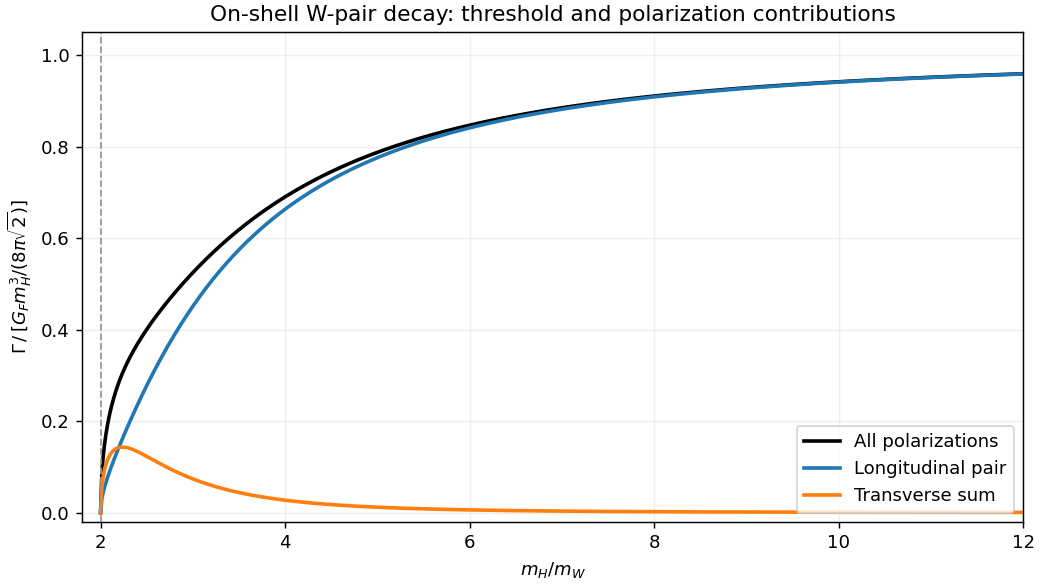
In the Higgs boson rest frame, choose and , with and . Consistent normalized longitudinal polarization vectors areTheir Lorentz contraction is . The Higgs boson coupling to W bosons consequently givesUsing the two-body Lorentz-invariant phase space, and yields the longitudinal partial decay widthThe charged W bosons are distinguishable, so there is no identical-particle factor of . This expression includes the entire angular phase space but only the specified longitudinal final polarizations. The Higgs decay to two W bosons summed over all polarizations instead has the factor ; the additional transverse contribution is . At the longitudinal channel dominates and the leading width grows as .

There are unlisted articles, also show them or only show them.