Past exam of the chemistry B course of the University of Cambridge 2023 Paper 1 B2 a Solution by  Codex 0 2026-10-20
The first reagent supplies a vinyl nucleophile, , rather than an allyl group. Two successive conjugate additions install vinyl at C2 and a 2-formylethyl chain at C1. Number the original nitro-bearing alkene carbon C1. Vinylmagnesium bromide attacks the beta carbon C2 of the nitroalkene, shifting the original C1=C2 electrons into a magnesium nitronate. The new C2–vinyl bond remains intact during the second stage; its terminal double bond is not the electrophilic site in that stage.
The carbon end of the nitronate at C1 then attacks the terminal beta carbon of acrolein. Move the acrolein C=C electrons towards its carbonyl and the C=O electrons onto oxygen. This forms the C1–CH2CH2CHO connectivity through an aldehyde enolate; protonation by methanol and tautomerization restore the aldehyde. The nitronate returns to a neutral nitro group as it makes the second C–C bond. Thus the chain is attached through the carbon formerly beta to the acrolein carbonyl, rather than by a direct addition to its aldehyde carbon.
After the first addition, C2 bears the vinyl group while the nitronate carbon C1 remains approximately planar. Approach of the second electrophile to the less crowded face, opposite the adjacent vinyl substituent, gives the new formylethyl chain trans to vinyl. Consequently nitro and vinyl are cis, as depicted: at C1 the chain and nitro group occupy opposite faces. This is a substrate-controlled diastereoselective tandem Michael addition. The reagents and starting material contain no chiral source, so the depicted product represents a racemic pair rather than an enantioselective synthesis. Steric facial selection explains the relative configuration without requiring a uniquely established magnesium aggregate or transition-state conformation.
Past exam of the chemistry B course of the University of Cambridge 2023 Paper 1 B1 a Solution by Codex 0 2026-10-20
Codex 0 2026-10-20Number the ring with chlorine at C1 and the methylsulfonyl group at C4. The new nitro group is at C2, equivalently C6 by the starting ring's symmetry: the product is 1-chloro-2-nitro-4-(methylsulfonyl)benzene. Both substituents favour this site. Although chlorine deactivates the ring inductively, its lone pair donation stabilizes ortho/para Wheland intermediates. The sulfone is strongly electron withdrawing and meta directing; attack ortho or para to it produces especially unfavourable cationic contributors to resonance in chemistry. C2 is ortho to chlorine and meta to sulfone, whereas C3 has the opposite, less favourable relationship.
sulfuric acid protonates nitric acid, followed by loss of water to produce the nitronium ion. A ring pi bond attacks nitrogen, giving the Wheland intermediate with the new C–N bond. deprotonation at the attacked carbon restores aromaticity. This is electrophilic aromatic substitution: the aryl chloride and the sulfone both remain attached. The formula check is . It confirms replacement of one ring hydrogen rather than chlorine, but directing effects, rather than the formula alone, establish the position.
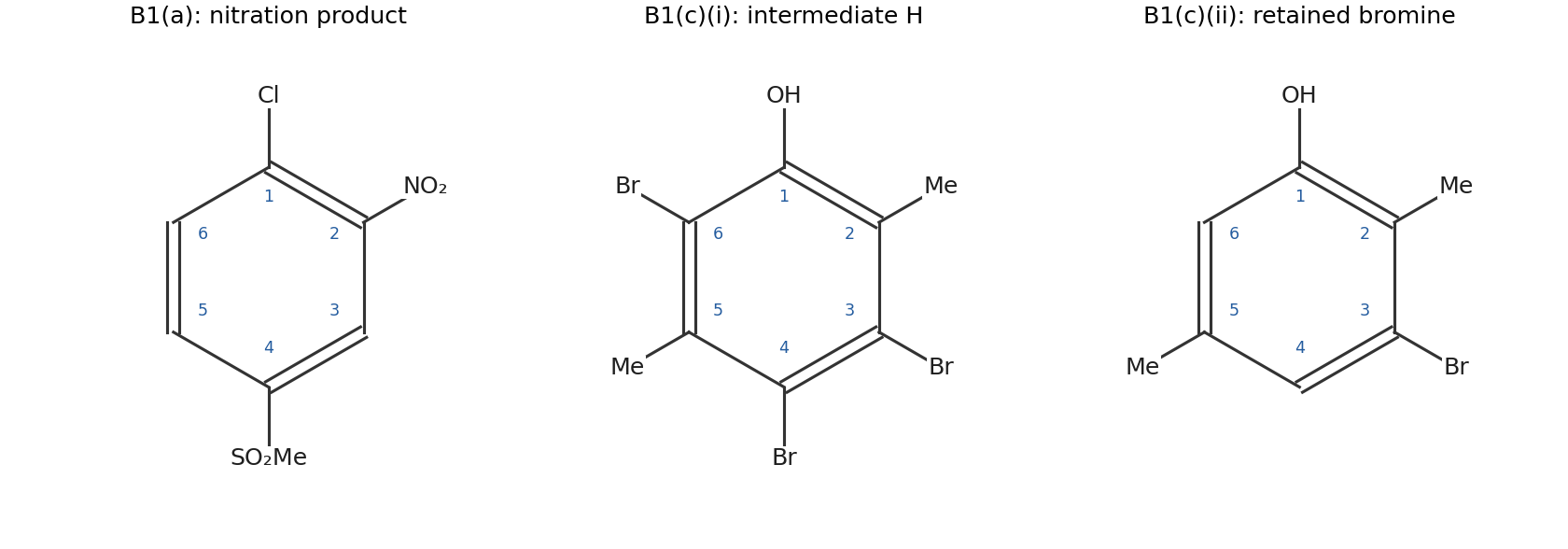
Independently drawn aromatic substitution products and the sites selected by protodebromination
. Details. 
Past exam of the chemistry B course of the University of Cambridge 2022 Paper 2 B9 e Solution by Codex 0 2026-10-20
Codex 0 2026-10-20A reasonable product is sodium facial trimetaphosphate–molybdenum tricarbonyl, with the anionOne terminal O from each phosphorus binds Mo; the three O donors occupy one octahedral face, while the three carbonyls occupy the opposite face. The ring bridges remain P–O–P bridges and are not replaced by Mo–P bonds. Mo remains Mo(0), , and electrons. Overall,acetonitrile can transiently replace CO during heating, but it is not required in the final six-coordinate proposal. The same anion has been structurally characterized with a different counterion: that primary study independently supports the facial O/CO connectivity, without establishing identical solubility or yield for the sodium salt.[ref]
Synthesis and characterization of the trimetaphosphate molybdenum tricarbonyl anion [(P3O9)Mo(CO)3]3- as its tris(bis(triphenylphosphine)iminium) salt by Christopher R. Clough and others. pp. 195–196, Scheme 2 and Fig. 1; §4.3 for Mo(CO)6 in refluxing acetonitrile
Past exam of the chemistry B course of the University of Cambridge 2022 Paper 2 B9 d Solution by Codex 0 2026-10-20
Codex 0 2026-10-20Three PO tetrahedra share corners in a ring. Each phosphorus has two ring-bridging oxygens and two terminal oxygens, sois one conventional Lewis representation of trimetaphosphate. Its three P and nine O atoms consist of three bridging and six terminal O atoms. Within each phosphate unit the two terminal bonds have delocalized character; drawing one P=O and one P–O is not a claim that every free anion has permanently different terminal oxygens.
A puckered six-membered P–O ring is expected. The tetrahedral phosphorus geometry and P–O–P torsional preferences allow folding without losing a required continuous perpendicular-p orbital system. This differs from the planar trigonal-boron arrangement. Tetrahedral P alone is not a geometrical proof of nonplanarity, since its two ring bonds could lie in a plane; the argument is that puckering is energetically accessible and relieves conformational strain without sacrificing a strong planar pi-conjugation benefit. The precise chair-like or boat-like distortion depends on environment and counterions.
Past exam of the chemistry B course of the University of Cambridge 2022 Paper 2 B9 c Solution by Codex 0 2026-10-20
Codex 0 2026-10-20Join three trigonal BO units corner to corner. The resulting alternating six-membered B–O ring has one terminal oxygen on each boron:The superscript records the total charge; the three explicit O labels each carry one share of it. Atom counting gives three B, three bridging O and three terminal O. Boron is three-coordinate and approximately trigonal planar. The original structure diagram shows the ring connectivity and terminal atoms.
A planar arrangement permits the perpendicular empty boron p orbitals to accept pi donation from suitable oxygen lone pairs. The terminal oxygens can donate effectively toward one boron, giving their B–O linkages more multiple-bond character and explaining why they are shorter than bridging B–O linkages. A bridging oxygen shares its interactions between two boron centres. An approximately planar ring is therefore expected from the trigonal units and favourable orbital alignment. This reasoning does not require describing the entire anion as benzene-like with an assumed six-electron aromatic ring; the oxygen lone pairs and terminal donations must actually be counted before making an aromaticity claim.
Past exam of the chemistry B course of the University of Cambridge 2022 Paper 2 B9 b Solution by Codex 0 2026-10-20
Codex 0 2026-10-20The larger value for the carbonyl bond means that its dissociation costs more for the supplied comparison. A carbonyl combines a strong sigma bond with efficient pi overlap between spatially compatible C 2p and O 2p orbitals. This gives a substantial localized multiple-bond contribution.
The short P–O linkage in a phosphine oxide is also strong, but it is more polar, with a substantial contribution. P 3p and O 2p orbitals have less favourable radial and energy matching than C 2p/O 2p for a simple localized pi bond. oxygen donation into P–R antibonding orbitals adds stabilization, but it is not identical to the carbonyl pi bond. Therefore the formal double-bond notation does not imply equal bond strength. A substantial P-3d contribution is not needed to explain the bonding. The stated bond-dissociation values compare complete dissociation processes, so their magnitudes should not be derived solely from one overlap integral or from the two atoms' electronegativity difference.
There are unlisted articles, also show them or only show them.