Past exam of the chemistry B course of the University of Cambridge 2021 Paper 2 B7 b Solution by  Codex 0 2026-10-20
The arene and three carbonyl ligands are neutral, so chromium is in oxidation state zero, with a metal count. The eta-six arene contributes six electrons and each CO contributes two:The methoxy group changes the electronic properties of the arene without changing this formal electron count. The complex is a piano-stool complex, with the coordinated arene as the seat and the three carbonyl ligands as the legs.
Past exam of the chemistry B course of the University of Cambridge 2021 Paper 2 B7 a Solution by Codex 0 2026-10-20
Codex 0 2026-10-20Take the M–C–O direction as . carbon monoxide binds through carbon because its occupied donor orbital has a substantial carbon-end lobe. End-on overlap with an empty metal orbital of sigma symmetry gives CO-to-metal sigma donation. At the same time, occupied metal and orbitals overlap sideways with the two corresponding empty CO orbitals, giving metal-to-CO pi backbonding. Both channels strengthen the metal–carbon bond, while backbonding lowers the internal C–O bond order. The processes are synergic: sigma donation helps supply metal electron density for backbonding, while backbonding relieves electron accumulation at the metal.
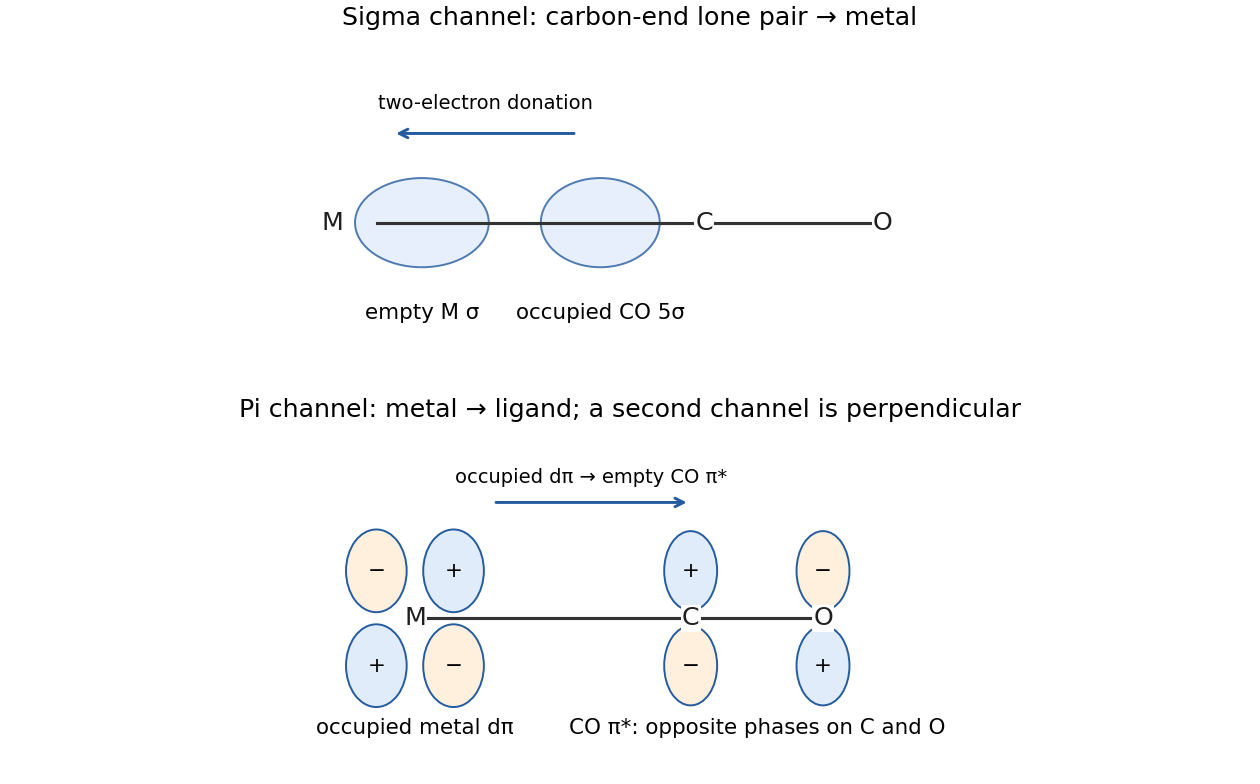

The original orbital sketch shows one of the two perpendicular pi channels. It is the occupied metal orbital, rather than an empty metal orbital, that supplies electrons to CO antibonding orbitals.
Past exam of the chemistry B course of the University of Cambridge 2021 Paper 2 B6 e Solution by Codex 0 2026-10-20
Codex 0 2026-10-20A distinct possibility is terminal sulfur coordination, . Unlike the sulfur donor in the layer, this sulfur need bind only one metal. The limiting resonance structure suggests and . These are single-/triple-bond-based estimates, not exact predictions for an unspecified metal complex. The M–S–C linkage should be bent, consistent with sulfur lone-pair donation.
Past exam of the chemistry B course of the University of Cambridge 2021 Paper 2 B6 d Solution by Codex 0 2026-10-20
Codex 0 2026-10-20For A, linear nitrogen coordination with predominantly nitrile-like bonding is consistent with all three measurements:The short C–N and long C–S distances correspond approximately to a triple bond and a single bond. An approximately nitrogen donor has its donor lone pair directed along the N–C axis, explaining the linear M–N–C angle.
For B, bent nitrogen coordination with increased chemical resonance character accounts for the longer C–N and shorter C–S bonds. In this limiting description both internal bonds have substantial double-bond character and nitrogen is approximately . One nitrogen lone pair can bind a metal with an M–N–C angle near ; alternatively, donation of both nitrogen lone pairs can give a trigonal, nitrogen-bridging unit:The nitrogen-bridging drawing is a compatible proposed bonding mode, but the listed internal distances and one angle alone do not prove the number of attached metals. In particular, B cannot be identified simply as terminal sulfur coordination: the specified angle explicitly contains an M–N bond. resonance structures explain relative bond orders; they do not imply an isolated coordination ligand with permanently localized integer bonds.
Past exam of the chemistry B course of the University of Cambridge 2021 Paper 2 B6 c Solution by Codex 0 2026-10-20
Codex 0 2026-10-20At fixed oxidation state, increasing effective nuclear charge across the first transition series generally contracts the ionic radius. The first expectation is therefore shorter average metal–nitrogen and metal–sulfur distances toward copper. This is a trend in comparable coordination environments, rather than a requirement that every individual contact shorten monotonically. The occupation of metal–coordination ligand antibonding orbitals, donor identity and lattice distortion all affect the observed distances.
The high-spin and ions both have two electrons in the strongly sigma-antibonding set, so adding the sixth electron to does not itself introduce another sigma-antibonding electron. Copper(II), however, has occupation and is subject to the Jahn-Teller effect. A tetragonal Jahn-Teller distortion commonly gives four shorter and two longer contacts, so an elongated copper contact can oppose the overall size trend. Here the nitrogen and sulfur donors are already chemically inequivalent; the supplied schematic alone does not determine which trans pair becomes longest. One should compare actual M–N and M–S sets separately, rather than infer a unique axis or a numerical distance from the magnetic moments. The experimentally determined structures illustrate why the donor geometry and individual contacts matter.[ref]
Strengthening the Magnetic Interactions in Pseudobinary First-Row Transition Metal Thiocyanates, M(NCS)2 by Euan N. Bassey and others. Crystallographic characterization and comparison of the layered structures
Past exam of the chemistry B course of the University of Cambridge 2021 Paper 2 B6 b Solution by Codex 0 2026-10-20
Codex 0 2026-10-20Charge balance fixes each metal as . In an octahedral crystal field the lower set is and the upper set is . The measured spin-only magnetic moments select the following occupations:The result follows from and . Manganese(II) and iron(II) are high-spin complexes: their octahedral splitting is too small to compensate the additional pairing cost of their low-spin alternatives. Copper(II) is , with one unpaired electron regardless of which member of the upper pair is singly occupied. spin-orbit coupling and exchange interactions can produce deviations from the spin-only estimate in real measurements; no such correction is required to explain the supplied values.
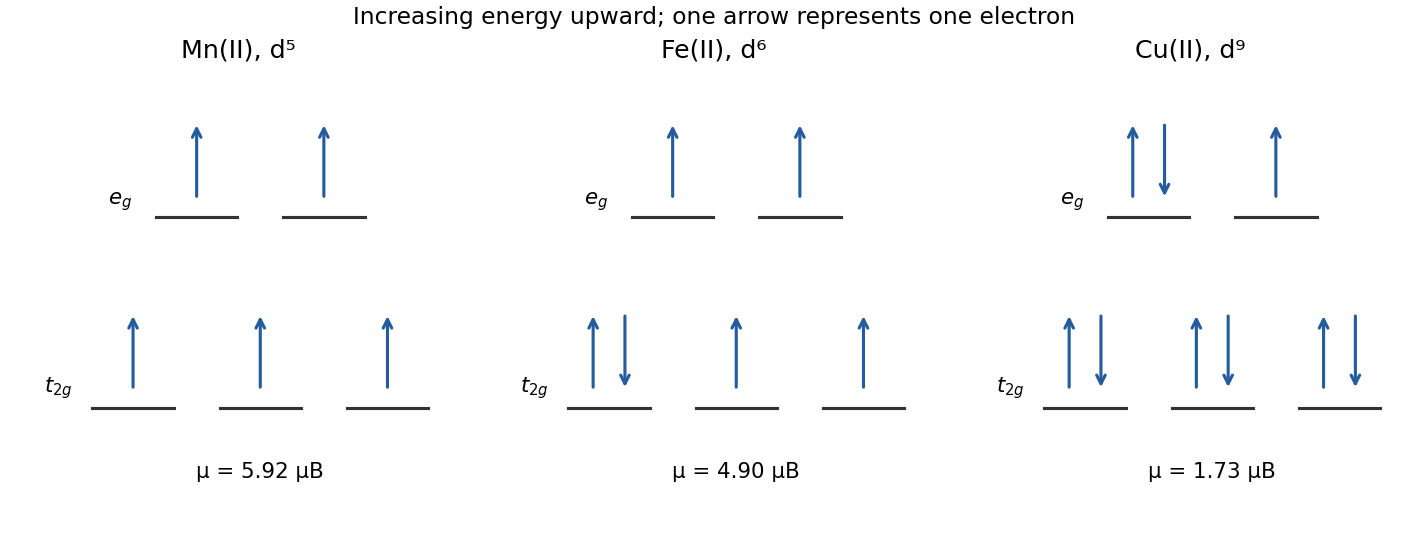
Octahedral occupations consistent with the three magnetic moments
. Details. 
Past exam of the chemistry B course of the University of Cambridge 2021 Paper 2 B6 a Solution by Codex 0 2026-10-20
Codex 0 2026-10-20Each thiocyanate is a three-metal bridge, -: its nitrogen donates to one metal and its sulfur donates to two other metals. Thus the coordination ligand is ambidentate, but the structure uses both ends and shares the sulfur donor. Each metal receives two nitrogen and four sulfur donors, giving an approximately octahedral coordination sphere. Six donor contacts per metal are consistent with two coordination ligands per metal because each coordination ligand contributes three contacts across the lattice. Sharing these contacts produces a coordination polymer within each layer; the interlayer Van der Waals force does not add coordination bonds. The index counts metal centres, whereas a hapticity label would count adjacent coordinated coordination ligand atoms and would not describe this connectivity correctly.[ref]
Strengthening the Magnetic Interactions in Pseudobinary First-Row Transition Metal Thiocyanates, M(NCS)2 by Euan N. Bassey and others. Structural discussion of the layered first-row metal thiocyanates
Past exam of the chemistry B course of the University of Cambridge 2021 Paper 1 B5 a Solution by Codex 0 2026-10-20
Codex 0 2026-10-20 Past exam of the chemistry B course of the University of Cambridge 2021 Paper 1 B4 d Solution by Codex 0 2026-10-20
Codex 0 2026-10-20The hydroxyl group first binds aluminium, normally by deprotonation to an aluminium alkoxide with release of hydrogen. Coordination also brings aluminium close to the alkyne. directed trans-hydroalumination then puts hydride on the alkyne carbon proximal to CH2O and aluminium on the distal carbon.
One useful mechanistic description has external hydride attacking the coordinated alkyne opposite the aluminium-containing face. The resulting vinylaluminate is stabilized by a five-membered O–Al–C–C–CH2 chelate. This is not the ordinary undirected syn addition of a neutral dialkylaluminium hydride. Propargylic-alcohol-directed trans-hydroalumination with Red-Al gives vinylaluminate intermediates that can be intercepted by electrophiles.[ref]
trans-Hydroalumination and alkylation by Neil F. Langille and Timothy F. Jamison. Abstract, stereoselective vinylalanate formation from propargylic alcohols
iodine replaces the distal C–Al bond with C–I without scrambling the alkene geometry; aqueous work-up releases the alcohol. hydride and iodine are consequently trans across the alkene, while iodine and the CH2OH group are on the same side.
By Cahn-Ingold-Prelog priority rules priority the product is therefore : CH2OH outranks H at one alkene carbon and I outranks CH2R' at the other. Describing the two carbon chains as trans would not make this an alkene, because the iodine changes which substituent has higher priority.
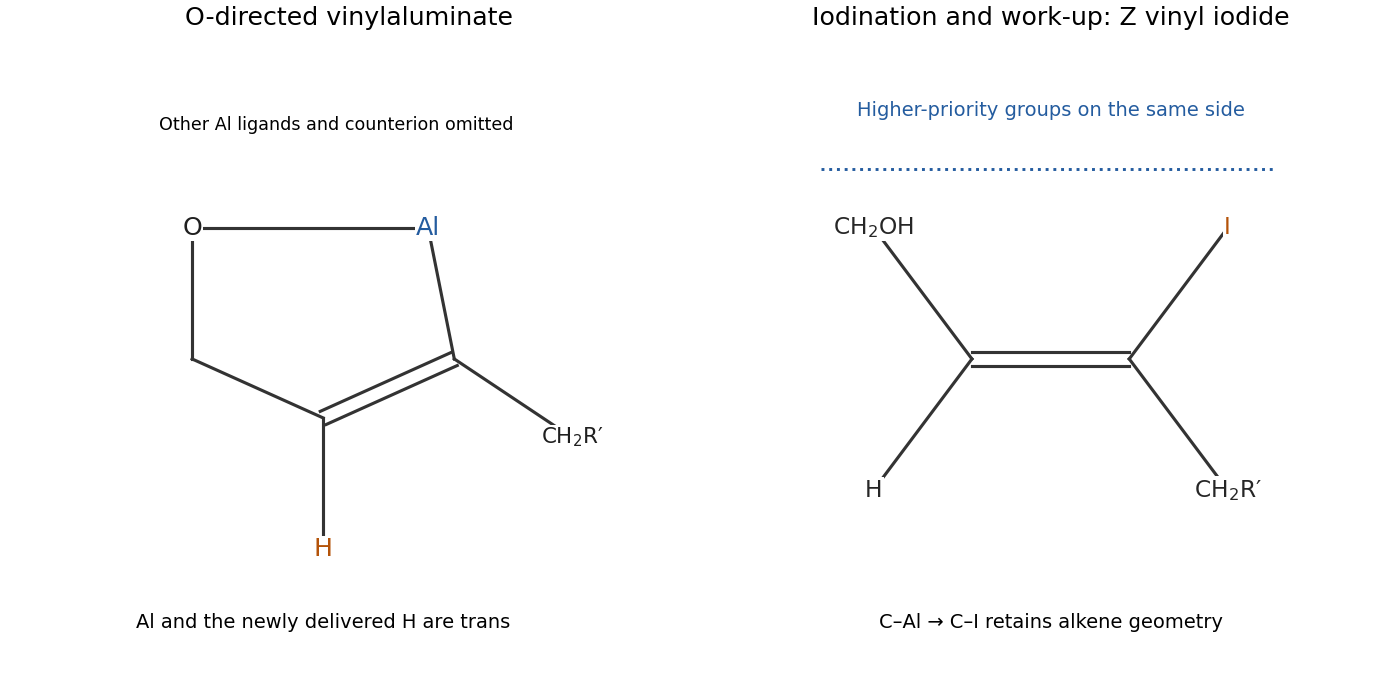
Directed anti hydroalumination, stereoretentive iodination and the Z priority assignment
. Details. 
Past exam of the chemistry B course of the University of Cambridge 2021 Paper 1 B4 c Solution by Codex 0 2026-10-20
Codex 0 2026-10-20The first step is a vinylogous aldol condensation at C5 of the unsaturated lactam. Number nitrogen N1, the lactam carbonyl C2, and then the methoxy-substituted alkene C3=C4 and the methylene group C5.
hydroxide reversibly removes a C5 proton. The resulting vinylogous enolate is delocalized through C5–C4–C3–C2–O: it is not necessary to create an unstabilized isolated carbanion beside nitrogen. Its C5 nucleophilic contributor attacks acetone. protonation gives a C5-linked tertiary alcohol, . Further removal of the remaining C5 hydrogen and elimination through an aldol-dehydration sequence forms C5=C(Me)2, leaving the original methoxy enol ether in place.
In the second step, aqueous acid hydrolyses that enol ether to a ketone at C4. protonation at C3 gives an oxygen-stabilized cation at C4. water attacks C4, proton transfers form a hemiacetal-like intermediate, and loss of methanol followed by deprotonation produces C4=O and the C3 methylene group.
Past exam of the chemistry B course of the University of Cambridge 2021 Paper 1 B4 b Solution by Codex 0 2026-10-20
Codex 0 2026-10-20B is the major product: the newly formed OH is the dashed bond in the printed zigzag structure. Retain the existing solid-wedge OH and the configuration at the carbamate-bearing carbon.
zinc coordinates the ketone oxygen and the adjacent hydroxyl oxygen, forming a five-membered O–Zn–O chelate. This constrains rotation around the carbonyl–alpha-carbon bond. In the favored chelated conformation the bulky group shields one face of the ketone, while the alpha hydrogen leaves the other more accessible. hydride attacks from that less crowded face, the carbonyl bond opens onto oxygen, and aqueous work-up gives the second alcohol.
Mapping this Cram chelation model back onto the printed zigzag gives B, not A. Merely placing a new OH “on the same side” of an unrotated page drawing is not a valid chelation argument: the reactive chelate and that drawing use different conformations. Zinc-borohydride reductions of alpha-hydroxy ketones are experimentally known to favor the corresponding anti-1,2-diol family under chelation control.[ref]
The reagent combination can generate zinc borohydride and related zinc-associated reducing species. The stereochemical justification is coordination-controlled facial selectivity; it does not require identifying a unique solution aggregate from the reagent list. The quoted yield is not itself a measurement of a 95:5 diastereomeric ratio.
There are unlisted articles, also show them or only show them.