Past exam of the chemistry B course of the University of Cambridge 2022 Paper 2 B8 b Solution by  Codex 0 2026-10-20
Use ionic electron counting, counting each ordinary donor atom once and keeping ligand charge distinct from denticity. A is 16-electron, B is 14-electron and C is 16-electron, so none is an 18-electron complex under this convention.
A contains a modified, monoanionic PNP pincer: the exocyclic double bond and altered pyridine-ring bond pattern in the drawing matter. Its two phosphines and its central N donor provide six electrons altogether, while neutral N provides two. Neutrality then gives Co(I), , and . Treating the modified pincer as a neutral intact pyridine ligand would incorrectly produce Co(0) and a 17-electron count. A four-coordinate approximately square planar molecular geometry in a complex can leave the strongly sigma-antibonding orbital empty and be stable at 16 electrons. The underlying modified-pincer chemistry has been examined using structure, spectroscopy and electronic-structure calculations.[ref]
Four-Coordinate Cobalt Pincer Complexes: Electronic Structure Studies and Ligand Modification by Homolytic and Heterolytic Pathways by Scott P. Semproni and others. JACS 136, 9211–9224; modified PNP framework and dinitrogen derivative
B has a neutral tertiary amine donor at the centre of its tripod and three anionic amido arms. Their combined charge is , so Re is Re(III), . The four N donors give eight electrons and N gives two: . Such an electron count is not inherently unexpected in an amido-supported complex: strong amido pi donation and the imposed five-coordinate geometry alter the orbital energies, and the empty orbitals are not nine equivalent slots that must all be filled. Steric protection and chelation also help stabilize this coordinatively restricted structure. The 14-electron figure uses the usual two-electron ionic count for each amido donor; pi bonding should not be appended to it inconsistently.
C has an anionic acyl carbon donor and a neutral phosphine in the chelate, together with two neutral PMe donors. Thus Co(I), , receives ligand electrons, giving . This is again a reasonable four-coordinate structure. The acyl C=O is part of a carbon-bound acyl ligand, not an additional free CO donor.
Past exam of the chemistry B course of the University of Cambridge 2022 Paper 2 B7 d Solution by Codex 0 2026-10-20
Codex 0 2026-10-20The anionic nitrogen donor replaces iodide to giveHere Cp denotes cyclopentadienyl and specifies attachment through the ring nitrogen of the pyrrolyl anion, . Fe(II), , receives six electrons from Cp, four from the two CO ligands and two from an N-bound pyrrolyl ligand: .
Two coupled CO stretching modes, approximately symmetric and antisymmetric combinations, account for the two strong carbonyl-region absorptions. The bent two-CO arrangement of this piano-stool complex permits both combinations to be infrared active. They are not evidence for two different chemical products.
Heating expels two CO molecules and changes the binding of the pyrrolyl ligand from to , giving the sandwich azaferrocene,The four electrons lost with CO are replaced by the four additional electrons donated on changing the hapticity of the pyrrolyl ligand. Thus is also Fe(II), , and 18-electron: . Each complex has one time-averaged Cp proton environment, two pairs of protons from the pyrrolyl ligand, one adjacent to N and one farther from N. Hence three proton environments, with integrals , fit both structures. For proton nuclear magnetic resonance, three signals means three chemical shift environments; the individual resonances can still show coupling.
Past exam of the chemistry B course of the University of Cambridge 2022 Paper 2 B7 c Solution by Codex 0 2026-10-20
Codex 0 2026-10-20Oxidizing cobaltocene removes its antibonding nineteenth electron and gives the particularly favourable 18-electron cobaltocenium cation. iodine can accept the electrons, giving cobaltocenium iodide at the simple stoichiometryEach cobalt changes from Co(II), , to Co(III), ; each iodine atom changes from 0 to . Excess iodine can change the isolated counterion to a polyiodide such as . In contrast, oxidation of 18-electron ferrocene would remove an electron from its occupied closed-shell manifold to form 17-electron ferrocenium. iodine is insufficient to drive that reaction under the conditions implicit here. ferrocene can still be oxidized by suitable stronger oxidants; an electron count is a useful rationale for the comparative redox behaviour, not a universal proof of a numerical electrode potential.
Past exam of the chemistry B course of the University of Cambridge 2022 Paper 2 B7 b Solution by Codex 0 2026-10-20
Codex 0 2026-10-20In ionic counting, two cyclopentadienyl anions donate electrons. Therefore ferrocene, cobaltocene and nickelocene contain 18, 19 and 20 valence electrons, respectively: Fe(II) is , Co(II) and Ni(II) . ferrocene fills the bonding and approximately nonbonding levels while leaving the next metal–ring antibonding pair empty. cobaltocene and nickelocene add one and two electrons to that antibonding set.
Increasing antibonding occupation lowers the net metal–ring bond order. It therefore explains the simultaneous increase in M–C distance and decrease in dissociation enthalpy from Fe to Co to Ni. The trend does not follow the shrinking size of the isolated metal ions; the orbital occupation is decisive here. The specified enthalpy separates the entire sandwich into a gaseous metal dication and two gaseous ring anions. It measures that complete ionic dissociation process, not ten independent localized M–C bond energies, so dividing it by ten is not a justified bond-energy determination.
Past exam of the chemistry B course of the University of Cambridge 2022 Paper 2 B6 c Solution by Codex 0 2026-10-20
Codex 0 2026-10-20Four equivalents of base remove the four carboxylic-acid protons from two ligand molecules, giving two dianionic pyridine-2,5-dicarboxylate linkers per Pt/Mn pair. The ring nitrogen and neighbouring 2-carboxylate supply a five-membered N,O chelate. A consistent chain has Pt(II), NO, with square planar molecular geometry, and Mn(II), O, with octahedral molecular geometry.
At each Pt, two ligands bind through their ring N and one O of the adjacent 2-carboxylate; their remote 5-carboxylates point toward successive Mn sites. At each Mn, a remote carboxylate from each of two neighbouring Pt-containing units binds through both O atoms. Two coordinated water molecules complete Mn's six-coordinate sphere. The repeating connectivity, with each bracket denoting a single organic linker, isEach Pt has a second N,O chelate extending in the opposite chain direction; each Mn similarly receives two carboxylate chelates. The original donor-connectivity diagram makes those counts explicit.
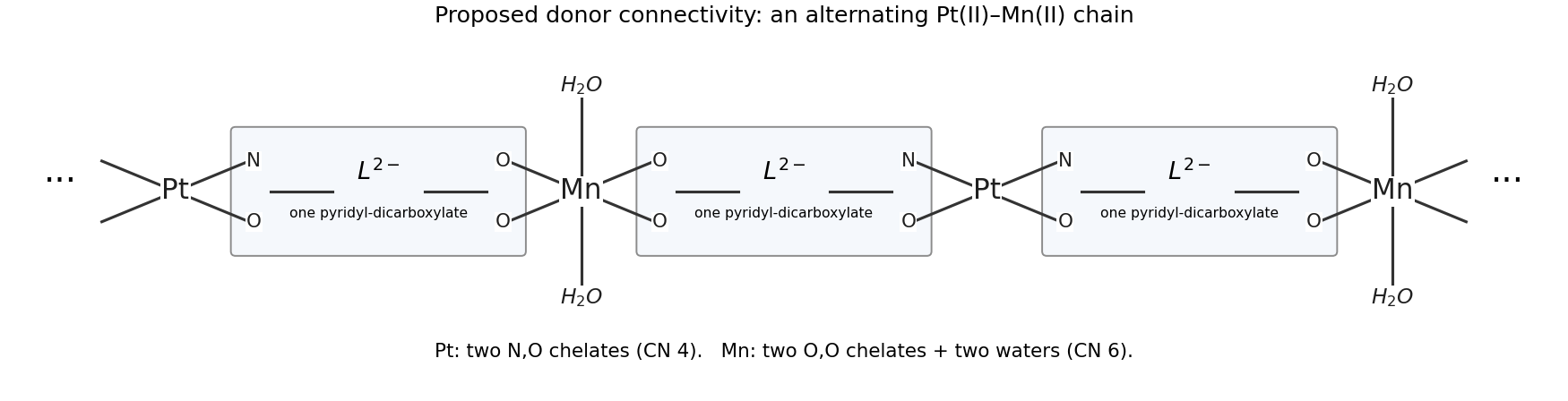

Pt(II) is and strongly favours square planar molecular geometry. Its affinity for the pyridyl N donor and the chelate effect select the mixed N,O pocket. Mn(II) is high-spin , is harder, and favours the carboxylate and water O donors; six-coordinate octahedral molecular geometry is natural in water. Charge balance per repeat is . A suitable repeat formulation is . This is a justified proposed coordination chain, not a unique crystal structure established from stoichiometry alone; water content, carboxylate bridging modes and actual porosity require structural characterization.
Past exam of the chemistry B course of the University of Cambridge 2022 Paper 2 B6 a Solution by Codex 0 2026-10-20
Codex 0 2026-10-20Six inward-directed donor orbitals form symmetry-adapted linear combinations of symmetry. They mix respectively with metal , and orbitals. Thus the sigma framework contains six occupied bonding molecular orbitals and six corresponding antibonding molecular orbitals. The metal orbitals have no sigma-compatible partner and remain nonbonding orbitals in this model. The important metal-dominated octahedral splitting isThe orbitals point directly toward the donors; the orbitals point between them. The original diagram shows the entire sigma framework, rather than treating the five metal d levels as the whole molecular-orbital diagram.
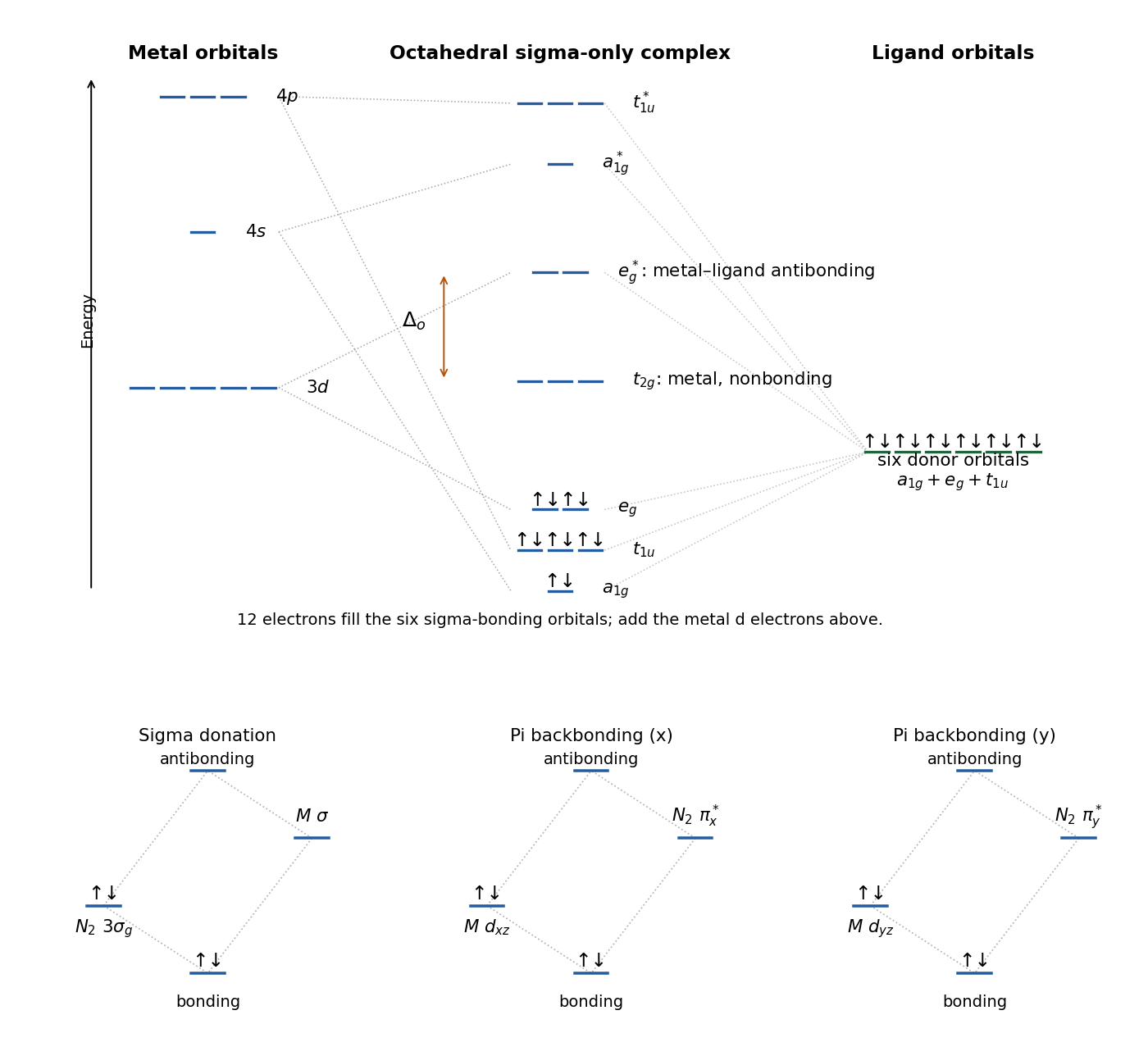
Sigma-only octahedral orbitals and the donation/backbonding channels of end-on dinitrogen
. Details. 
For the same donor set and approximately the same geometry, . The higher metal charge usually shortens the metal–donor distances and strengthens the interaction that raises . This comparison holds other chemical variables fixed: changing the ligand at the same time could reverse a comparison between two unrelated complexes.
There are unlisted articles, also show them or only show them.