Past exam of the advanced quantum physics course of the University of Cambridge 2015 Paper 1 4 Solution by  Codex 0 2026-10-20
Insert the interaction-picture expansion into the Schrödinger equation. The phases multiplying the basis states already solve the unperturbed evolution, leavingHermiticity requires , not unless the coupling is real. Since the diagonal matrix elements vanish and , expanding the cosine givesThe conjugate pair of couplings conserves . Near resonance, the difference frequency is slow while the sum frequency is approximately . Rapid terms alternate sign before an appreciable slow transfer accumulates. The rotating-wave approximation retains the slow terms when ; resonance alone is insufficient for a strong drive. Counter-rotating corrections include small shifts of the resonance and need not remain negligible at arbitrary strength or arbitrarily long times.
For the spin preparation, use and . Choose and to fix helicity, with , and . The initial is the lower state. For negative , reverse the RF rotation sense; pulse areas use , and signed Larmor precession determines the corresponding phase adjustment.
A circularly rotating magnetic drive uses two transverse fields in quadrature during :With , their interaction Hamiltonian is exactly constant,The minus sign in the second RF component selects co-rotation for the specified positive gyromagnetic ratio. Exponentiating this Pauli matrix givesThe laboratory phase of a resonant spin pulse includes free precession. Returning to the laboratory frame and removing a common phase,Unlike a linearly polarized RF field, this exactly co-rotating field has no counter-rotating component. A single linearly polarized field gives the same slow rotation in the weak-drive rotating-wave approximation with . For the circular field above, . Keeping these amplitude conventions distinct avoids a factor-of-two pulse-duration error.
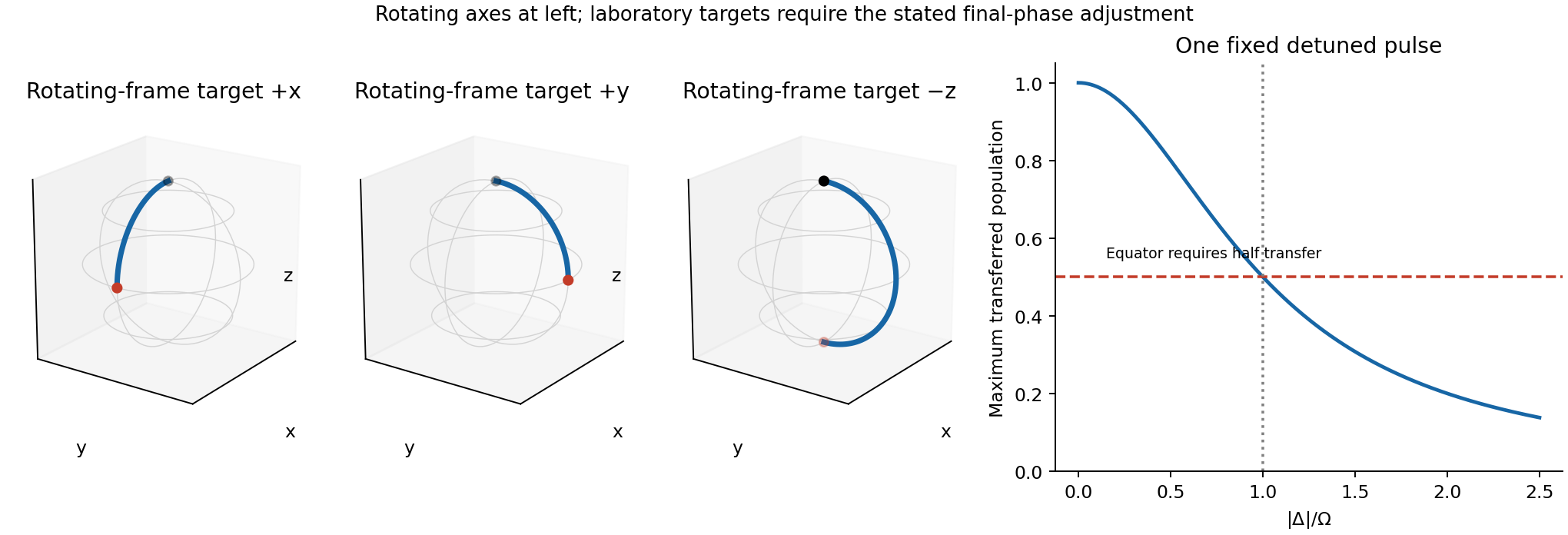

For a single harmonic pulse detuned by , the effective rotating-frame field tilts out of the transverse plane. Its rotation rate becomes , and its maximum population transfer is . Exact inversion to is impossible with one fixed nonzero-detuning pulse. Half transfer, needed for a transverse eigenstate, gives the equatorial reachability of a detuned spin pulse criterion . With that condition, changing the duration and RF phase can still prepare or at the chosen laboratory stopping time. The mere statement does not ensure this condition, because the drive can be much weaker than either frequency. If , neither transverse target is reached by that single pulse. These restrictions concern fixed-frequency, fixed-amplitude single-pulse control; retuning, chirping or phase-controlled composite pulses change the available controls and can remove the restriction. No dissipative spin relaxation is included in this coherent two-state model.
Past exam of the advanced quantum physics course of the University of Cambridge 2015 Paper 1 3 Solution by Codex 0 2026-10-20
Codex 0 2026-10-20Introduce a bookkeeping parameter in and expand and . Fix phase and normalization at this order by . The first-order Schrödinger equation isangular momentum projection onto gives . angular momentum projection onto a different eigenstate givesCompleteness therefore yields the first-order nondegenerate perturbation theory resultNonzero energy denominators are essential. The displayed state has unit norm through first order; exact normalization would change terms of second order. A continuum, if present, contributes its corresponding integral as well as any discrete sum.
For the oscillator in a static electric field, electrostatic potential energy is and . parity gives , and the supplied Gaussian wavefunctions giveSince , the two-state first-order ground state isThus , and the induced electric dipole isIt is aligned with the field for either sign of . The harmonic-oscillator electric polarizability is . The position operator connects only to , so the requested two-state calculation contains the complete first-order dipole response, rather than dropping other first-order terms.
Complete the square to find the exact electric-field displacement of a quantum harmonic oscillator:The exact normalized ground wavefunction is , with energy . Its mean displacement is , soThe first-order dipole equals the exact dipole, because the restoring force is exactly linear and translating a harmonic well does not change its width or frequency. This agreement of one expectation value does not make the truncated wavefunction exact. The Hellmann–Feynman theorem provides an independent check: .
For perturbation theory to approximate the state, , or . The exact translated ground state has the original-oscillator expansionIt is a coherent state with mean occupation . Large fields require many oscillator levels, whereas the first-order state retains only two. The normalized two-state truncation of a displaced oscillator instead giveswhich incorrectly tends towards zero for large instead of following the displaced well. In position space the truncated polynomial times Gaussian also develops a node absent from the exact ground state. Taking a linearized formula outside its small-state-correction regime is therefore invalid even though its dipole coefficient happens to be exact.
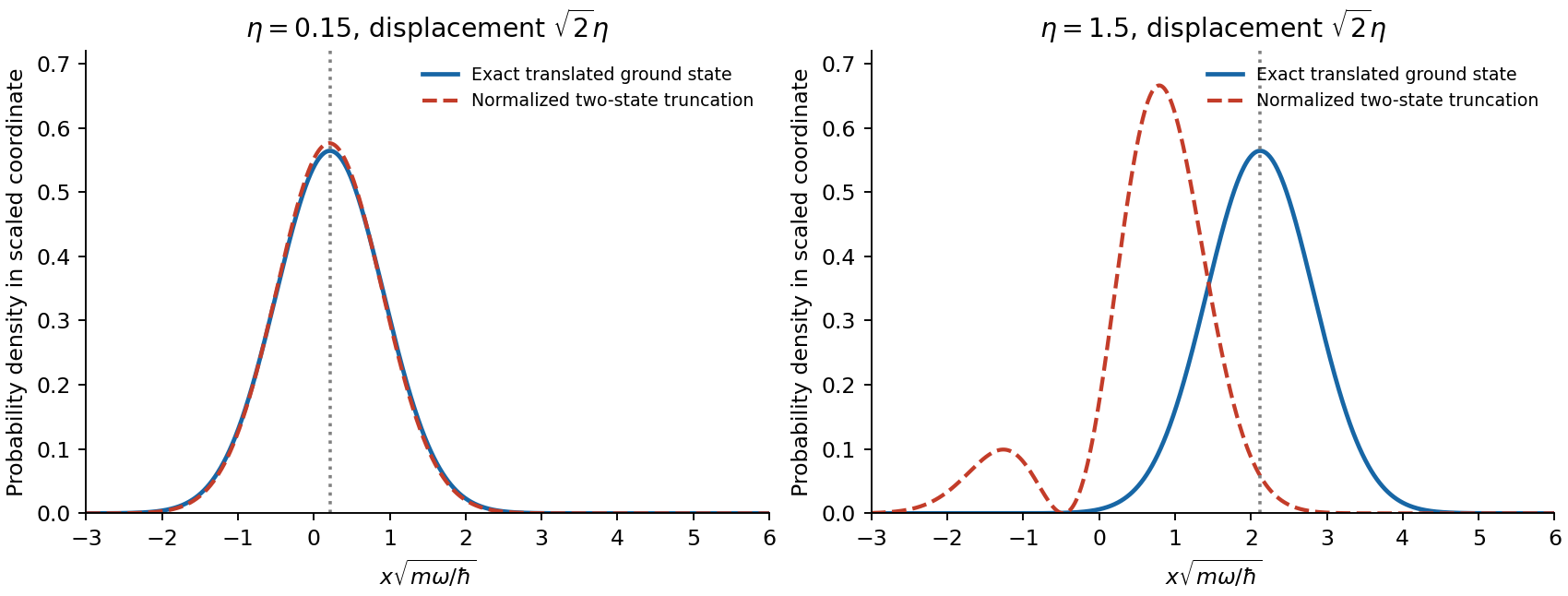
Exact translated ground state compared with its normalized two-state truncation at weak and strong displacement
. Details. 
Past exam of the advanced quantum physics course of the University of Cambridge 2014 Paper 1 4 Solution by Codex 0 2026-10-20
Codex 0 2026-10-20The quoted expansion is nondegenerate perturbation theory for a known isolated eigenstate of a time-independent Hamiltonian. A useful small-mixing condition is for coupled states. First order is a diagonal expectation value; second order describes virtual mixing. A degenerate or nearly degenerate coupled subspace must first be treated by diagonalization there. Symmetry can eliminate terms, and convergence still needs checking. Ground-state second-order shifts are nonpositive because all denominators are negative.[ref]
Quantum Mechanics by Richard Fitzpatrick. Non-degenerate perturbation theory and its breakdown at coupled degeneracies
For the rotational Stark effect, , where is the polar angle to the field. The source calls it azimuthal, which is inconsistent with this coupling. Rotor states have parity , while is odd, so every first-order matrix element within one fixed- manifold vanishes. The degeneracy therefore causes no first-order splitting.
Only with the same contribute in second order. Using their energy differences and ,For this simplifies to the quadratic Stark shift of a polar linear rotor,For , only contributes, with squared angular matrix element and denominator :Here is the rotational energy constant, unlike the magnetic field in Question3.
The unperturbed line gives . The shifts are for and for . Subtracting the common lower-state shift gives transition shifts and . Their separation determines the dipole moment from a rotational Stark doublet:The unit is the debye. Using external and gives , consistent with weak-field perturbation theory. The two shifted frequencies are about and ; polarization selects or . The inferred value is a magnitude; these shifts do not determine the dipole's sign.[ref]
CODATA recommended values of the fundamental physical constants: 2022 by National Institute of Standards and Technology. Exact SI Planck constant
[ref]Triatomic Spectral Database by National Institute of Standards and Technology. Section5: debye conversion
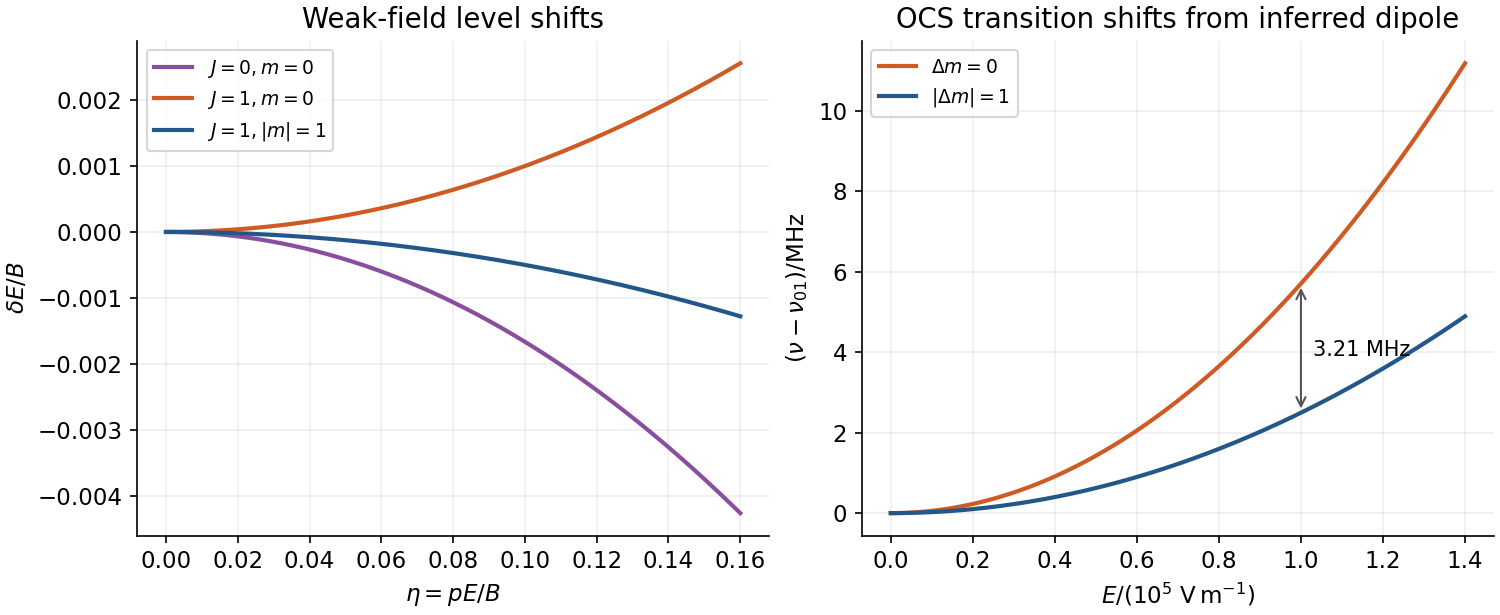
Opposite-parity mixing produces quadratic rotor shifts and a polarization-dependent rotational doublet
. Source. Details. 
Past exam of the advanced quantum physics course of the University of Cambridge 2014 Paper 1 3 Solution (energy sketch) by Codex 0 2026-10-20
Codex 0 2026-10-20The square-root branches avoid one another when ; crossings with a parallel-spin branch are allowed because total spin projections differ. At zero field the positive- sketch has one lower singlet and a triplet above it. The source supplies no numerical moment ratio, so the two panels show explicit illustrative signed choices, including the exactly compensated case.
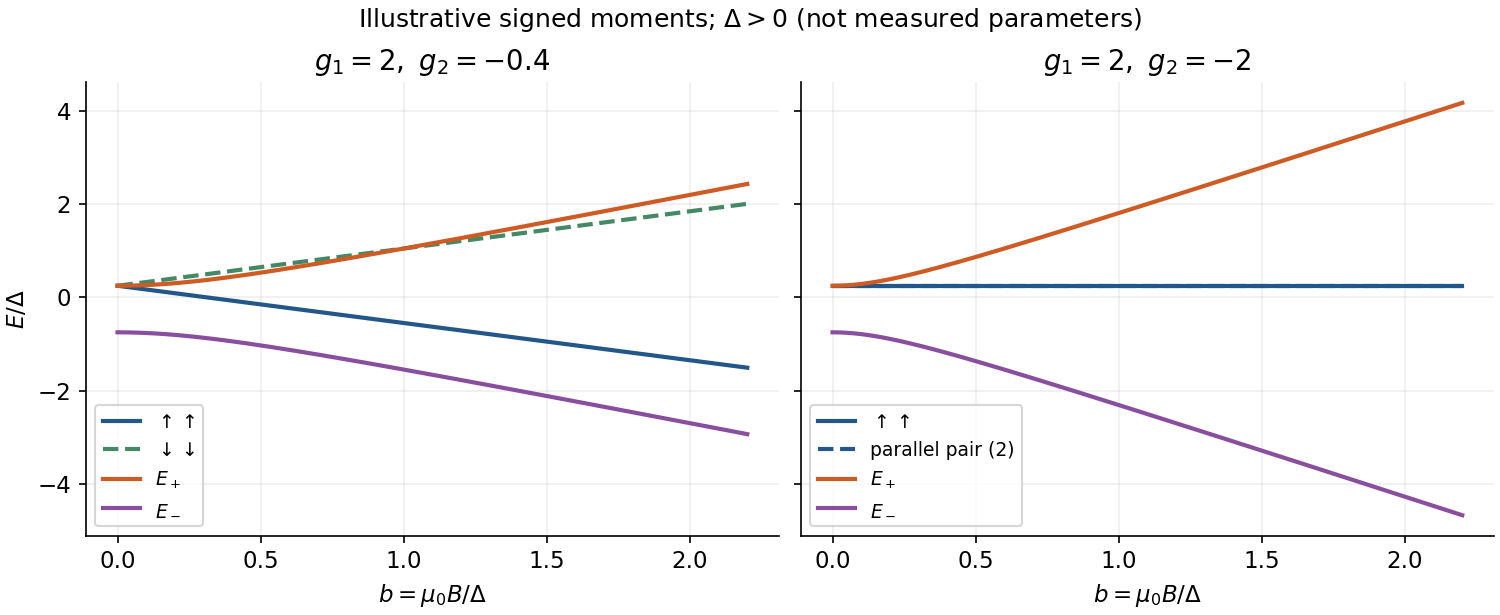
Two-spin exchange and Zeeman energies depend on the signed moment ratio, with an exact parallel-spin degeneracy for opposite equal moments
. Source. Details. 
Past exam of the advanced quantum physics course of the University of Cambridge 2014 Paper 1 3 Solution by Codex 0 2026-10-20
Codex 0 2026-10-20For spin one-half, , henceThey raise or lower the spin projection by one unit of and annihilate the corresponding endpoint. The exchange identity preserves total spin projection.
Write , and . In the listed order , direct action givesThe printed matrix instead uses . Permuting the listed indices to recovers its central block and diagonal entries. This is a basis-order mismatch in the source, not a different Hamiltonian.
The two-spin exchange spectrum with unequal signed magnetic moments isUse the products as the signed magnetic coefficients in the stated Hamiltonian. Opposite physical charges must be represented in those signs; they do not by themselves imply equal moment magnitudes. Here denotes the source's magneton, not vacuum permeability.
There are unlisted articles, also show them or only show them.