Past exam of the biochemistry and Molecular Biology course of the University of Cambridge 2024 Paper 1 Section A 3 Solution by  Codex 0 2026-10-20
Strong lac expression requires relief of lactose-responsive repression together with a favourable glucose-responsive activation state. In Escherichia coli, the lac operon encodes beta-galactosidase, lactose permease and a transacetylase. LacI binds operator DNA and represses transcription; binding of the inducer allolactose shifts its conformation and reduces operator occupancy. Basal expression provides enough permease and beta-galactosidase to import and process some lactose, including formation of allolactose. This explains induction without requiring a completely silent system somehow to manufacture its own detector.
Glucose availability affects positive regulation. When glucose is scarce, the physiological state of the phosphotransferase system favours activation of adenylate cyclase and increased cyclic AMP. Binding of cyclic AMP activates catabolite activator protein, also called CRP, which binds near the lac promoter and helps recruit RNA polymerase. In glucose-rich conditions this activation is reduced. Operator repression and activator-dependent recruitment act at distinct sites, so relief of repression does not guarantee maximum expression. The promoter behaves approximately as a requirement for lactose availability AND glucose scarcity, but its quantitative output is graded rather than a perfect digital gate.
Glucose also regulates inducer entry. During glucose uptake through the phosphotransferase system, the glucose-specific EIIA glucose protein tends to be dephosphorylated. That form can bind and inhibit lactose permease, reducing lactose entry and hence allolactose formation. This inducer exclusion reinforces repression while a preferred substrate is being used. Mutations in the central cytoplasmic loop of the permease that abolish regulation and binding provide a way of separating transport inhibition from promoter regulation.[ref]
Involvement of the central loop of the lactose permease of Escherichia coli in its allosteric regulation by the glucose-specific enzyme IIA of the phosphoenolpyruvate-dependent phosphotransferase system by C. Hoischen and others. Hoischen and colleagues, 1996, abstract and permease-loop mutagenesis results
It is therefore incomplete to attribute every glucose effect to cyclic AMP alone.The four limiting conditions make the integration clear. Without lactose, LacI represses whether glucose is high or low; an active CRP cannot simply substitute for inducer. With lactose and abundant glucose, induction is limited by weak activation and often by inducer exclusion. With lactose and little glucose, repression is relieved and CRP-dependent recruitment is favoured, giving the highest expression. With both sugars initially available, glucose consumption followed by adaptation to lactose can produce diauxic growth; the timing depends on concentrations, transport and culture conditions.
Genetic and physiological controls distinguish the mechanisms. A loss-of-function LacI mutation should remove inducer dependence and can be complemented by a functional repressor supplied in trans. An operator mutation acts primarily in cis, on the linked operon. A superrepressor that cannot respond appropriately to inducer can remain repressive despite lactose. Compare promoter reporters and lactose-uptake measurements separately, because an uptake defect and a transcription defect can give similar growth phenotypes. Adding cyclic AMP tests one activation arm, but cannot necessarily overcome a permease blocked by inducer exclusion. The cell combines a local substrate signal with a global carbon-use signal, acting through both transcription and transport.
Past exam of the biochemistry and Molecular Biology course of the University of Cambridge 2024 Paper 1 Section A 2 Solution by Codex 0 2026-10-20
Codex 0 2026-10-20PCR converts a selected DNA sequence into a detectable and manipulable quantity; different downstream measurements give it different uses. A pair of PCR primers defines the interval amplified by DNA polymerase. Repeated denaturation, annealing and extension produce approximately copies while PCR efficiency remains constant. At ideal efficiency, twenty cycles give about a millionfold amplification; depletion and accumulating products eventually cause a PCR plateau. Specificity derives from both primer-binding sites and their orientation, and should be checked by product size, melting behaviour or sequencing.
One application is genotyping. A disease-associated substitution can be detected by amplifying the surrounding region and reading the sequence, probing with an allele-specific oligonucleotide, or digesting a restriction site changed by the variant. An early demonstration amplified the human beta-globin region for restriction-based diagnosis of sickle cell disease. Amplification increased sensitivity; the restriction pattern supplied the allele information.[ref]
Enzymatic amplification of beta-globin genomic sequences and restriction site analysis for diagnosis of sickle cell anemia by R. K. Saiki and others. Saiki and colleagues, 1985, abstract: amplification followed by restriction-site analysis
A negative disease-specific signal is interpretable only if a control locus amplifies, because poor extraction or an inhibitor can mimic absence of an allele. In forensic DNA profiling, several short tandem repeat loci are amplified and fragment lengths compared. A multilocus match supports identity statistically; it does not eliminate contamination, mixtures, allelic dropout or the need for appropriate population-frequency estimates.For infectious agents, primers can detect a pathogen-specific DNA sequence. An RNA virus first requires reverse transcription, followed by polymerase chain reaction. In RT-qPCR, fluorescence is monitored during amplification, and a threshold cycle is related to starting RNA using calibrated standards and efficiency measurements. This also measures changes in cellular gene expression: compare a target transcript between conditions after suitable normalization. Include extraction controls, a no-template reaction and, for RNA measurements, a no-reverse-transcriptase control to detect genomic DNA contamination. A positive pathogen signal establishes the presence of target nucleic acid, not necessarily a viable organism or infectious virus. Likewise, RNA abundance is not a direct measurement of protein abundance or transcription rate, since RNA degradation also matters.
PCR is also a preparative method. Amplified coding sequences can be assembled into expression vectors; primer tails can add restriction sites, assembly overlaps, sequencing adaptors or an affinity tag. High-fidelity polymerase reduces unwanted substitutions, but the final clone should still be sequenced. Site-directed mutagenesis introduces a specified substitution using mutagenic primers, whereas error-prone PCR creates a library for directed evolution. Sequencing after selection distinguishes the intended change from other mutations. In chromatin immunoprecipitation, quantitative amplification of recovered loci can test enrichment of a DNA-associated protein, with input DNA and immunoprecipitation controls needed to interpret it.
These examples separate presence, identity, quantity and construction. Endpoint band intensity is a poor substitute for quantitative amplification measured before the PCR plateau; multiplex assays can also suffer unequal amplification. The appropriate answer therefore identifies what is amplified, what is measured, and which alternative explanation each control excludes.
Past exam of the biochemistry and Molecular Biology course of the University of Cambridge 2024 Paper 1 Section A 1 Solution by Codex 0 2026-10-20
Codex 0 2026-10-20A guide specifies the target; the attached Cas9 machinery determines whether expression changes through DNA repair or direct transcriptional regulation. In CRISPR genome editing, a guide RNA supplies sequence complementarity to a genomic target adjacent to a suitable protospacer adjacent motif. The commonly used Cas9 from Streptococcus pyogenes recognizes an NGG motif, where N is any base. Recognition involves both that motif and pairing between the guide and target DNA; an arbitrary complementary sequence is therefore insufficient. In mammalian experiments, a nuclear-localized Cas9 and guide can be delivered by expression constructs or as a preassembled ribonucleoprotein. Multiplexing means supplying several guides, rather than engineering a new DNA-binding protein for every target. The original mammalian demonstration combined programmable targeting with endogenous repair to change genomic sequences.[ref]
Multiplex genome engineering using CRISPR/Cas systems by Le Cong and others. Cong and colleagues, 2013, abstract and results on endogenous mammalian targeting
For a loss-of-function experiment, a cut in an early constitutive exon is repaired by non-homologous end joining and related end-joining pathways. Insertions or deletions can change the reading frame, introduce a premature stop, and trigger nonsense-mediated decay. Neither cleavage nor an insertion/deletion automatically proves a gene knockout: repair can preserve the reading frame, alternative splicing can bypass the exon, and a mammalian cell may retain an intact allele. Targeting a promoter or enhancer can instead alter the amount or cell specificity of expression. Two guides can delete a defined regulatory segment, but the resulting junction and possible larger rearrangements need verification. homology-directed repair with a donor can introduce an expression tag, repair a mutation, or replace a regulatory sequence; its efficiency depends on cell state and competing repair pathways. Changing the genomic coding sequence can change protein activity without changing transcript abundance, so these outcomes should be distinguished.
Expression can also be controlled without cleavage. Catalytically inactive dCas9 retains guide-directed binding. Positioning it at an appropriate regulatory region can obstruct transcription; recruiting a repressive domain such as KRAB strengthens CRISPR interference in mammalian cells. Fusing an activation domain, or recruiting several activators, gives CRISPR activation at an endogenous promoter. These approaches preserve the coding sequence and permit graded or inducible perturbation, although chromatin context and guide position strongly affect performance. Mammalian experiments comparing regulatory fusions established that the same targeting platform can repress or activate transcription.[ref]
CRISPR-mediated modular RNA-guided regulation of transcription in eukaryotes by Luke A. Gilbert and others. Gilbert and colleagues, 2013, results on dCas9-based repression and activation in eukaryotic cells
The readout should match the proposed mechanism: sequence the target for editing, measure messenger RNA by RT-qPCR, and measure the protein and its biological activity. Use multiple independent guides, a nontargeting guide, delivery-matched controls, and several independently derived clones or a controlled pooled experiment. Rescue with a guide-resistant functional gene supports causality; overexpression rescue alone can have dosage artefacts. Check relevant predicted off-target effects, assess cell viability, and distinguish direct expression changes from selection of surviving cell states. A nuclease perturbation can itself activate a DNA-damage response. Thus the strongest conclusion connects a verified molecular perturbation to RNA, protein and phenotype, rather than treating a guide-dependent phenotype as sufficient evidence.
Past exam of the atomic and Optical Physics course of the University of Cambridge 2016 Paper 1 3 Solution by Codex 0 2026-10-20
Codex 0 2026-10-20Write , , and take . The Bogoliubov spectrum is gapless and positive for . Its small- and large-momentum limits areThe low-energy excitations are collective sound modes; high-energy excitations approach particles with a mean-field energy offset. With healing length and ,The crossover occurs at of order one, not at an additional energy gap.
The critical velocity of a homogeneous condensate follows because the Landau criterion compares an excitation energy with the energy that flow can release by transferring its momentum. Creating a mode is energetically possible when . For this isotropic spectrum,The infimum is the long-wavelength speed of sound. This tests energetic stability against the stated excitations; it is not a calculation of a dissipation rate or a universal vortex-nucleation threshold.
For an external potential varying slowly on the healing scale, the Thomas–Fermi approximation for a condensate neglects density-gradient kinetic energy in the stationary Gross–Pitaevskii equation. In occupied regions it givesHere is the appropriate local number density; in the ring it is a linear density and is the one-dimensional coupling. This is the local-density sound speed of a condensate. The formula applies where , not in an empty region where its square root would be imaginary.
Normalize the condensate order parameter to the atom number:up to an arbitrary constant phase. A wavefunction normalized to one instead has amplitude , with then providing density. Acting with gives angular momentum per atom and in total for the uniform ring. The superfluid velocity isThe interaction chemical potential is ; a flowing uniform state also has the constant kinetic contribution to its total chemical potential. Its speed of sound is set by the interaction term. Applying givesFor a uniform ring condensate, this is the continuum phonon criterion used here. Quantization of the available excitation wavelengths in a very small ring can modify a finite-size threshold.
For the nonrotating equilibrium with a raised left half, let and be the bulk linear densities. Within the same Thomas–Fermi approximation for a condensate,When both halves are occupied, normalization fixesand thereforeThese expressions require . Beyond that threshold, extending them would give a negative left density and is unphysical. Instead the left bulk empties, all atoms occupy a segment of length , andAt equality the left bulk just reaches zero density. kinetic energy rounds the interface and produces tails beyond the Thomas–Fermi approximation for a condensate, so an exactly empty half is the idealized bulk result.
A nonconstant breaks rotational symmetry:Consequently angular momentum is no longer a good quantum number, and an eigenfunction need not be times a constant amplitude. Nevertheless, while the order parameter is nonzero around the whole ring, single-valuedness requiresThe integer is a phase winding of a condensate, not an assertion that the inhomogeneous state remains an angular-momentum eigenstate. A superfluid phase slip can change it if the amplitude vanishes locally.
Conservation of particles gives . For steady density the one-dimensional particle current is constant. Since the two halves have equal lengths,The current bottleneck in an inhomogeneous condensate occurs because a lower-density region has faster flow at the same current; it also has a smaller speed of sound. This makes the raised half the limiting region.
For the equilibrium approximation givesThe winding condition and equal lengths requireThus the left-hand sound-speed test isThe right-hand condition is only , so it is less restrictive.
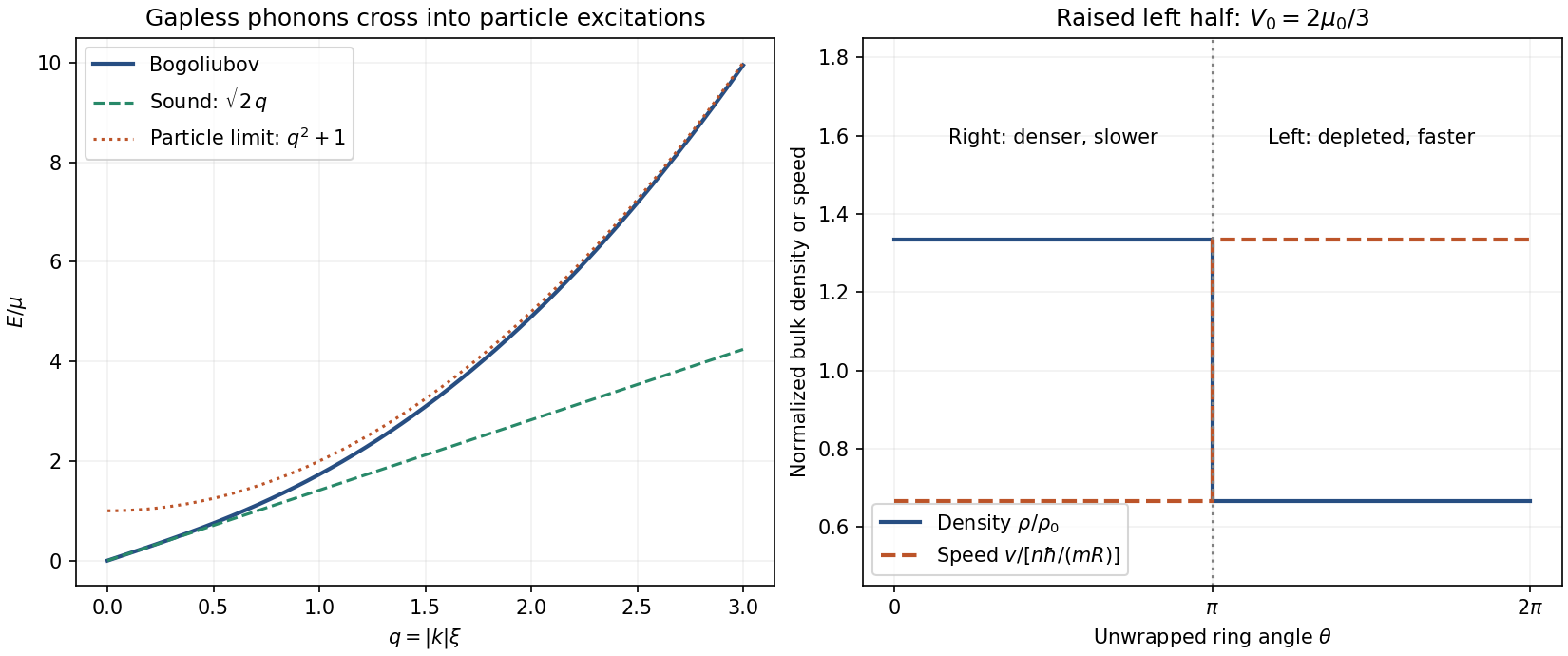
This local sound-speed estimate for ring-flow stability uses the step-potential equilibrium in a ring condensate densities together with the local sound-speed test, as suggested by the preceding approximations. A quantitatively self-consistent finite-current solution also includes and the quantum pressure of a condensate in the stationary Gross–Pitaevskii equation, allowing flow to change the density. Smooth steps suppress reflection but do not alone remove those terms. The result is the stated local-density estimate; it should not be promoted to an exact stability theorem for every finite interacting ring.
Past exam of the atomic and Optical Physics course of the University of Cambridge 2016 Paper 1 1 Solution by Codex 0 2026-10-20
Codex 0 2026-10-20Take the field along and write , with Bohr magneton . The printed Hamiltonian uses dimensionless angular-momentum operators, with eigenvalues and ; physical angular momenta carry an additional . Thus and are energies. Assume the usual positive spin-orbit interaction coefficient . Reversing its sign reverses the zero-field ordering but not the state count.
An electron has . addition of angular momentum givesThe coupled angular-momentum state count can be checked directly. The product basis contains states. The coupled basis containsCoupling therefore reorganizes the states rather than creating or losing them. There is no hyperfine multiplicity because .
Use to obtainThe two spin-orbit interaction energies are and . In a weak field, project the Zeeman effect onto a fixed multiplet:This is the first-order energy formula, not a statement that has no matrix elements between different values. For a common and a conventional choice of relative phase, its complete coupled-basis block isThe inter-multiplet Zeeman coupling terms give second-order weak-field corrections because the two spin-orbit interaction multiplets are already separated.
In the strong-field basis the Zeeman part is diagonal, . WriteIts diagonal matrix elements are . Its off-diagonal matrix elements connect to with coefficientand the reverse spin change has replaced by in the corresponding ladder coefficient. These terms preserve but mix the two product states. To first order in , the energy correction is simply .
For the P state, . Measured relative to its gross-structure centroid, the six low-field levels areThus the upper quartet starts at with slopes in a plot against ; the lower doublet starts at with slopes . Their zero-field separation is .
At high field all six product-state energies, retaining the term linear in , areThe two zero-slope levels have different and no mutual matrix element, so their first-order degeneracy does not require an additional degenerate perturbation. At finite field they split at order .
An exact interpolation makes the requested whole-field sketch unambiguous. The stretched levels areFor , use product states and . Their Hamiltonian block issoThese energies reduce to the quartet and doublet at zero field and to the six strong-field expressions above. Within a fixed , the nonzero off-diagonal element prevents a crossing of the two branches. Levels in different sectors can cross without hybridizing. For the S state, and the spin-orbit interaction term vanishes, leavingthroughout this Hamiltonian's range of validity.
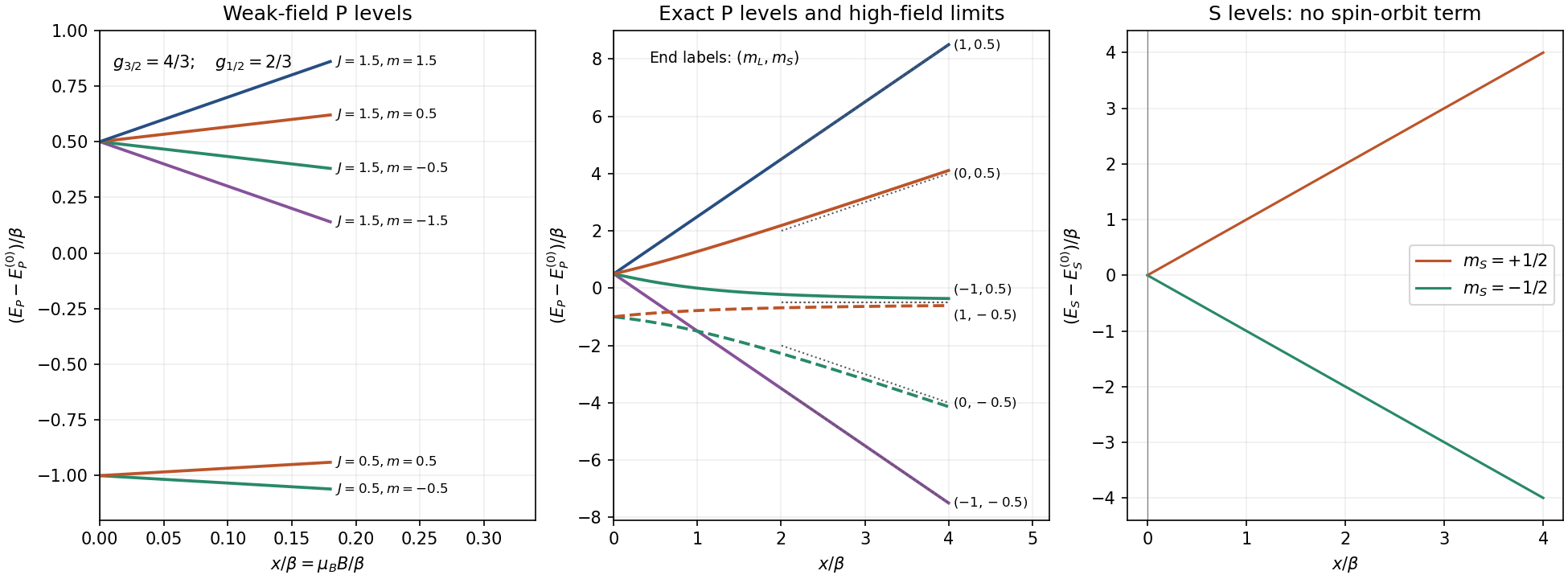
For electric dipole transitions at low field, and apply, with the usual exclusion of . Each P state has opposite parity to the S state. The transition has four allowed sublevel pairs. For , the two stretched upper states each have one destination and the other two each have two, giving six. Hence there are 10 allowed state-to-state channels at weak nonzero field. Relative to the two zero-field transition energies, their Zeeman shifts are
In the decoupled high-field limit, an electric dipole acts on orbital coordinates, so . Each of the six P product states connects to the S state with the same spin and . Thus there are 6 allowed channels in the limiting product-state description. Their photon energies areThis Paschen-Back transition-channel count is not the count of distinct frequencies: to first order in the two channels coincide, giving 5 distinct frequencies, with shifts . If the residual spin-orbit interaction splitting is unresolved there are the three usual orbital Zeeman groups.
The apparent loss of four channels is a change in eigenstate mixing, not a change in Hilbert-space dimension. At finite large field, four weak spin-forbidden Paschen-Back lines arise from small opposite-spin admixtures, with intensities vanishing as . A generic finite-field calculation therefore retains ten nonzero channels; six carry finite strength in the complete-decoupling limit. Observation direction and polarization select which of these channels a detector actually receives.
Past exam of the atomic and Optical Physics course of the University of Cambridge 2015 Paper 1 2 Solution by Codex 0 2026-10-20
Codex 0 2026-10-20Interpret the box as a hard-wall cube. Its one-particle levels are for positive integers, giving . Counting lattice points in a positive octant and differentiating the large-radius count gives the supplied continuum density of states. Expressing its prefactor through yieldsHere denotes the dimensionless constant requested in this question, to distinguish it from the unrelated hyperfine constant of question 1. Periodic boundary conditions would have zero ground energy and would not permit this parametrization by a nonzero .
Separate the ground-state occupation from excited particles. The finite-box ground-energy convention in Bose condensation makes the chemical potential approach the ground energy from below as that occupation becomes macroscopic. In the thermodynamic continuum approximation one shifts the energy zero to the ground state and sets the limiting chemical potential to zero in the excited-state integral. The difference between the exact shifted density and its bulk form gives finite-size corrections; at the transition . ThusThe identity follows by expanding and integrating each term. The excited states have a finite saturation capacity. Setting that capacity equal to determines condensation:Equivalently , with .
At fixed , below the chemical potential is pinned to its limiting value andAbove , and there is no macroscopic ; the chemical potential adjusts rather than allowing the saturation expression to exceed the available particles. At fixed , put . For , and is not macroscopic; for , saturates while grows linearly. This is particle saturation in a homogeneous Bose gas; the sharp threshold is a thermodynamic-limit approximation to finite-box occupations.
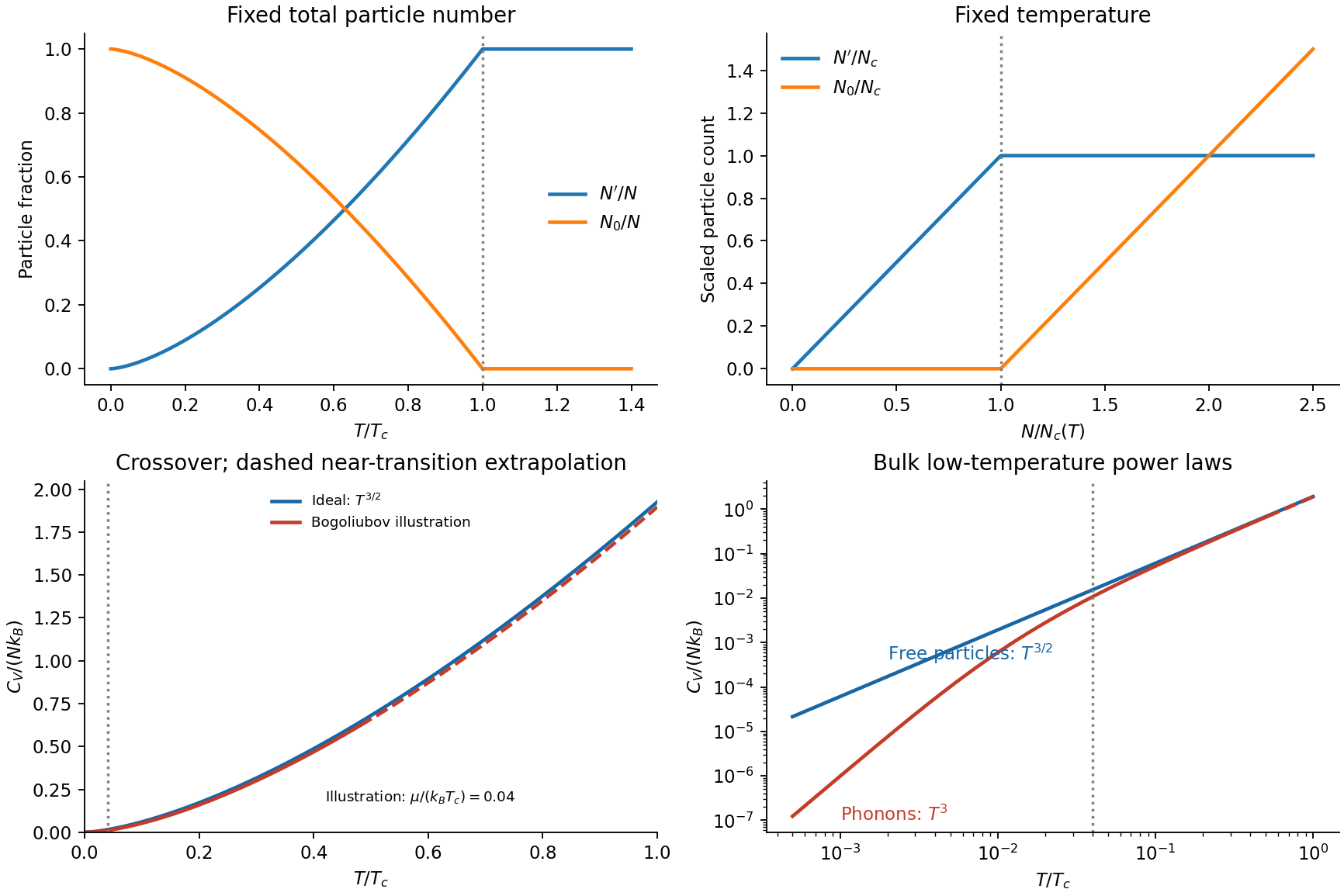
Ideal-box particle saturation and the heat-capacity crossover from phonons to particle-like excitations
. Details. The interaction scale compares differently with confinement and transition energies:Thus the stated range makes interactions dominate the ground-state confinement energy while remaining small on the thermal scale controlling . This is an interaction-dominated ground state with nearly ideal condensation temperature. It also gives the dilute-gas parameter . A contact model has and ; the question's suppresses order-one factors, and the uniform ground energy per particle is , rather than exactly . Weak interactions can shift slightly, but their dimensionless strength makes that a small relative effect. In a hard-wall box, boundary healing layers do not overturn bulk interaction dominance when their thickness is small compared with .
At , thermally occupied Bogoliubov modes have , with . There is one acoustic branch for this spinless gas. Its thermal energy determines the phonon heat capacity of a dilute Bose gas:The zero-temperature interaction energy does not itself contribute to this leading temperature derivative at fixed . This bulk power law also requires so that the phonon spectrum may be treated as continuous; a strictly finite box eventually has discrete-level activated behaviour.
For the noninteracting condensed Bose gas, the ideal Bose-gas heat capacity below condensation follows by integrating :Its limiting value at is about . At very low temperature the interacting phonon curve is suppressed relative to the ideal curve, has slope three on logarithmic axes, and crosses over towards particle-like behaviour around . Since , most of the interval below is approximately ideal at leading weak-coupling order. The figure marks a qualitative extrapolation near the transition: a zero-temperature Bogoliubov spectrum does not determine precise interacting critical heat capacity or its small transition shift. The illustrative fixed- interpolation is not claimed as a controlled critical-region calculation.
Past exam of the atomic and Optical Physics course of the University of Cambridge 2015 Paper 1 1 Solution by Codex 0 2026-10-20
Codex 0 2026-10-20Use the ordered basis and , withA pure quantum superposition has on the Bloch sphere. In contrast, a mixed state has , inside the sphere for . At equal populations its vector is zero. Equal populations alone therefore do not distinguish a coherent superposition from a mixture; their off-diagonal density matrix elements differ.
Choose the drive phase so the rotating-frame Hamiltonian is , where as specified. The Rabi vector is the angular-velocity vectorHere is the on-resonance population oscillation angular frequency, not the unhalved coefficient of a cosine coupling. From , rotation about at givesFor , the rotation axis is nearly transverse, the trajectory nearly a great circle, and transfer is almost complete. For , the axis bisects and , the orbit lies in , and never exceeds . Each member remains a pure state in this coherent evolution.
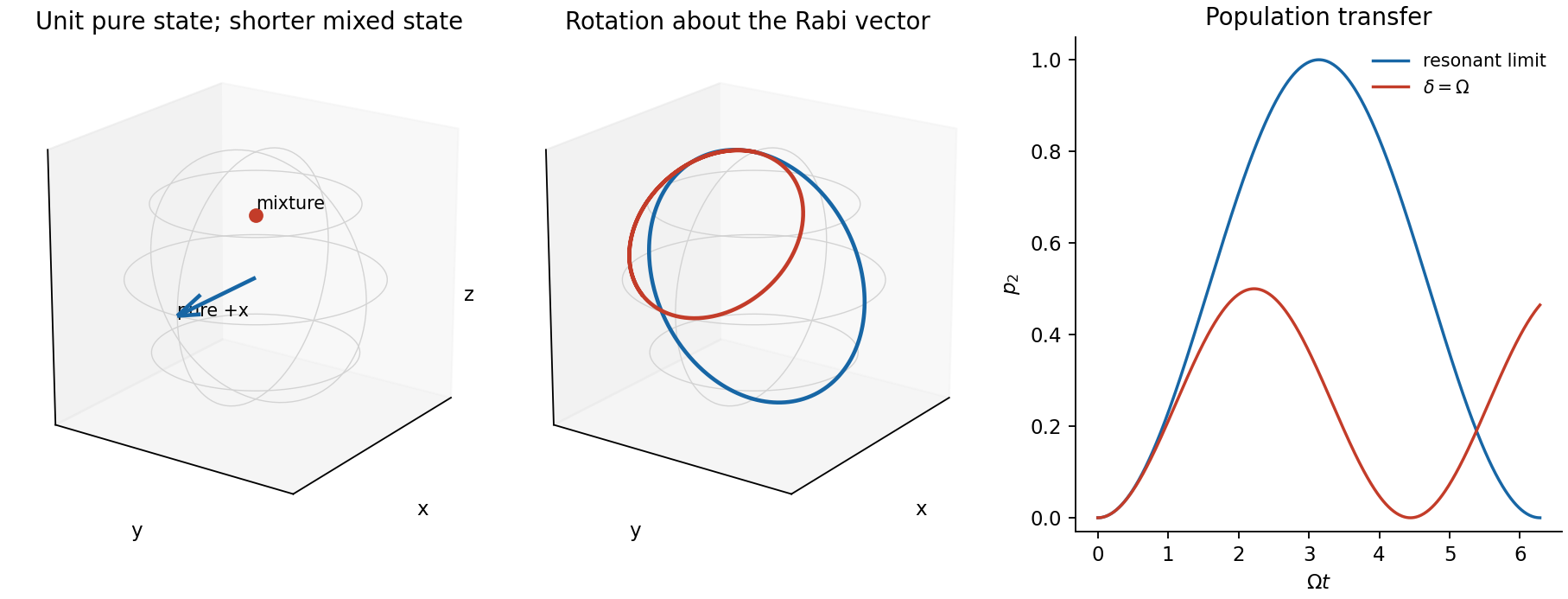
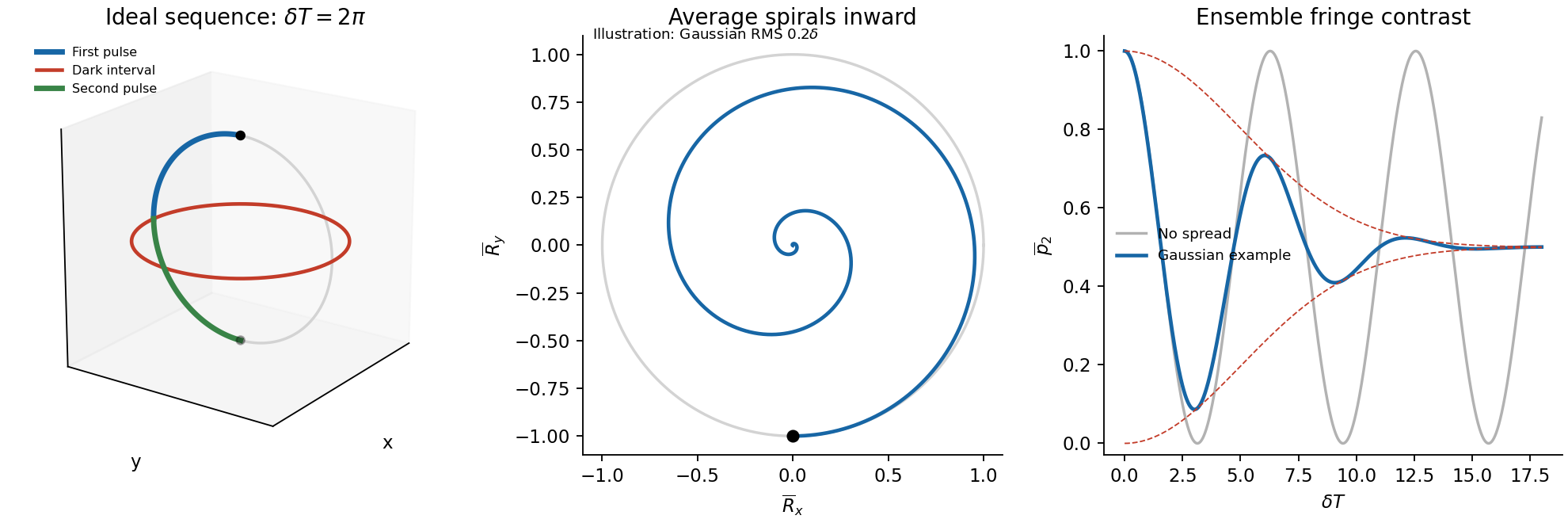
For the Ramsey free interval, let atom have detuning . Instantaneous ideal pulses give the Ramsey ensemble coherence factor . Averaging the free-evolution vector obtained in step (ii) givesDifferent atoms fan out around the equator, shortening the ensemble Bloch vector even though every individual's vector remains unit length. A broad smooth detuning distribution usually makes the average spiral towards the centre and damps the Ramsey fringes towards . The dephasing time is of order . inhomogeneous ensemble dephasing is not necessarily irreversible decoherence of individual atoms; an appropriate spin echo can rephase static frequency offsets.
The given spread does not specify a probability distribution or whether it denotes an RMS width. An exact envelope is therefore not determined. The figure illustrates, rather than infers, a Gaussian distribution with RMS , for which . A uniform distribution would instead give a sinc envelope and side lobes. Both have the same qualitative initial loss of contrast on the quoted inverse-spread scale.
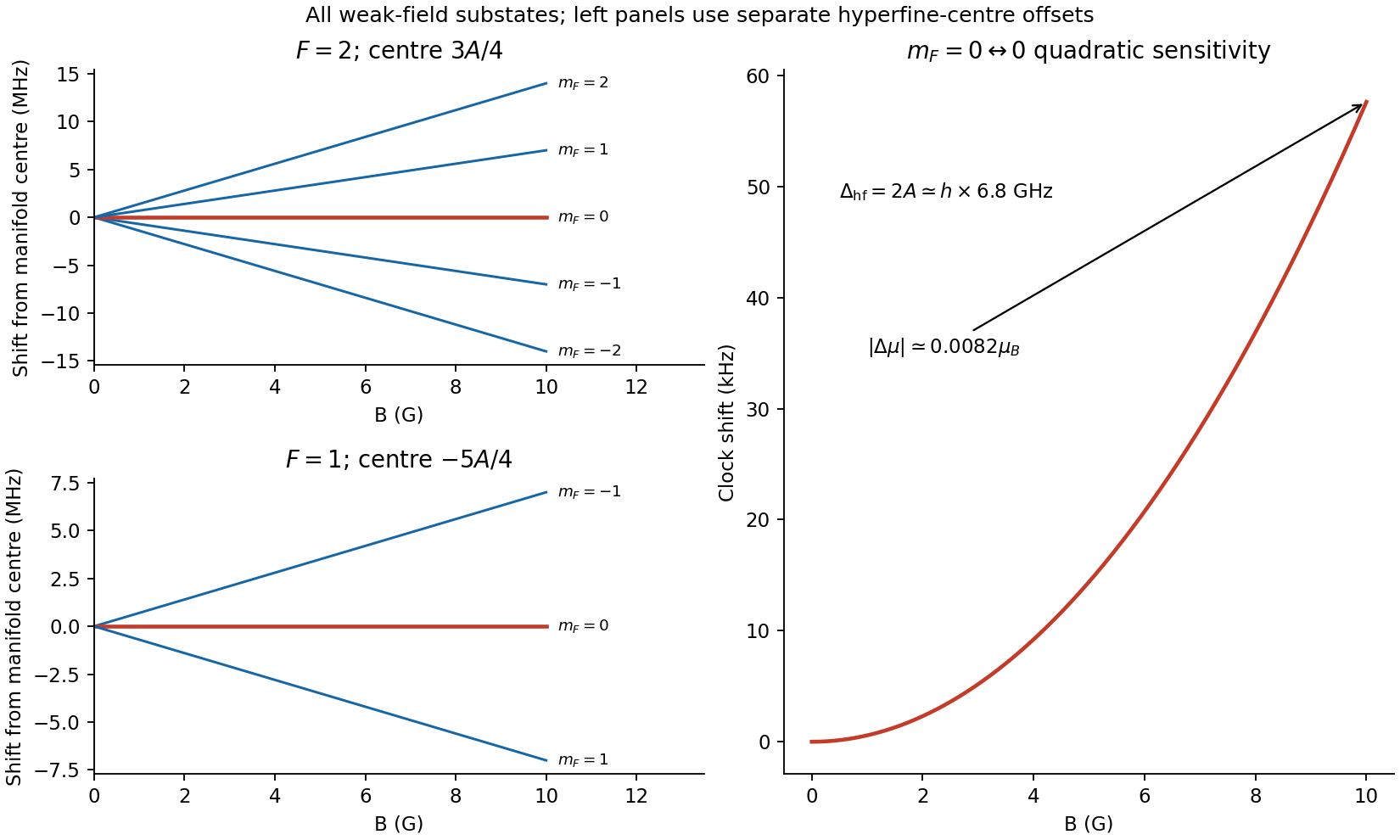
In the rubidium-87 ground-state hyperfine structure, and , so . Taking givesThe zero-field splitting is . Ignoring the small nuclear magnetic term, the weak-field Landé g-factors are and . The diagram labels all three and five substates, with linear shifts .
The pair and is connected by a magnetic dipole transition with , , driven with its oscillating magnetic component along the quantization axis. Both first-order shifts vanish, giving the rubidium-87 clock transition first-order insensitivity near zero field. Its insensitivity does not imply absence of quadratic shifts.
For these two levels the Breit-Rabi formula gives the quadratic Zeeman shift of a clock transition:where the last expression neglects the nuclear term and sets . HenceThis uses and the supplied . With physical moments defined by , the differential magnetic moment is . If effective magnetic moment denotes the positive energy slope instead, that slope difference is positive. The magnitude and physical frequency sensitivity are the same. Retaining the full atomic factors gives the familiar quadratic clock-frequency coefficient about ; the simplified supplied parameters give about .[ref]
Rubidium 87 D Line Data by Daniel A. Steck. §3, equations (26)–(29); table of magnetic factors and clock-transition quadratic shift
Use a far-detuned optical dipole trap, such as a red-detuned focused-beam trap, to confine both clock states. Their first-order magnetic moments vanish; their residual quadratic magnetic slopes are opposite, so a simple static magnetic-field minimum does not confine both in the same way. An optical potential acts through the electronic polarizability and can trap both ground hyperfine states. It is not perfectly state independent: differential AC Stark shifts, intensity noise and residual magnetic gradients still need control during Ramsey evolution.
Past exam of the atomic and Optical Physics course of the University of Cambridge 2014 Paper 1 2 Solution by Codex 0 2026-10-20
Codex 0 2026-10-20Set the ground-state energy to zero. Bose-Einstein occupation of an excited level is , with . As particles are added, approaches zero and the excited-state population saturates. Separating the ground state from the density-of-states integral therefore givesThe excited-state integral must actually converge: alone is not a sufficient condition in complete generality. A power law with suffices at low energy, as in the stated three-dimensional box.
Let denote the density-of-states prefactor, not a heat capacity. Substitution givesThe condensate has zero energy on this reference, so a further factor of in the integral givesRelative to the classical value, the ratio is . Macroscopic occupation of the zero-energy state and the Bose distribution both lower the average energy.
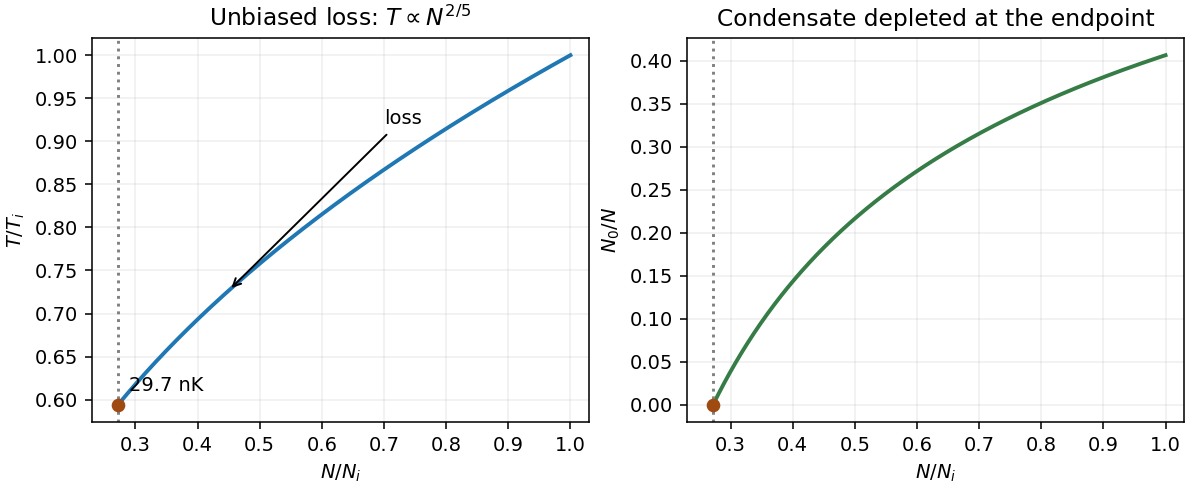
At fixed volume the condensed gas has . Unbiased random loss keeps average constant, henceRemoving a condensate atom removes essentially no energy and by itself leaves the excited cloud's temperature unchanged. Removing an excited atom removes its energy; during re-equilibration, some zero-energy condensate atoms join the excited population and share the remaining energy, lowering temperature. Averaging over unbiased loss gives the stated constant energy per particle, even though each individual type of loss need not preserve it separately.
Using and the supplied volume,There is only one occupied internal spin state, so no factor belongs in the density of states. During loss, , hence . Condensation disappears at :As a consistency check, agrees with .
Both this process and evaporative cooling of atoms require particle loss and re-equilibration. Ordinary evaporation preferentially removes energetic atoms, reducing , and can cool an uncondensed classical gas. Here loss is energy independent, stays constant, and cooling relies on the condensed gas's unusual equation of state; random loss of a classical ideal gas would leave its temperature unchanged. Exact noninteraction would prevent collisional rethermalization: the imposed equilibrium assumption can be understood as weak thermalizing interactions whose equation-of-state corrections are neglected.


There are unlisted articles, also show them or only show them.