Past exam of the chemistry course of the year 1 of the natural sciences course of the University of Cambridge 2021 Paper 1 4 c Solution by  Codex 0 2026-10-20
Measure the reversible cell potential at several temperatures while maintaining standard-state thermodynamic activities and the same phases. From and ,The sign of the slope gives the sign of the standard reaction entropy. Measuring a loaded cell voltage without correcting polarization would not give this reversible thermodynamic derivative.
Past exam of the chemistry course of the year 1 of the natural sciences course of the University of Cambridge 2021 Paper 1 4 b Solution by Codex 0 2026-10-20
Codex 0 2026-10-20 Past exam of the chemistry course of the year 1 of the natural sciences course of the University of Cambridge 2021 Paper 1 4 a Solution by Codex 0 2026-10-20
Codex 0 2026-10-20Write both electrode reactions first as reductions:The conventional cell reaction runs with oxidation on the left and reduction on the right. Reverse the first equation and multiply the second by four:Four electrons pass through the external circuit per reaction as written. This direction consumes the oxide; deposition requires the reverse electrolysis direction.
Past exam of the chemistry course of the year 1 of the natural sciences course of the University of Cambridge 2021 Paper 1 3 c Solution by Codex 0 2026-10-20
Codex 0 2026-10-20Let . One standard route is:where the last two carbons are joined through oxygen to form the epoxide shown in the product drawing.
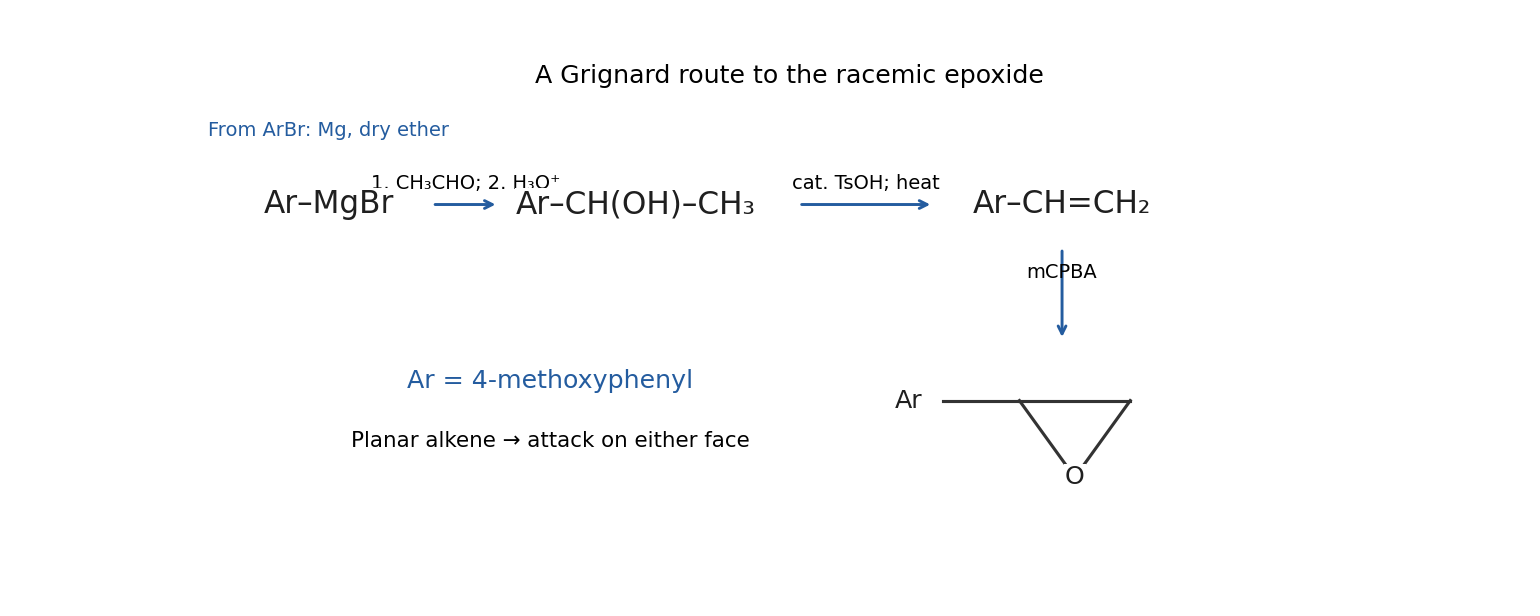

Use rigorously dry conditions for Grignard formation/addition; quench only after the aldehyde addition. Dehydration gives the styrene, and peracid oxidation transfers oxygen across its double bond. The methoxy substituent is compatible with this sequence. No asymmetric reagent is specified, so the target epoxide is racemic.
There are unlisted articles, also show them or only show them.