Past exam of the chemistry B course of the University of Cambridge 2025 Paper 2 B6 a Solution by  Codex 0 2026-10-20
The nitrite ion is an ambidentate ligand: its Lewis structures leave donor lone pairs on both nitrogen and oxygen. In the N-bound mode, , the nitrogen lone pair makes a sigma bond to the metal, while a suitable unoccupied nitrite molecular orbital can accept metal electron density by pi backbonding. Thus N-bound nitro is a sigma donor and pi acceptor. The nitrite group remains bent at nitrogen; N coordination does not make it a linear nitrosyl.
In the O-bound mode, , an oxygen lone pair makes the metal–oxygen sigma bond. A second occupied oxygen orbital can donate sideways into an available metal orbital: O-bound nitrito is a sigma and pi donor, rather than the strong pi acceptor of the N-bound description. oxygen's greater electronegativity lowers its donor orbital energies, but the occupied oxygen orbitals still explain its pi-donor classification. Actual mixing depends on metal oxidation state and geometry.
A further possibility is bidentate coordination, , with both oxygen atoms attached to one metal. Each attachment has oxygen-to-metal sigma donation; additional pi donation depends on orbital alignment. nitrite can also be a bridging ligand between metals. Neither alternative should be confused with linkage isomerism, which specifically compares attachment through different atoms at the same binding site.
Past exam of the chemistry B course of the University of Cambridge 2025 Paper 1 B5 d Solution by Codex 0 2026-10-20
Codex 0 2026-10-20- : a very small four-membered hydrogen-bonded loop, incompatible with a favourable repeating peptide-backbone geometry.
- : a seven-membered loop associated with a gamma turn; a long regular two-residue-per-turn structure is strongly constrained.
- : the ten-membered hydrogen-bonded rings of a 3-10 helix, with about three residues per turn.
- : the thirteen-membered rings of an alpha helix, with about 3.6 residues per turn.
- : the sixteen-membered rings of a pi helix, with about 4.4 residues per turn.
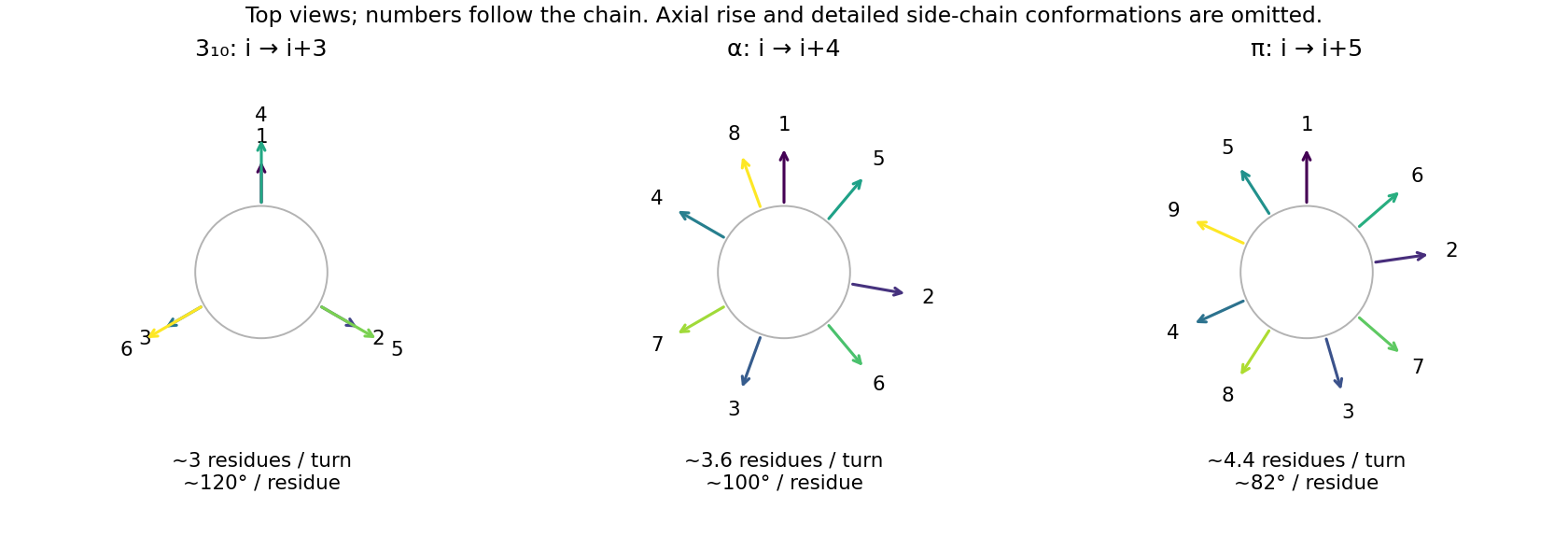

The alpha helix provides a favourable combination of allowed backbone torsions, reasonably linear hydrogen bonds, and side-chain packing. Its successive side chains advance by about , rather than lining up in the three columns of the narrower 3-10 helix. Smaller repeating rings impose more severe backbone constraints; the wider pi helix gives a different, generally less favourable packing arrangement. Short 3-10 and pi-helical segments can still occur in proteins, so this is a preference for a common extended secondary structure, not a prohibition of the alternatives. Proline and sequence-specific interactions can disrupt the idealized backbone donor pattern.
Past exam of the chemistry B course of the University of Cambridge 2025 Paper 1 B5 b Solution by Codex 0 2026-10-20
Codex 0 2026-10-20The functional group interaction profile compares donor strength and acceptor strength . In water, strong–strong contacts compensate for desolvation, giving the upper-right black region. Strong–weak contacts lose favourable solvent interactions without adequate replacement, giving the two grey regions. Weak–weak association gives the lower-left black region through the hydrophobic effect.
Past exam of the chemistry B course of the University of Cambridge 2025 Paper 1 B5 a Solution by Codex 0 2026-10-20
Codex 0 2026-10-20For hydrogen-bond acceptance, the three strongest groups are the terminal carboxylate, the Cys–CO–N(Pro) tertiary-amide carbonyl, and the Pro–CO–NH(Tyr) secondary-amide carbonyl, in that qualitative order. Negative charge makes carboxylate a particularly strong acceptor. Both amide oxygens accept strongly; greater nitrogen alkyl donation generally makes a tertiary amide oxygen more basic than the comparable secondary-amide oxygen. This last ordering is a functional-group estimate, not a precise calculation of a folded tripeptide's site parameters.
For donation, the order is terminal ammonium tyrosine phenolic OH the peptide NH between Pro and Tyr. The thiol is a weaker donor. Protonated ammonium has no available lone pair to accept; the proline amide nitrogen has no N–H bond to donate, and amide nitrogen lone pairs are delocalized into carbonyl groups. The carboxylate has no O–H donor in the drawn protonation state.
There are unlisted articles, also show them or only show them.