Past exam of the chemistry course of the year 1 of the natural sciences course of the University of Cambridge 2021 Paper 1 1 b Solution by  Codex 0 2026-10-20
Carbon-13 NMR spectra: 1 = C, 2 = A, 3 = B. Approximate shifts, read from the printed axes, are shown in the annotated structures.
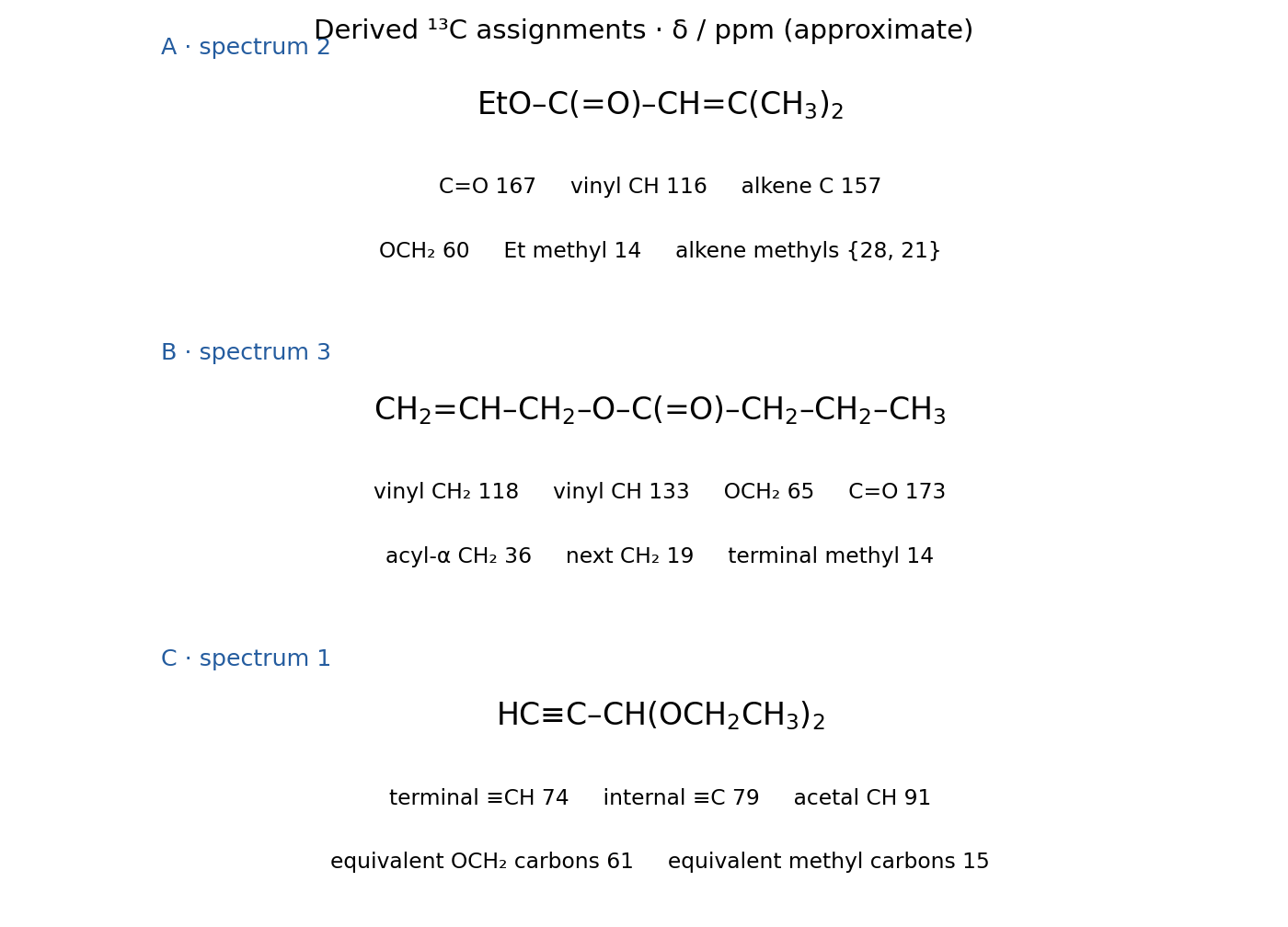
- C: has five carbon environments: acetal CH near ; substituted/terminal alkyne carbons near and ; OCH near ; and methyl near . One alkyne signal is close to the CDCl solvent region, which must not be counted as a new molecular environment.
- A: has ester carbonyl near , substituted alkene C near , vinyl CH near , OCH near , two nonequivalent alkene methyls near and , and ethoxy methyl near .
- B: has carbonyl near , vinyl CH near , terminal vinyl CH near , OCH near , acyl-alpha CH near , the next CH near , and terminal methyl near .
The two methyls in A are chemically distinct because one is cis and the other trans to each substituent at the other alkene carbon. Their two measured shifts are secure; assigning an individual methyl to a particular side of the drawn double bond requires an additional stereospecific shift argument or experiment, so their spatial interchange is left explicit.
Past exam of the chemistry course of the year 1 of the natural sciences course of the University of Cambridge 2021 Paper 1 1 a Solution by Codex 0 2026-10-20
Codex 0 2026-10-20A has a strong ester C=O band at roughly –, lowered by conjugation with C=C. B's unconjugated ester carbonyl is nearer –; it also has terminal-alkene features, including the approximately pair.
C has no carbonyl band. Its terminal alkyne gives a relatively sharp sp C-H stretch near and a usually weaker C≡C feature near –. C-O stretching alone is less diagnostic because esters and the acetal all contain C-O bonds. The numbers are characteristic ranges, not exact frequencies inferred from an unprinted IR trace.
Past exam of the chemistry B course of the University of Cambridge 2025 Paper 2 B9 d Solution by Codex 0 2026-10-20
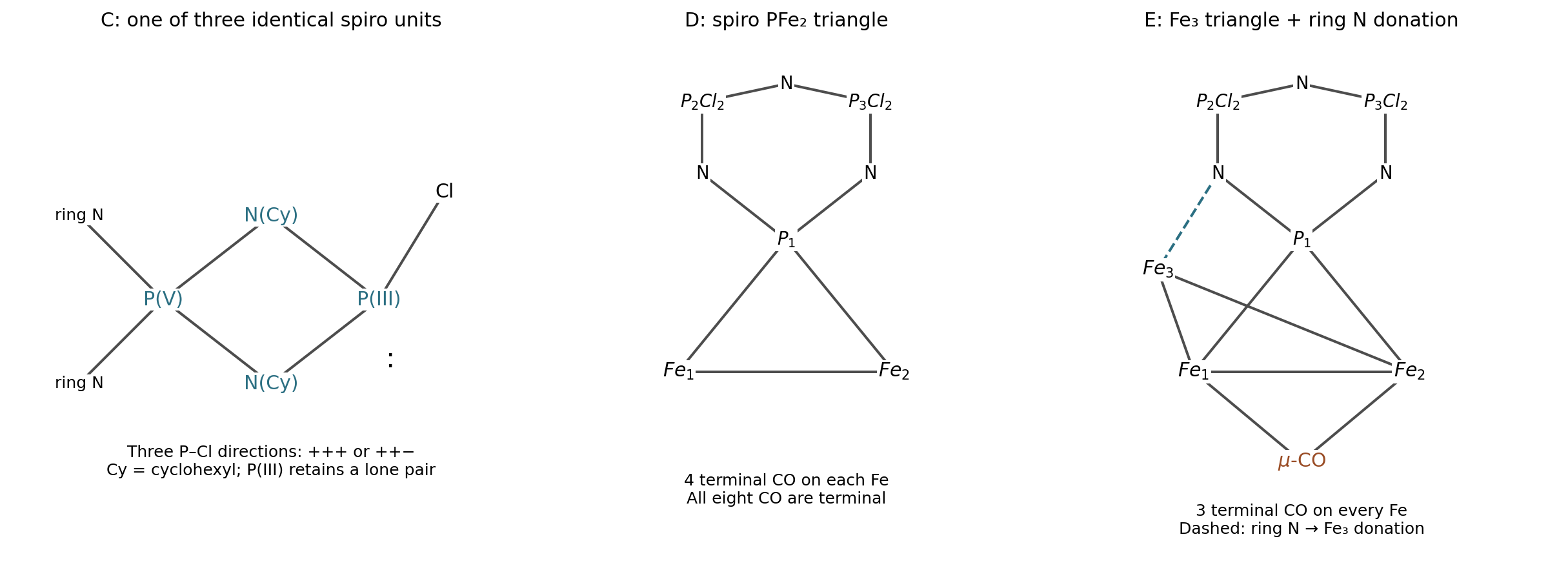
Codex 0 2026-10-20Replace the two chlorides on one ring phosphorus with the two ends of the diiron unit. has a spiro triangle, with an Fe–Fe bond, a –Fe bond to each metal and four terminal CO ligands on each Fe. The other two phosphorus atoms retain their groups. Its composition is . In neutral electron counting, each metal has .
has a triangular Fe cluster, one bridging CO, and an adjacent ring NFe bond. The two original metals remain bonded to and to one another, and each bonds to the added third Fe. Each Fe bears three terminal CO ligands; one additional bridging carbonyl ligand spans the original Fe–Fe edge. A nitrogen directly adjacent to donates its lone pair to the third Fe. The formula is therefore , satisfying retained CO ligands. The original diagram above gives all metal–metal and metal–ring connections.
The counts are an especially useful structural check. Each original Fe has . The added Fe has . Omitting nitrogen coordination leaves the third Fe two electrons short; omitting the bridging CO leaves both original metals one electron short.
In , the two untouched phosphorus sites are equivalent: an phosphorus-31 nuclear magnetic resonance system gives their doublet with integral 2, and the unique triplet with integral 1. The two equivalent nuclei do not split each other. In , coordination of one adjacent nitrogen distinguishes the two sides of the ring, producing three inequivalent phosphorus sites. Each couples to the other two and gives a doublet of doublets in the first-order limit; equal couplings or strong coupling could distort this simple pattern.
The high-frequency infrared spectroscopy bands belong to terminal carbonyl stretching modes. The extra low-frequency band is diagnostic of a strongly backbonded bridging carbonyl ligand. The number of IR bands counts allowed, possibly overlapping normal modes, not individual CO ligands. Formula, 18-electron rule, NMR equivalence and IR together select this model; the historical experimental work independently established diiron spiro rings and triiron products containing both P–Fe and N–Fe bonds.[ref]
Iron-Containing Metallophosphazenes and Their Clusters Derived from Chlorophosphazenes and Organometallic Dianions by Harry R. Allcock and others. 1984, pp. 4966–4977, diiron compound 2, triiron compound 3, and conversion with iron carbonyls
Past exam of the chemistry B course of the University of Cambridge 2025 Paper 2 B9 c Solution by Codex 0 2026-10-20
Codex 0 2026-10-20, with two cyclohexylamino substituents on each original phosphorus. All six P–Cl bonds have been replaced; the six N–H bonds of those substituents remain. Each equivalent of triethylamine traps one equivalent of HCl.
contains three four-membered spiro rings, one at each original ring phosphorus. Each PCl joins the two geminal NHCy groups: replacement of two of its chlorides forms two new P–N bonds and releases two HCl, consuming both N–H protons. The new phosphorus retains one chloride and a lone pair, making it three-coordinate P(III); the original six-membered ring retains P(V). The product formula is . For each spiro ring, the original phosphorus is bonded to both exocyclic nitrogens, and each of those nitrogens is bonded to the same new PCl center; the braces do not indicate a simple linear substituent.
The three new P–Cl directions permit an all-cis isomer and a cis,trans isomer. Relative to the central ring, write these as and , with cyclic relabeling giving equivalent choices. Reversing all signs does not create a third relative configuration. This describes the configuration pattern; puckering and substituent conformations are additional structural details.


Past exam of the chemistry B course of the University of Cambridge 2025 Paper 2 B9 a Solution by Codex 0 2026-10-20
Codex 0 2026-10-20The six P–N bonds are not well described as three permanently localized single bonds alternating with three ordinary double bonds. The strongly polar P–N framework has contributions from ionic bonding and nitrogen lone pair donation into neighboring phosphorus-centered acceptor combinations, including P–Cl orbitals. This negative hyperconjugation supplies additional P–N bonding and equivalent environments around the ring. Approximate planarity is compatible with these interactions, but equal lengths and planarity alone do not establish benzene-like aromaticity. Large phosphorus participation is not required.[ref]
Gallium binds to a ring nitrogen, and the two P–N bonds flanking that nitrogen lengthen. Formation of the NGaCl coordinate covalent bond changes the available nitrogen electron density and local geometry, weakening its contribution to the adjacent P–N interactions. The other four P–N bonds retain greater multiple-bond character and are correspondingly shorter. Loss of the threefold equivalence and altered local geometry permit the ring to pucker. This is a Lewis acid-base adduct, not replacement of a P–Cl bond by GaCl. Single-crystal structures and variable-temperature multinuclear nuclear magnetic resonance establish this class of nitrogen-bound group-13 adducts.[ref]
Group 13 Lewis acid adducts of [PCl2N]3 by Zin-Min Tun and others. 2011, pp. 8937–8945, adduct structures and variable-temperature NMR
Past exam of the chemistry B course of the University of Cambridge 2025 Paper 2 B7 d Solution by Codex 0 2026-10-20
Codex 0 2026-10-20The CO trans to a phosphine ligand competes for metal pi donation with a weaker pi acceptor than CO itself, whereas a cis CO has another CO trans to it. The trans-to-phosphine carbonyl can therefore benefit from stronger M–CO pi backbonding; loss of one of the four cis carbonyls is commonly favored. Capture of the incoming phosphine at that vacancy gives the cis bis(phosphine) product. The fourfold statistical availability of cis sites reinforces an electronic preference but does not establish it by itself.
This is the carbonyl cis effect, rather than the square-planar trans effect applied without qualification. A fuller explanation compares the five-coordinate dissociation transition states and their ligand site preferences. Product geometry alone cannot prove which CO first departed, because the intermediate can rearrange before capture. Isotopically labeled CO exchange is a more discriminating experiment; the classic studies explicitly separate this issue from product stereochemistry.[ref]
Cis labilization of ligand dissociation. 3. Survey of group 6 and 7 six-coordinate carbonyl compounds. The site preference model for ligand labilization effects by Jim D. Atwood and Theodore L. Brown. 1976, pp. 3160–3161, isotope exchange, intermediate rearrangement and limitations of inferring dissociation sites from substitution products
Past exam of the chemistry B course of the University of Cambridge 2025 Paper 2 B7 c Solution by Codex 0 2026-10-20
Codex 0 2026-10-20A dissociative substitution begins with slow CO loss,followed by capture of the incoming ligand in coordination chemistry. A more electron-releasing increases metal-to-CO pi backbonding in the six-coordinate reactant, stabilizing it and strengthening its M–CO attachments. Removing CO sacrifices a useful pi acceptor from that electron-rich center. Thus the activation free energy for CO dissociation often rises and the substitution slows. Within an otherwise matched series, captures this sensitivity. The rate depends on the relative energies of reactant and dissociation transition state, so the trend is conditional: large changes in steric hindrance, geometry or mechanism can override the electronic effect.
There are unlisted articles, also show them or only show them.