Past exam of the chemistry B course of the University of Cambridge 2025 Paper 1 B4 a Solution by  Codex 0 2026-10-20
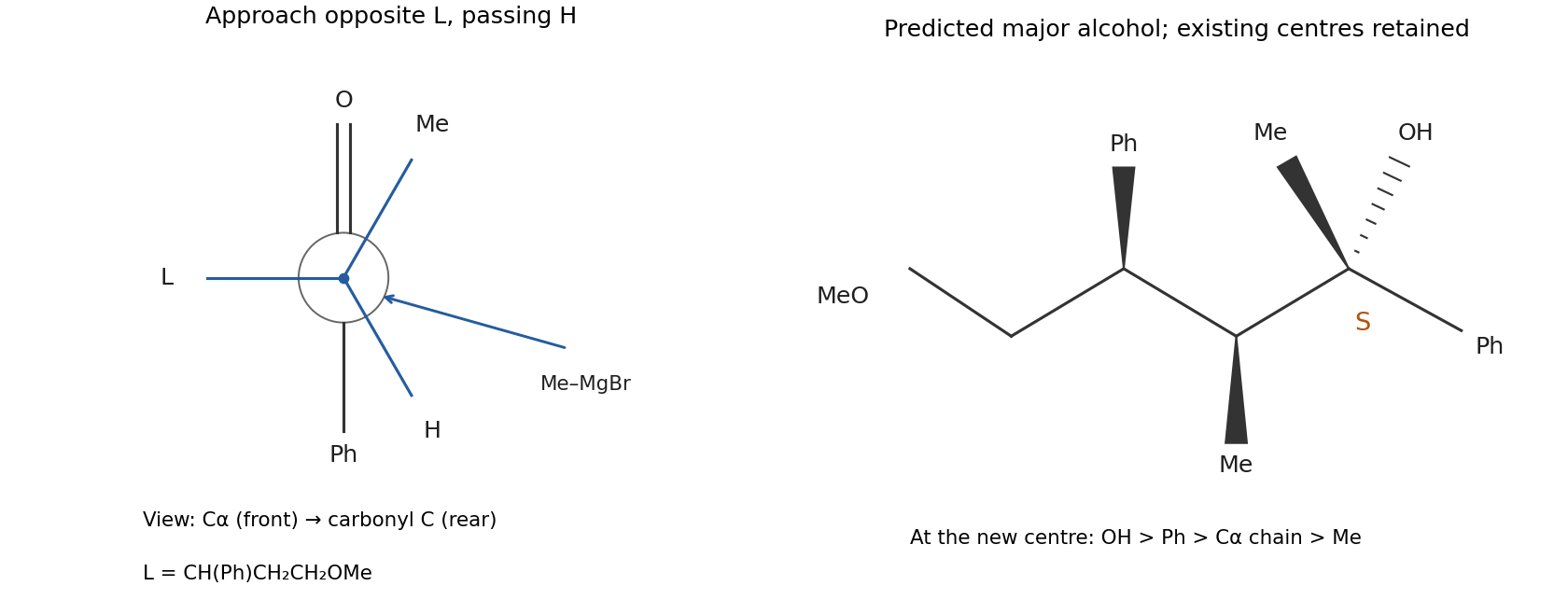
Apply the Felkin-Anh model to the stereocentre alpha to the ketone. Its large group is the chain continuing through the phenyl-bearing carbon, its medium group is methyl, and its small group is hydrogen. In the preferred transition-state arrangement, put the large group approximately perpendicular to C=O and approach from the opposite face, passing the small hydrogen along a Bürgi-Dunitz trajectory. The remote ether cannot form the usual small alpha-alkoxy chelate, and the coordinating solvent further supports using an open-addition prediction.[ref]
Felkin-Anh and Cram Chelate by University of Windsor. pp. 1–2: perpendicular large group and nucleophilic approach past the small group
The predicted new stereocentre is . In the question's zigzag projection, this corresponds to the new OH bond directed behind the page and the newly introduced methyl toward the reader, with the original stereocentres unchanged. The new-centre priority order is OH phenyl the substituted alpha-carbon chain methyl. This is a model-based major-product prediction, rather than a quantitative diastereomeric ratio.
Past exam of the chemistry B course of the University of Cambridge 2025 Paper 1 B3 d Solution by Codex 0 2026-10-20
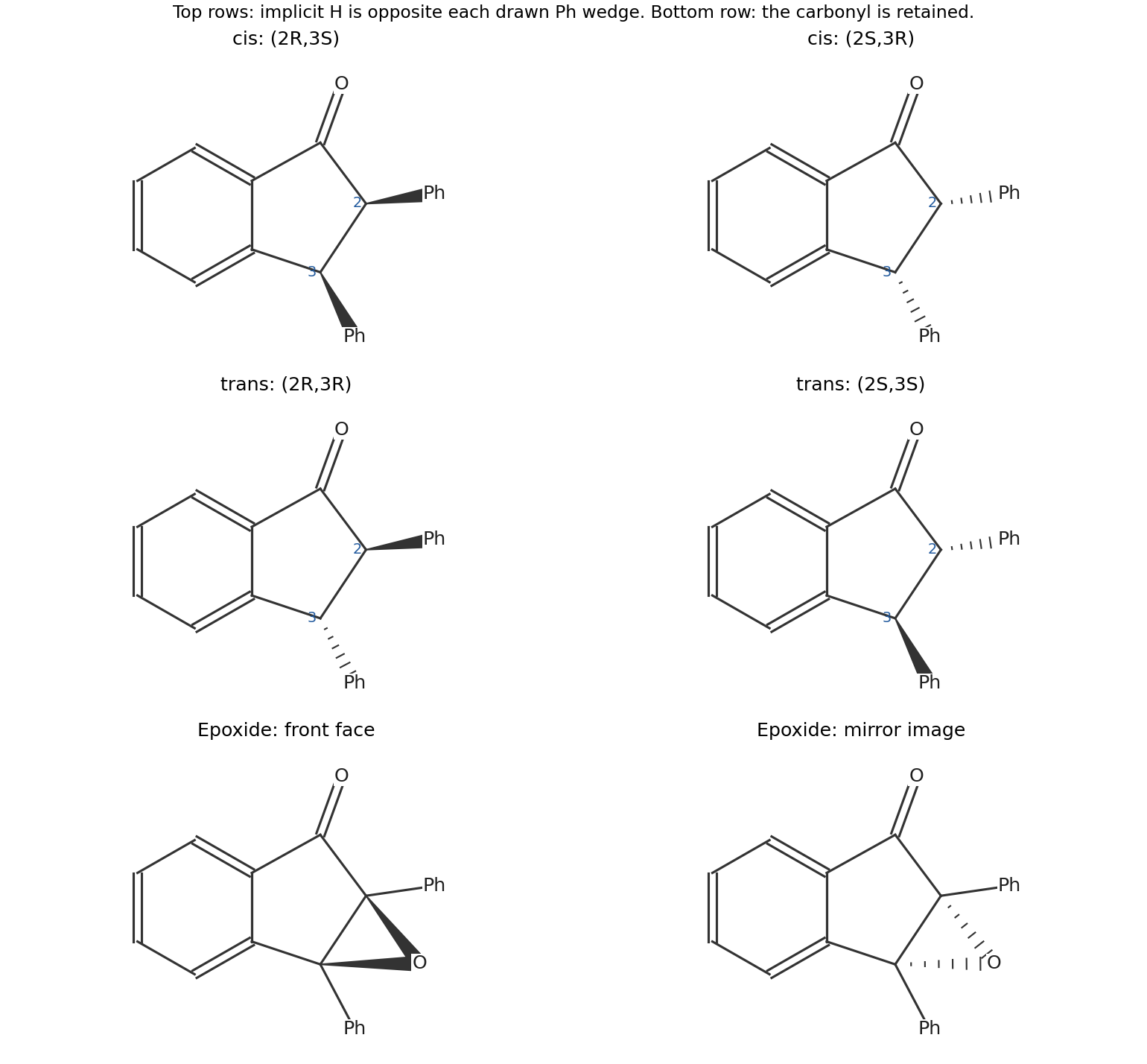
Codex 0 2026-10-20The products are the two mirror-image 2,3-epoxy-2,3-diphenylindan-1-ones, shown in the bottom row of the stereoisomer diagram. The original carbonyl remains, and an additional oxygen bridges the former double bond, giving the stated formula.
In the Weitz-Scheffer epoxidation, hydroperoxide anion adds conjugatively to the enone. The resulting enolate closes onto the attached peroxide oxygen with O–O bond cleavage and loss of hydroxide. Attack on the two faces of the achiral planar substrate gives the two enantiomers in equal amounts. This is a racemic epoxide pair, rather than a one-to-one mixture of different diastereomeric epoxide connectivities.
Past exam of the chemistry B course of the University of Cambridge 2025 Paper 1 B3 b Solution by Codex 0 2026-10-20
Codex 0 2026-10-20Reduction makes stereogenic centres at C2 and C3 of the indan-1-one framework. The four products are the cis pair and , and the trans pair and . Each pair consists of enantiomers; any cis member is diastereomeric to either trans member. There is no meso product because the carbonyl-containing and aromatic sides of the ring do not make C2 and C3 symmetry-equivalent.
For checking the Cahn-Ingold-Prelog priority rules, at C2 the order is carbonyl-side carbon phenyl C3 H. At C3 it is fused aromatic carbon phenyl C2 H. The fused aromatic path outranks the separate phenyl path because it reaches the carbonyl-containing part of the framework.
Past exam of the chemistry B course of the University of Cambridge 2025 Paper 1 B3 a Solution by Codex 0 2026-10-20
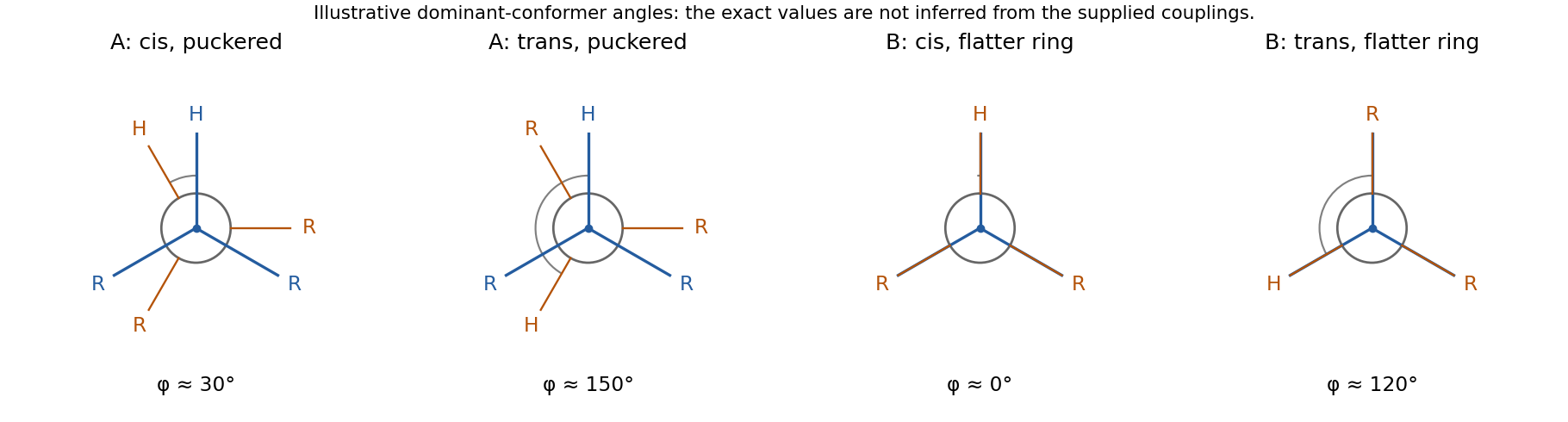
Codex 0 2026-10-20The relevant quantity is the H–C–C–H dihedral angle, through the Karplus relation, rather than the labels cis and trans alone. Couplings tend to be larger near eclipsed or antiperiplanar arrangements and smaller nearer a right angle. The observed value averages the accessible conformations.
In A, the saturated five-membered ring is puckered. A preferred envelope-like conformation can place the trans hydrogens closer to an antiperiplanar arrangement, giving a slightly larger coupling than the cis pair. In B, the double bond restricts ring geometry toward a flatter arrangement: the cis hydrogens are more nearly eclipsed, whereas the trans pair has an oblique dihedral angle. The cis coupling is then larger. Approximate Newman projections illustrate these trends; exact angles cannot be recovered from four coupling constants without a calibrated relation and conformational populations.
Past exam of the chemistry B course of the University of Cambridge 2025 Paper 1 B2 c Solution by Codex 0 2026-10-20
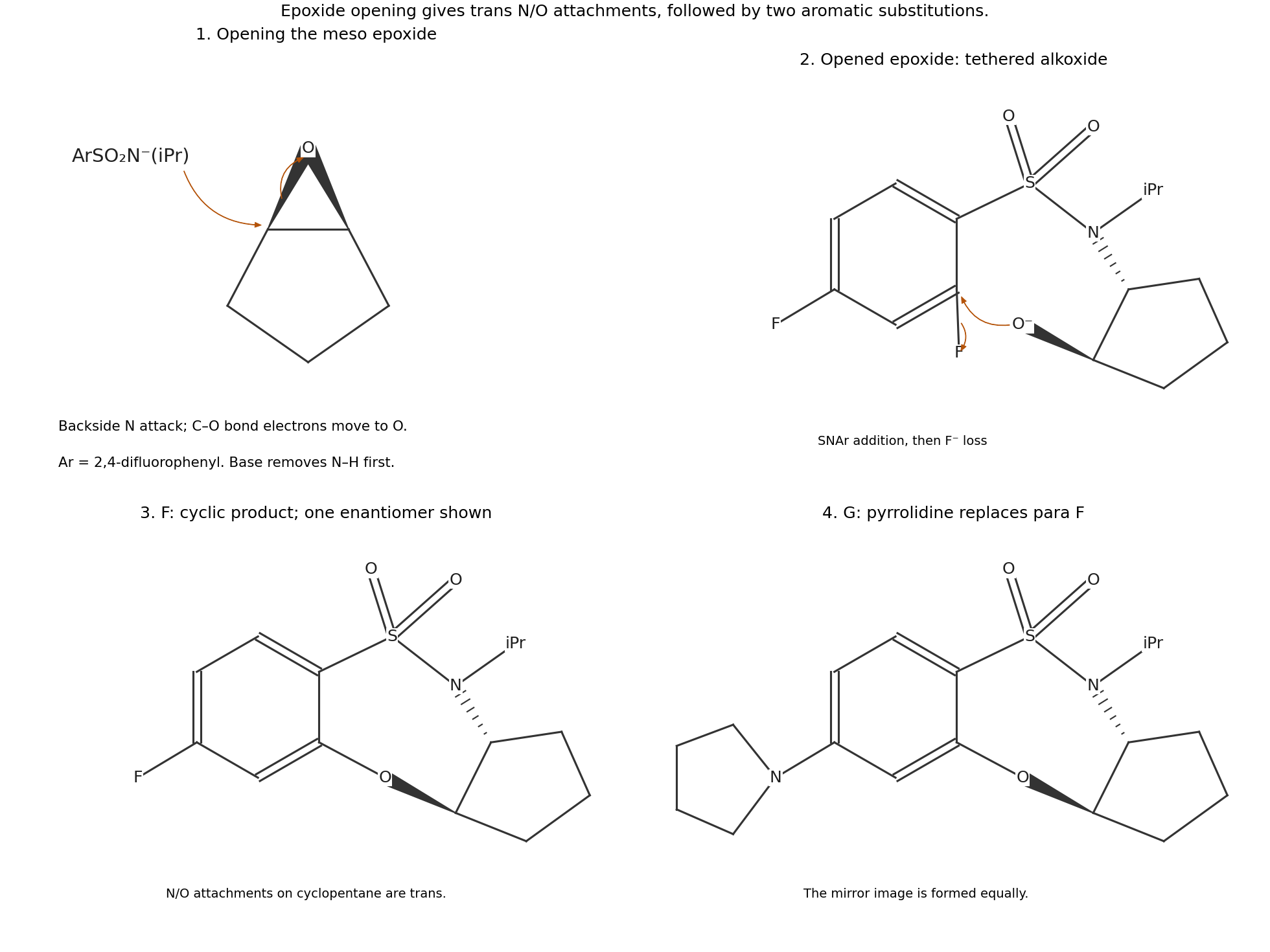
Codex 0 2026-10-20Base deprotonates the sulfonamide. Its nitrogen attacks one epoxide carbon from the back, breaking the C–O bond at that carbon and producing an adjacent alkoxide. The nitrogen and oxygen attachments on the cyclopentane are therefore trans. The alkoxide then attacks the aromatic carbon bearing the fluorine ortho to the sulfonyl group. Intramolecular nucleophilic aromatic substitution expels fluoride and closes a seven-membered heterocycle with the path . The para fluorine remains.
This tandem epoxide-opening/ring-closing pathway is required by the formula of F: simple epoxide addition would retain both fluorines, whereas F contains only one. In the second stage, pyrrolidine replaces the remaining para fluorine by another nucleophilic aromatic substitution, producing G. The mass balance is F plus pyrrolidine minus HF, as required by the given formula of G.


There are unlisted articles, also show them or only show them.