Past exam of the MPhil in micro- and nanotechnology enterprise course of the University of Cambridge 2019 Paper 2 Section A(iii) 19 iii Solution by  Codex 0 2026-10-20
For the hydraulic ladder network, using the frontier star just defined, start at a single groove with . Put , and . The exact update isAfter all grooves have been included, the left frontier is a blind end, so no external flow passes through . The inlet-to-outlet resistance is . Iterate 49 times to obtain .
An equivalent closed form, for , isThus substitute ; no single number follows without . Checks are , , and as . The formula counts only the inter-groove segments in each rail; extra inlet/outlet lead resistances, if present, must be added separately. All elements obey linear laminar-flow pressure-drop laws.
Past exam of the MPhil in micro- and nanotechnology enterprise course of the University of Cambridge 2019 Paper 2 Section A(iii) 19 ii Solution by Codex 0 2026-10-20
Codex 0 2026-10-20For a triangular resistance network with edge resistances , replacing it by a star gives the arm at each terminal as the product of its two adjacent triangle resistances divided by . This Delta-star transformation preserves the pressure-flow relation at all three terminals, just as in a linear electrical network.
Apply it recursively to the two-rail ladder. Represent the first grooves by a three-terminal star with arms leading respectively to the fixed inlet, frontier of the left rail and frontier of the right rail. Grooves are added from inlet toward outlet. Adding the next pair of rail segments gives and ; the new groove closes a triangle between the old star centre and the two new rail endpoints. Convert that triangle to a star and combine its centre arm in series with .
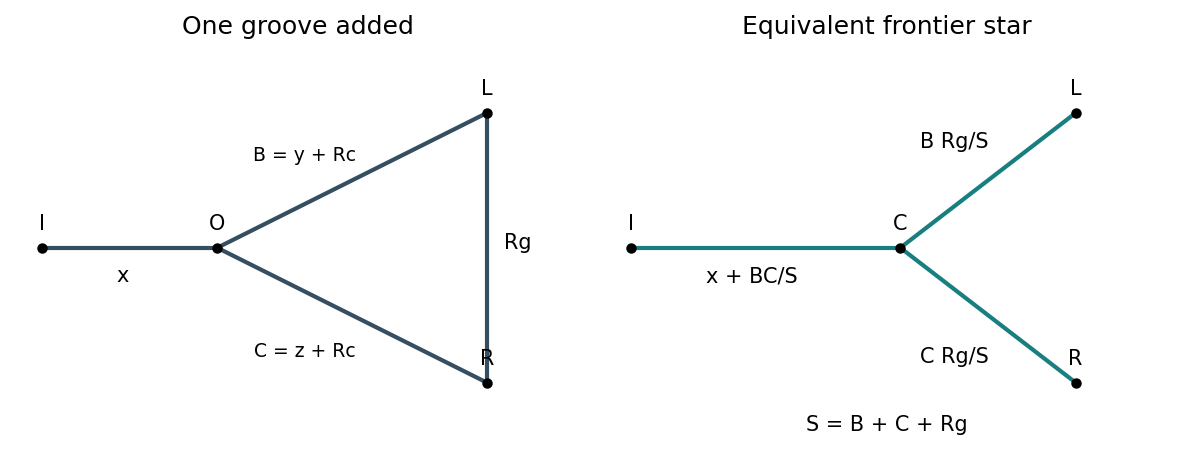

This method retains unequal pressure drops and unequal flow division along the rails; their finite resistances cannot be ignored when assigning the groove flows.
Past exam of the MPhil in micro- and nanotechnology enterprise course of the University of Cambridge 2019 Paper 2 Section A(iii) 19 i Solution by Codex 0 2026-10-20
Codex 0 2026-10-20Negligible rail resistance makes all left-hand groove ends equipotential and all right-hand ends equipotential. The equal hydraulic resistances therefore connect in parallel:Here uses the total inlet flow. The two blind rail ends carry no flow beyond their final grooves.
Past exam of the MPhil in micro- and nanotechnology enterprise course of the University of Cambridge 2019 Paper 2 Section A(iii) 18 iii Solution by Codex 0 2026-10-20
Codex 0 2026-10-20 Past exam of the MPhil in micro- and nanotechnology enterprise course of the University of Cambridge 2019 Paper 2 Section A(iii) 18 i Solution by Codex 0 2026-10-20
Codex 0 2026-10-20 Past exam of the MPhil in micro- and nanotechnology enterprise course of the University of Cambridge 2019 Paper 2 Section A(iii) 17 iv Solution by Codex 0 2026-10-20
Codex 0 2026-10-20 Past exam of the MPhil in micro- and nanotechnology enterprise course of the University of Cambridge 2019 Paper 2 Section A(iii) 17 iii Solution by Codex 0 2026-10-20
Codex 0 2026-10-20 Past exam of the MPhil in micro- and nanotechnology enterprise course of the University of Cambridge 2019 Paper 2 Section A(iii) 17 ii Solution by Codex 0 2026-10-20
Codex 0 2026-10-20 Past exam of the MPhil in micro- and nanotechnology enterprise course of the University of Cambridge 2019 Paper 2 Section A(iii) 17 i Solution by Codex 0 2026-10-20
Codex 0 2026-10-20 Past exam of the MPhil in micro- and nanotechnology enterprise course of the University of Cambridge 2019 Paper 2 Section A(ii) 16 iii Solution by Codex 0 2026-10-20
Codex 0 2026-10-20Spin-valve read-head noise limits the field-to-electrical response: sensitivity is a response relative to noise, not merely a large total resistance. A small free-layer volume gives larger thermally driven angular fluctuations and can lose magnetic stability when its anisotropy barrier is insufficient compared with . Edge damage, stray coupling to the reference layer, nonuniform domains and Barkhausen jumps cause hysteresis and noise. Johnson noise and low-frequency resistance noise compete with a limited GMR signal; raising sense current is restricted by heating and current-induced disturbance.
One useful design combines a single-domain, gently biased free layer with a flux-compensated synthetic-antiferromagnetic reference. This reduces reference stray fields, suppresses unstable domain switching and holds the free layer near a linear operating point. The active sensing width can remain small while magnetic and electrical design preserve adequate stability and signal. An alternative is a magnetic tunnel junction with an optimized barrier, giving a larger magnetoresistance signal; its resistance-area product, shot noise and barrier reliability still require optimization. Shrinking every magnetic dimension indefinitely is not a sensitivity improvement.
[ref]
Giant room-temperature magnetoresistance in Fe-MgO-Fe junctions by Shinji Yuasa and others. Demonstration of large tunnel magnetoresistance with a crystalline MgO barrier
Past exam of the MPhil in micro- and nanotechnology enterprise course of the University of Cambridge 2019 Paper 2 Section A(ii) 16 ii Solution by Codex 0 2026-10-20
Codex 0 2026-10-20For collinear saturated layers, , where . Thus parallel states have and , whereas antiparallel states have and . The free layer switches in the smaller-field interval; the reference layer switches only at larger fields and its loop is shifted by exchange bias.
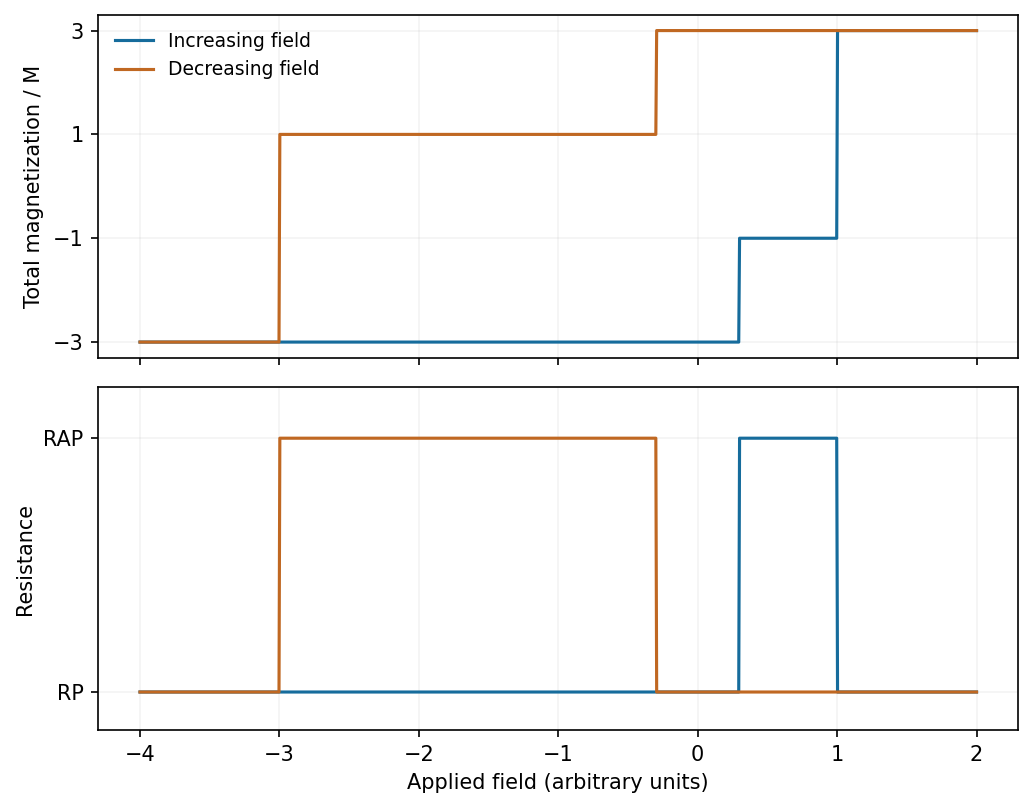
Illustrative major magnetization and resistance loops, with an exchange-shifted reference-layer reversal
. Source. Details. 
Past exam of the MPhil in micro- and nanotechnology enterprise course of the University of Cambridge 2019 Paper 2 Section A(ii) 16 i Solution by Codex 0 2026-10-20
Codex 0 2026-10-20A spin valve contains a magnetically soft free ferromagnet, a thin nonmagnetic metallic spacer and a reference ferromagnet pinned by exchange bias from an antiferromagnet. The recording track's stray field rotates or reverses the free-layer moment while the reference remains approximately fixed. Spin-dependent scattering makes the resistance lower for parallel moments and higher for antiparallel moments. A sense current converts this into a voltage signal, or a fixed voltage into a current signal.
A useful angular approximation is . Biasing the equilibrium moments near gives an approximately linear response to small track fields. Pinning stability, magnetic shielding and the sensor's spatial extent matter for reading adjacent narrow bits.[ref]
Past exam of the MPhil in micro- and nanotechnology enterprise course of the University of Cambridge 2019 Paper 2 Section A(ii) 15 iii Solution by Codex 0 2026-10-20
Codex 0 2026-10-20 Past exam of the MPhil in micro- and nanotechnology enterprise course of the University of Cambridge 2019 Paper 2 Section A(ii) 15 ii Solution by Codex 0 2026-10-20
Codex 0 2026-10-20The wave function vanishes in regions I and III. In region II it is sinusoidal and satisfies . The time-independent equation there isA nonzero stationary state therefore has standing-wave nodes at the two walls; it cannot have a nonzero constant ground-state wave function.
There are unlisted articles, also show them or only show them.