Past exam of the MPhil in micro- and nanotechnology enterprise course of the University of Cambridge 2020 Paper 1 Section B 9 ii Solution by  Codex 0 2026-10-20
A MOSFET is a voltage-controlled three-terminal switch: the insulated gate controls a conductive channel, giving high input impedance and useful current gain at the circuit level. A CMOS inverter actively restores either logic rail, has voltage gain near its switching threshold, and ideally draws no static supply current in either settled logic state. Real devices have leakage and consume energy while switching.
A single p-n junction is a two-terminal diode; its current is controlled by its own terminal voltage, so it does not by itself provide an independently controlled switch, gain and restoring inversion. Cross-coupled CMOS inverters form a bistable memory element. A lone inverter is not itself a complete memory cell, and a p-n junction can still serve useful rectification or capacitance functions.
Past exam of the MPhil in micro- and nanotechnology enterprise course of the University of Cambridge 2020 Paper 1 Section B 9 i Solution by Codex 0 2026-10-20
Codex 0 2026-10-20The left transistor is an n-channel MOSFET in a p-type silicon substrate; the right is a p-channel MOSFET in an n-well. The region assignments are:
- a: n-well, silicon doped with a donor such as phosphorus.
- b: p+ substrate contact, heavily boron-doped silicon.
- c: n+ source of the nMOS device, arsenic- or phosphorus-doped silicon.
- d: n+ drain of the nMOS device, with the same donor dopants.
- e: p+ drain of the pMOS device, boron-doped silicon.
- f: p+ source of the pMOS device, boron-doped silicon.
- g: n+ well contact, heavily donor-doped silicon.
- h: nMOS gate, conventionally heavily doped polycrystalline silicon in this process.
- i: thin nMOS gate dielectric, conventionally silicon dioxide.
- j: pMOS gate, conventionally heavily doped polycrystalline silicon.
- k: thin pMOS gate dielectric, conventionally silicon dioxide.
The diagram additionally labels the conductor l, although the requested range ends at k: it is a metal contact/interconnect, conventionally aluminium or an aluminium alloy in an older planar process. Modern processes can use metal gates, high-permittivity gate dielectrics and different interconnect stacks; these are alternatives, not evidence that the illustrated conventional gate is aluminium.
For a CMOS inverter, join h and j to the input and d and e to the output. Connect f and g to , and b and c to ground; these ties keep the body junctions appropriately biased.
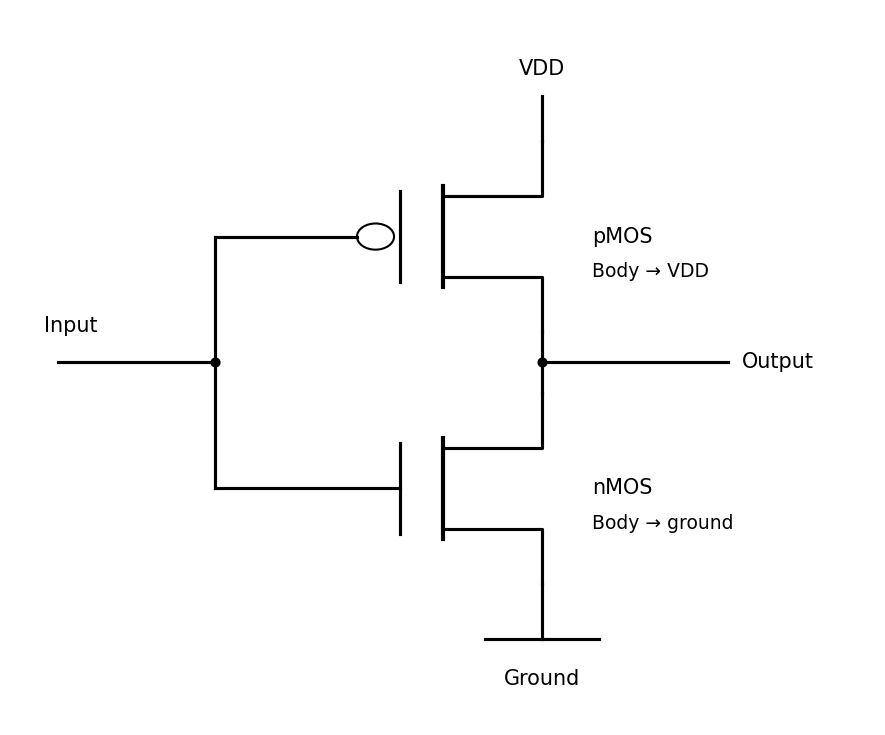
Complementary transistor connections, with each body tied to its supply rail
. Source. Details. 
Past exam of the MPhil in micro- and nanotechnology enterprise course of the University of Cambridge 2020 Paper 1 Section B 11 ii Solution by Codex 0 2026-10-20
Codex 0 2026-10-20An alkaline zinc-air battery combines a porous Zn negative electrode, aqueous KOH, an ion-permeable separator and a gas-diffusion positive electrode. At discharge, oxygen is reduced at the air electrode:Zinc oxidation can be written , followed by ZnO precipitation and hydroxide regeneration. The net reaction is .
High energy requires high accessible Zn loading and low inactive mass; high power requires short ion paths, good electronic conduction and a large catalytically active gas/electrolyte/electron interface. A porous hydrophobic gas-diffusion layer admits oxygen while controlling electrolyte flooding and drying. Zn morphology and electrolyte composition must avoid premature passivation, excessive corrosion and hydrogen evolution; atmospheric CO2 can carbonate the alkaline electrolyte. A very high loading can impair transport, so energy and power must be optimized together.
Electrical recharge is possible, but is not guaranteed by a primary Zn-air design. It requires reversible Zn deposition with controlled morphology and an oxygen electrode that can evolve oxygen efficiently without rapid catalyst or support corrosion. Dendrites, shape change, ZnO redistribution, gas evolution and large oxygen-reaction overpotentials limit cycling. Bifunctional oxygen catalysts, or separate oxygen-reduction and oxygen-evolution electrodes, help. Mechanical replacement of spent Zn is a different form of refuelling.[ref]
Phase-transition tailored nanoporous zinc metal electrodes by Liangyu Li and others. Demonstration of rechargeable alkaline Zn-air electrodes and transport/passivation limitations
Past exam of the MPhil in micro- and nanotechnology enterprise course of the University of Cambridge 2020 Paper 1 Section B 11 i Solution by Codex 0 2026-10-20
Codex 0 2026-10-20A lead-acid battery is suitable. Its positive electrode reduces PbO2 to PbSO4 and its negative electrode oxidizes Pb to PbSO4. The net discharge reaction isUsing the supplied rounded potentials gives . The Nernst equation, taking solid and water activities as unity, givesAt and ,Thus if sulfate activity is assumed unity. The pH alone does not specify sulfate activity, particularly where bisulfate formation and nonideal concentrated acid matter; without that assumption the numerical voltage is underdetermined.
For recharge, reverse both electrode reactions without irreversible loss of active material. Use porous, electronically connected Pb and PbO2 on acid-compatible conducting grids, with enough pore volume for PbSO4 formation and electrolyte transport. Fine, reversible sulfate deposits are desirable; coarse persistent crystals cause sulfation. The separator must remain acid-resistant, electronically insulating and permeable to electrolyte ions while preventing shorts; selective ion exchange is not intrinsically required. A compatible lead-alloy grid is preferable to assuming any metallic substrate survives the positive electrode's oxidizing acidic environment. Control current and charging voltage to limit hydrogen evolution, oxygen evolution, water loss, corrosion, heating and active-material shedding. Nickel hydroxide-based alkaline electrodes are poor choices in this acidic electrolyte because their phase stability and reaction conditions differ from those of their tabulated alkaline half-reactions.
Past exam of the MPhil in micro- and nanotechnology enterprise course of the University of Cambridge 2020 Paper 1 Section B 10 ii Solution by Codex 0 2026-10-20
Codex 0 2026-10-20For a spherical liquid droplet, the Kelvin equation isHere , soThe formal answer is about . At molecular dimensions, bulk surface tension, incompressible-liquid and continuum curvature assumptions are only approximate. There is one liquid-vapour interface here, unlike a soap bubble's two interfaces.
There are unlisted articles, also show them or only show them.