Past exam of the MPhil in micro- and nanotechnology enterprise course of the University of Cambridge 2019 Paper 1 Section B 12 i Solution by  Codex 0 2026-10-20
A thermoelectric generator uses the Seebeck effect and needs a spatial temperature gradient: a couple develops between hot and cold junctions. It can deliver continuous power under a steady thermal gradient and has no moving parts, but requires sustained heat flow and adequate hot- and cold-side thermal contacts. Thermal conduction, internal electrical resistance and the material's thermoelectric figure of merit limit conversion.
A pyroelectric generator responds to a time-dependent spontaneous electric polarization. Under approximately uniform heating or cooling, when the electrical boundary condition allows charge flow. It can harvest temporal thermal fluctuations without a persistent spatial gradient. However, at a constant uniform temperature its ordinary pyroelectric current stops; practical extraction needs cycling, low-leakage electronics and a suitable load. A large open-circuit voltage is not evidence of a large available average power. Temperature-driven nanowire measurements provide a primary experimental example of this distinction.[ref]
Past exam of the MPhil in micro- and nanotechnology enterprise course of the University of Cambridge 2019 Paper 1 Section B 11 iv Solution by Codex 0 2026-10-20
Codex 0 2026-10-20At unchanged intrinsic catalyst kinetics, increasing the electrochemically accessible true area by multiplies exchange current per geometric area by . Equivalently, the local current density at a fixed total geometric current falls by . Each Tafel equation activation loss decreases by :Thus and , an increase of , or about . Power does not increase a hundredfold, because the voltage improvement is logarithmic and the specified geometric current is unchanged. This assumes both electrodes gain accessible active area, the original exchange currents use the original area basis, and the porous structure does not introduce additional transport or Ohmic losses.
Past exam of the MPhil in micro- and nanotechnology enterprise course of the University of Cambridge 2019 Paper 1 Section B 11 iii Solution by Codex 0 2026-10-20
Codex 0 2026-10-20The reversible voltage follows from the two-electron hydrogen reaction:At the specified geometric current density, the magnitude of each activation loss follows its Tafel equation, :Both losses reduce the delivered fuel cell voltage. Therefore and . The very small oxygen exchange current is responsible for most of the activation loss. The calculation uses current densities on a common area basis, unit water activity and the stated gas conditions, and neglects the losses the problem excludes.
Past exam of the MPhil in micro- and nanotechnology enterprise course of the University of Cambridge 2019 Paper 1 Section B 11 ii Solution by Codex 0 2026-10-20
Codex 0 2026-10-20In a galvanic cell, a spontaneous oxidation-reduction reaction supplies electrical work: for discharge, the anode is negative, and the cathode positive. A discharging electric battery and a hydrogen–oxygen fuel cell are two practical examples. The first stores its reactants internally; the second is supplied continuously with fuel and oxidant.
An electrolytic cell consumes externally supplied electrical work to drive electrode reactions or material transfer under an applied potential. Its anode is positive and cathode negative. water electrolysis for hydrogen production and metal electroplating are two practical examples. oxidation always occurs at the anode and reduction at the cathode in both cell types; the electrode signs change. The electrolyte conducts ions, while electrons flow through the external circuit. A rechargeable battery can operate in either regime depending on whether it is discharging or being charged.
Past exam of the MPhil in micro- and nanotechnology enterprise course of the University of Cambridge 2019 Paper 1 Section B 11 i Solution by Codex 0 2026-10-20
Codex 0 2026-10-20The oxygen-pressure exponents can be explained by a change in the dominant charge state of metal vacancies, with holes carrying the p-type current. For a divalent metal oxide, a doubly negative metal vacancy is in Kröger–Vink notation. A conventional oxygen-incorporation reaction isTreating regular oxygen-site activity as constant, the law of mass action gives . If these are the compensating defects, charge neutrality gives , hence and , assuming nearly constant hole mobility.
For singly negative vacancies, useNow and , so . The charge-state equilibrium gives : the singly charged fraction can therefore dominate as oxygen pressure and hole concentration increase. This is a consistent dilute-defect model, not a unique experimental identification of every defect. Changes in mobility, defect association or other compensating defects require independent tests.
Past exam of the MPhil in micro- and nanotechnology enterprise course of the University of Cambridge 2019 Paper 1 Section B 10 iii Solution by Codex 0 2026-10-20
Codex 0 2026-10-20For two equal spheres, the Derjaguin approximation uses . A planar nonretarded Van der Waals force interaction has energy per area , soThe force is attractive, with magnitude , taking separation increase as positive. Using the sphere–plane value of would overestimate it by a factor of two. The gap is much smaller than either radius, as required. Treat the supplied Hamaker constant as the effective one for the intervening medium; roughness, solvation and molecular-scale contact can modify a literal experiment.
Past exam of the MPhil in micro- and nanotechnology enterprise course of the University of Cambridge 2019 Paper 1 Section B 10 ii Solution by Codex 0 2026-10-20
Codex 0 2026-10-20Balance upward surface-tension force against the weight of the liquid column. The capillary action isWith perfect wetting, , , and , . The diameter, not the radius, is . This neglects the small meniscus-volume correction, gas-density buoyancy and contact-angle hysteresis.
Past exam of the MPhil in micro- and nanotechnology enterprise course of the University of Cambridge 2019 Paper 1 Section A(iii) 7 ii Solution by Codex 0 2026-10-20
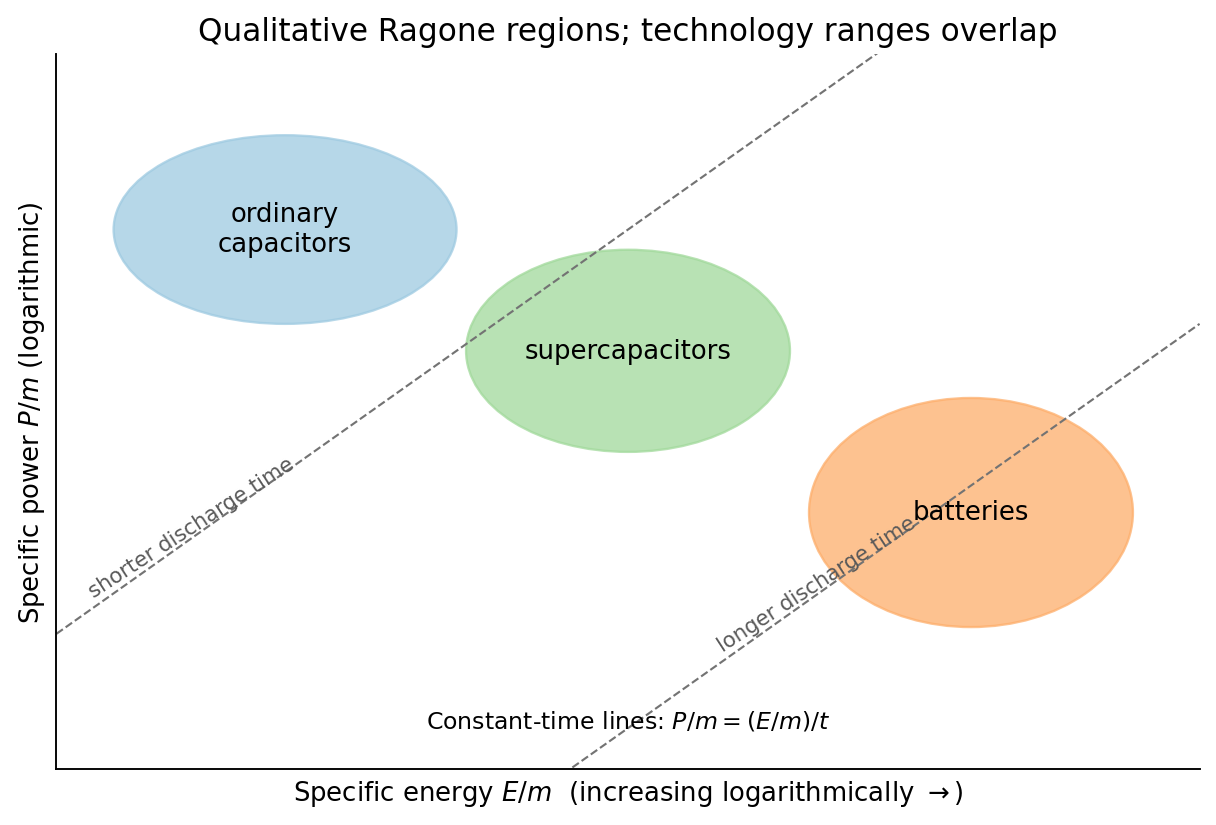
Codex 0 2026-10-20An ordinary capacitor stores energy by separating charge across a dielectric: and . Electronic charge redistribution is rapid, giving high specific power, but the dielectric breakdown field and modest capacitance limit specific energy. Series resistance limits pulse power and produces heating; a large nominal capacitance does not remove those losses.
A supercapacitor has a much larger interfacial area and nanometre-scale charge separation. An electric double-layer capacitor stores charge without a bulk redox transformation; pseudocapacitance adds sufficiently fast surface or near-surface redox storage. ion motion in pores, electrolyte stability and series resistance constrain its response. Its specific energy usually exceeds an ordinary capacitor's while high specific power and cycling durability remain possible.
An electric battery stores chemical free energy through coupled electrode oxidation-reduction reactions. It can store substantial energy per mass, but charge transfer, ionic transport, diffusion and heat removal constrain rapid discharge. The terminal voltage and accessible capacity depend on discharge rate and state of charge. Accordingly the plotted order follows the storage and transport mechanisms; it is not a claim that every battery has less power than every supercapacitor.
Past exam of the MPhil in micro- and nanotechnology enterprise course of the University of Cambridge 2019 Paper 1 Section A(iii) 7 i Solution by Codex 0 2026-10-20
Codex 0 2026-10-20A Ragone plot has specific energy on its horizontal logarithmic axis and specific power on its vertical logarithmic axis, normally in and . The comparison must use the same mass convention: complete devices cannot fairly be compared with electrode-active-material values. At approximately constant delivered power, the discharge time isThus constant-time lines slope upward on the log–log plot. Ordinary capacitors lie toward high power and low energy; batteries toward higher energy and lower power; supercapacitors bridge the two. Technology and operating limits produce overlapping regions, not universal sharp boxes.

Past exam of the MPhil in micro- and nanotechnology enterprise course of the University of Cambridge 2019 Paper 1 Section A(iii) 6 ii Solution by Codex 0 2026-10-20
Codex 0 2026-10-20With , the standard reaction Gibbs free energy and dimensionless equilibrium constant areFor the reaction as written, , and the Nernst equation gives . Consequently zero cell potential requires under the specified unit-activity-coefficient assumption. Reversing that ratio reverses the conclusion. This mathematical ratio does not by itself guarantee experimentally attainable concentrations without precipitation or other chemistry.
Past exam of the MPhil in micro- and nanotechnology enterprise course of the University of Cambridge 2019 Paper 1 Section A(iii) 5 iii Solution by Codex 0 2026-10-20
Codex 0 2026-10-20In the high-surface-potential Schulze-Hardy rule, the critical coagulation concentration scales approximately as with the counterion valence. HenceThe more highly charged counterion therefore requires about eleven times less concentration in this idealized estimate. This assumes the cations are the counterions of a negatively charged surface, the surface-potential regime is appropriate, and the only changing mechanism is electrostatic stabilization. Specific adsorption and hydrolysis of aluminium ions can invalidate this scaling; matching ionic strengths instead is not the same prediction.
There are unlisted articles, also show them or only show them.