
Chapter IV; inspected §§70–75.
Chapter III, pp. 119–155; inspected §§61–64.
The metre, symbol , is the SI base unit of measurement for length. It is defined by fixing the speed of light in vacuum to , with the second defined independently. Thus light in vacuum travels one metre in of a second.
The exact defining constant does not make every measured length exact. Realizing a length standard can involve optical interferometry, frequency references, alignment and corrections for propagation through air; their imperfections contribute to measurement uncertainty. The definition specifies the reference, whereas an experiment supplies an imperfect realization.[ref]
The International System of Units (SI), ninth edition, SI Brochure. section 2.3.1: definition of the metre
In 1947, Willis Eugene Lamb Jr. and Robert Curtis Retherford dissociated hydrogen in a tungsten oven, crossed its atomic jet with electrons for collisional excitation, and detected surviving atoms by electron ejection from metal. An electrometer and galvanometer read the current. They interrupted fixed-frequency microwaves while sweeping the static magnetic field; a flip coil calibrated the field. Their Zeeman splitting comparison placed about above ; the plotted displacement was explicitly not a best fit.[ref]
Fine Structure of the Hydrogen Atom by a Microwave Method by Willis Eugene Lamb Jr. and Robert Curtis Retherford. Fine Structure of the Hydrogen Atom by a Microwave Method, pp. 241–243, Figs. 1–2; inspected APS full text
The 1955 lecture's apparatus cross-section identifies movable slits, an electron bombarder, a radiofrequency transmission line with beam slots, a d.c. quenching electrode, metal target, electron collector, and magnet poles. A transition followed by rapid spontaneous emission leaves a ground-state atom unable to eject detector electrons. The scan holds radiofrequency and amplitude fixed. Natural linewidth and unresolved hyperfine structure broaden resonances, whose analysis yields zero-field separations.[ref]
Fine Structure of the Hydrogen Atom by Willis Eugene Lamb Jr.. Fine Structure of the Hydrogen Atom, delivered December 12, 1955; Columbia-hosted Nobel Lectures scan, printed pp. 288–290, Figs. 2–7
Static electric field quenching supplied a control. The 1947 report identifies natural linewidth, hyperfine structure, excessive microwave intensity, and field inhomogeneity as width contributions, and flags imperfect magnetic calibration. It does not specify an absolute microwave-frequency calibration procedure.[ref]
Fine Structure of the Hydrogen Atom by a Microwave Method by Willis Eugene Lamb Jr. and Robert Curtis Retherford. pp. 242–243, Fig. 1 caption and discussion of proposed refinements
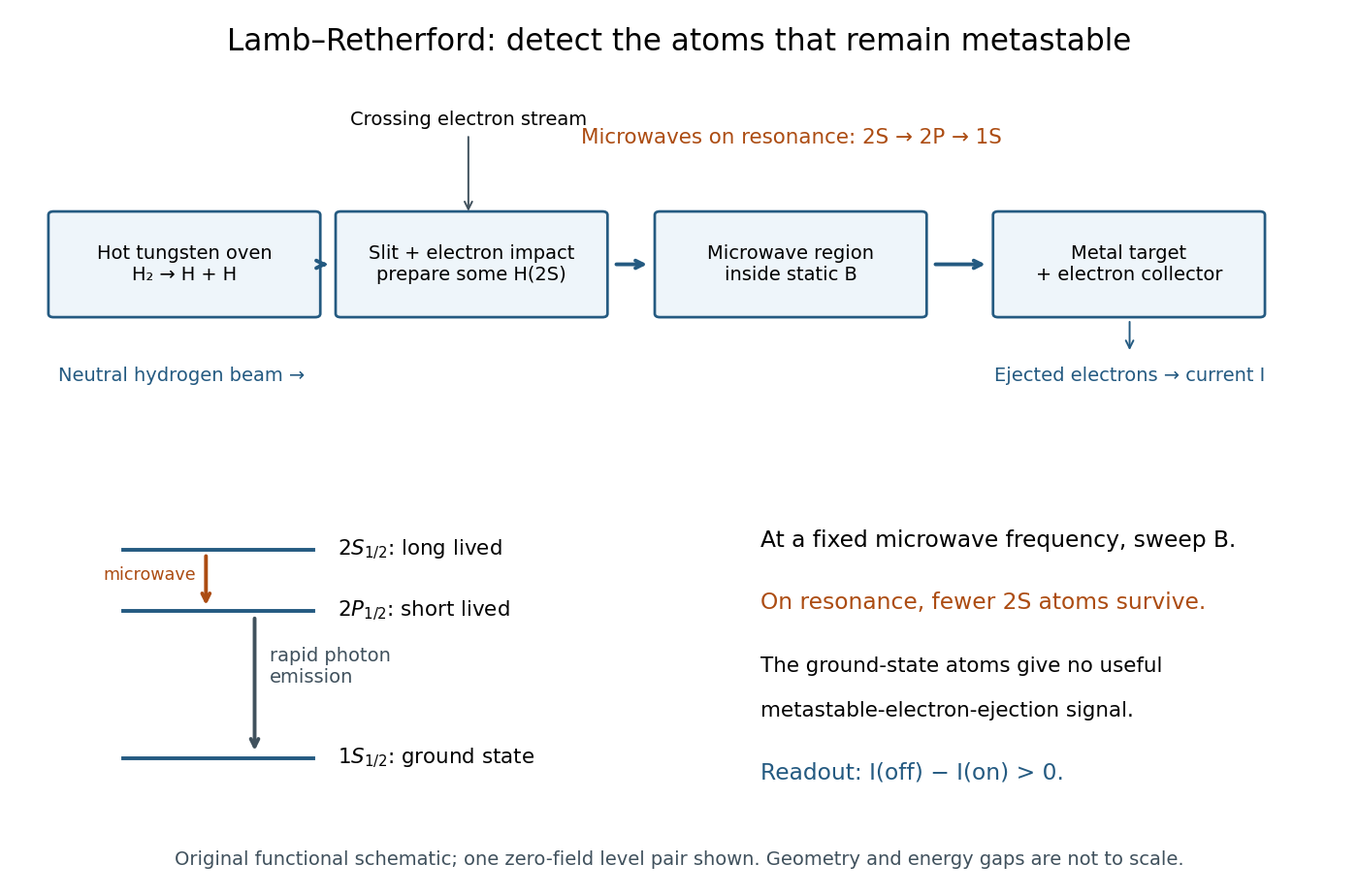
Metastable beam preparation and electron-current readout
. Original functional schematic of the Lamb-Retherford measurement principle, based on the apparatus descriptions above. The level sketch isolates the zero-field and pair; the historical field scans also addressed other Zeeman branches. Geometry and energy gaps are not to scale. Details.
The surname is Robert Curtis Retherford's: “Retherford” and “Rutherford” name different people. The historical Lamb-Retherford experiment should retain the former spelling.[ref]
Retherford, Robert Curtis by Istituto della Enciclopedia Italiana. Retherford, Robert Curtis, professional biography and account of the 1947 experiment
The zero-field energy levels here are averaged over hyperfine structure; is the Planck constant. Electron self-energy and vacuum polarization produce radiative corrections. Self-energy describes the bound electron's radiative interaction with its own electromagnetic field. Precision predictions also include nuclear recoil and proton charge radius effects; assigning recoil terms to the reference or Lamb shift is convention-dependent. A finite proton charge radius changes binding independently of radiative effects.[ref]
A vacuum-electric field “jiggling” picture motivates one contribution, not every hydrogen atom energy correction.
There are unlisted articles, also show them or only show them.