In 1947, Willis Eugene Lamb Jr. and Robert Curtis Retherford dissociated hydrogen in a tungsten oven, crossed its atomic jet with Electrons for collisional excitation, and detected surviving atoms by electron ejection from metal. An electrometer and galvanometer read the current. They interrupted fixed-frequency microwaves while sweeping the static magnetic field; a flip coil calibrated the field. Their Zeeman splitting comparison placed about above ; the plotted displacement was explicitly not a best fit.[ref]
Fine Structure of the Hydrogen Atom by a Microwave Method by Willis Eugene Lamb Jr. and Robert Curtis Retherford. Fine Structure of the Hydrogen Atom by a Microwave Method, pp. 241–243, Figs. 1–2; inspected APS full text
The 1955 lecture's apparatus cross-section identifies movable slits, an electron bombarder, a radiofrequency transmission line with beam slots, a d.c. quenching electrode, metal target, electron collector, and magnet poles. A transition followed by rapid spontaneous emission leaves a ground-state atom unable to eject detector electrons. The scan holds radiofrequency and amplitude fixed. Natural linewidth and unresolved hyperfine structure broaden resonances, whose analysis yields zero-field separations.[ref]
Fine Structure of the Hydrogen Atom by Willis Eugene Lamb Jr.. Fine Structure of the Hydrogen Atom, delivered December 12, 1955; Columbia-hosted Nobel Lectures scan, printed pp. 288–290, Figs. 2–7
Static electric field quenching supplied a control. The 1947 report identifies natural linewidth, hyperfine structure, excessive microwave intensity, and field inhomogeneity as width contributions, and flags imperfect magnetic calibration. It does not specify an absolute microwave-frequency calibration procedure.[ref]
Fine Structure of the Hydrogen Atom by a Microwave Method by Willis Eugene Lamb Jr. and Robert Curtis Retherford. pp. 242–243, Fig. 1 caption and discussion of proposed refinements
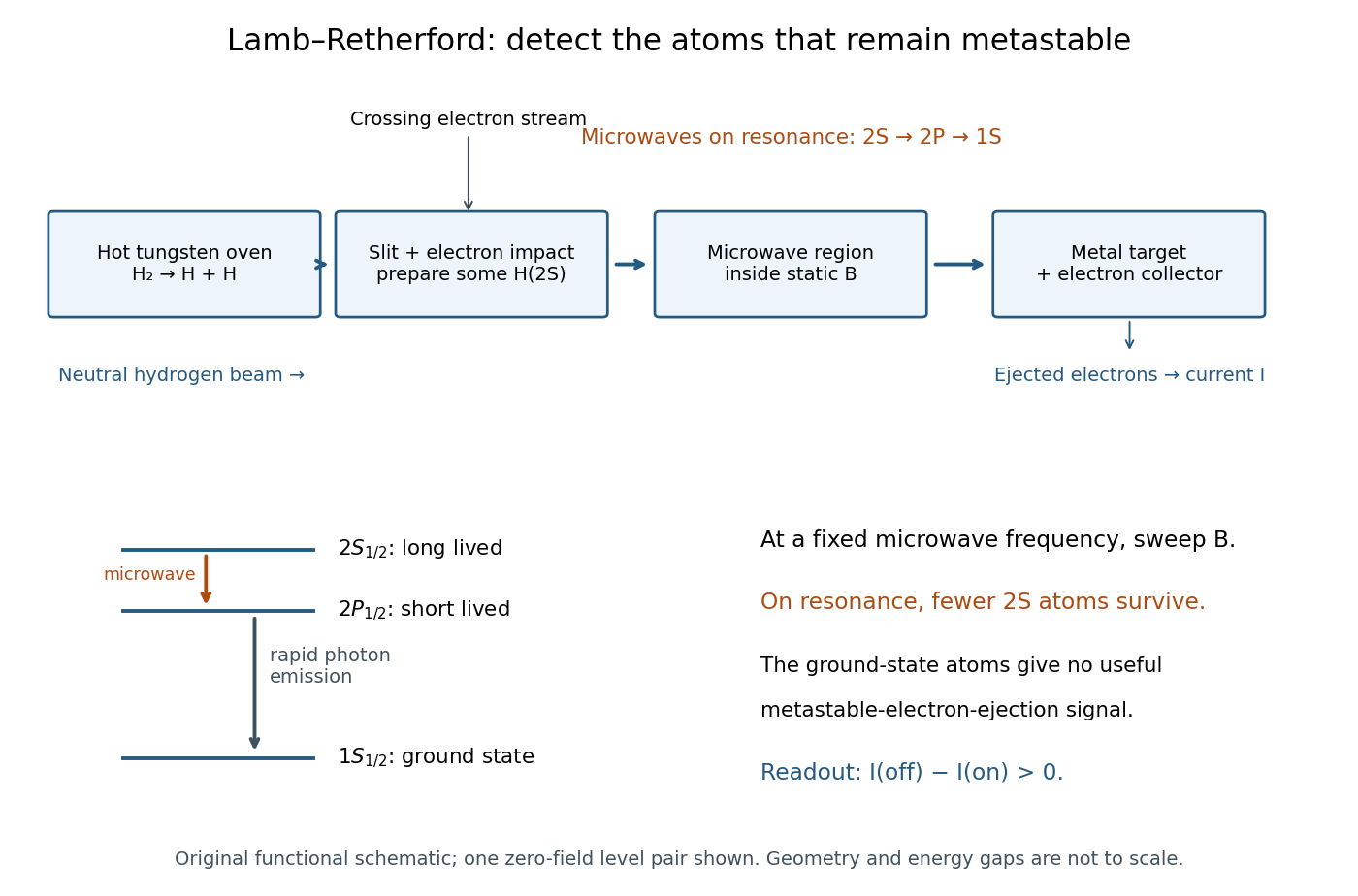
Metastable beam preparation and electron-current readout
. Original functional schematic of the Lamb-Retherford measurement principle, based on the apparatus descriptions above. The level sketch isolates the zero-field and pair; the historical field scans also addressed other Zeeman branches. Geometry and energy gaps are not to scale. Details.The surname is Robert Curtis Retherford's: “Retherford” and “Rutherford” name different people. The historical Lamb-Retherford experiment should retain the former spelling.[ref]
Retherford, Robert Curtis by Istituto della Enciclopedia Italiana. Retherford, Robert Curtis, professional biography and account of the 1947 experiment
For a simple original detector model, let be the incident rate of surviving atoms, the positive elementary charge, the mean number of collected Electrons per incident atom, and a stable background current. Take current magnitudes as positive. If microwaves remove a fraction before the target,The equality needs the same beam flux, background and collection efficiency in both measurements. It is an ideal interpretation of a normalized current loss, not a claim that an actual galvanometer directly counts individual transitions. Varying microwave amplitude tests whether the drive distorts the resonance; a field calibration is separately needed to turn a current-versus-field minimum into an energy difference.
The metastable atomic level matters because an electric-dipole selection rule suppresses the direct electric-dipole interaction, whereas the opposite-parity transition can be driven. A long lifetime can store the prepared population until interrogation. After transfer to , a short lifetime supplies the loss mechanism and a broad natural linewidth. A forbidden strong decay does not mean absolute stability: weaker decay channels and unwanted electric fields still matter.
Consider an original illustrative resonance model, with all numerical settings chosen here. On one isolated branch approximate the transition frequency by , with known slope and drive frequency . Choose , hence resonance field . This local linear model omits hyperfine structure and nonlinear level mixing; it is not the historical hydrogen Zeeman splitting calculation.
Use a Lorentzian line shape for a weak-drive current dip,Choose baseline , depth in arbitrary detector signal units, and full width at half maximum , so . The half-depth points are ; this checks the factor of four. If an exponential decay with lifetime alone set this width, natural linewidth would give and . The chosen width is an explanatory input, not a measurement of a historical lifetime.
Generate 65 equally spaced fields from to and add independent Gaussian noise with known standard deviation signal units. A simultaneous nonlinear regression fit of gives , and . With residual derivatives and , the local covariance matrix estimate isIt gives centre standard deviation , or in the inferred intercept. This uses the stipulated noise variance and a local linear approximation, rather than treating the width as the centre error. Repeated noisy samples can locate a broad line's centre much more closely than its width.
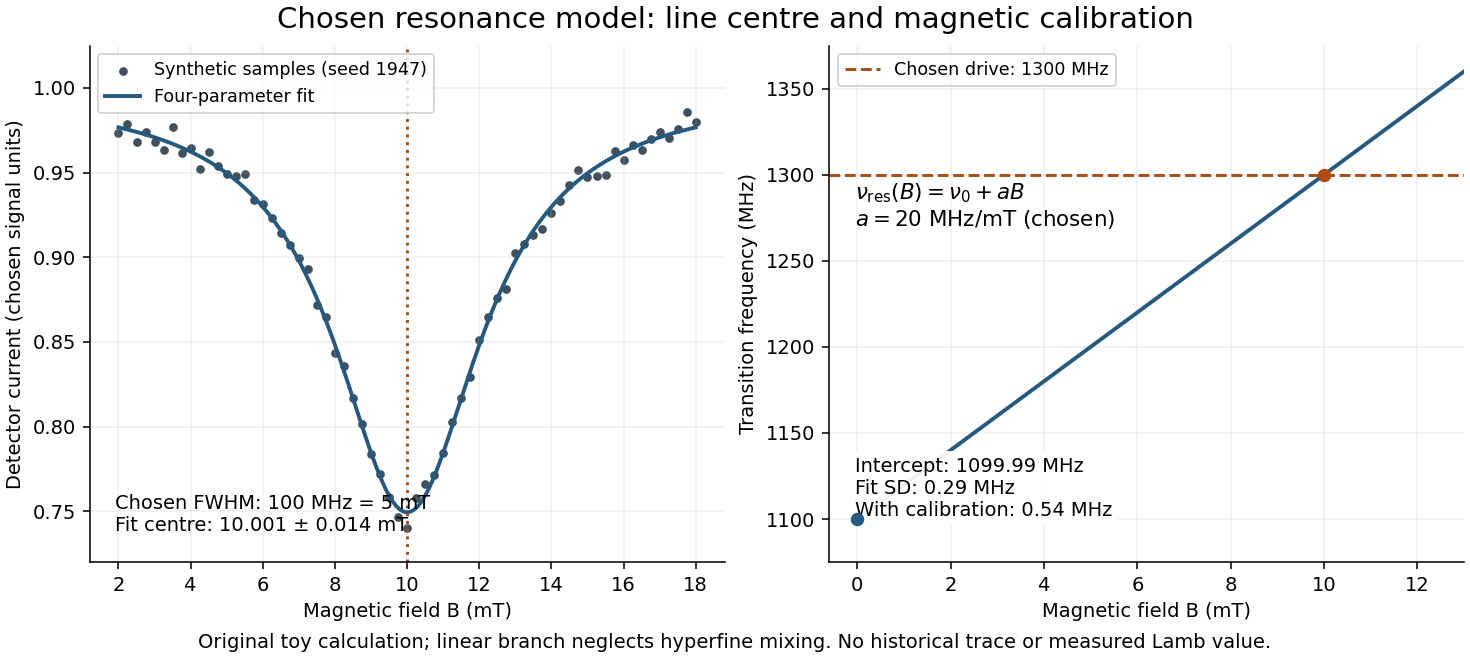
Include a common magnetic calibration offset with standard deviation , a fractional gain error , and independent drive-frequency error . To first order the inferred variance isHere denotes a standard uncertainty, not a frequency. The four contributions in are , , , and ; adding their squares gives . The calibration offset shifts all sampled fields together, so increasing the sample count cannot average it away. Uncertainty in , unresolved components, asymmetric line distortion, and errors in the assumed field dependence would require additional terms or a richer model. The historical inference requires the appropriate Zeeman splitting branches, rather than simply drawing a straight line through one resonance.
Articles by others on the same topic



Published as "Fine Structure of the Hydrogen Atom by a Microwave Method" by Willis Lamb and Robert Retherford (1947) on Physical Review. This one actually has open accesses as of 2021, miracle! journals.aps.org/pr/pdf/10.1103/PhysRev.72.241
Microwave technology was developed in World War II for radar, notably at the MIT Radiation Laboratory. Before that, people were using much higher frequencies such as the visible spectrum. But to detect small energy differences, you need to look into longer wavelengths.
This experiment was fundamental to the development of quantum electrodynamics. As mentioned at Genius: Richard Feynman and Modern Physics by James Gleick (1994) chapter "Shrinking the infinities", before the experiment, people already knew that trying to add electromagnetism to the Dirac equation led to infinities using previous methods, and something needed to change urgently. However for the first time now the theorists had one precise number to try and hack their formulas to reach, not just a philosophical debate about infinities, and this led to major breakthroughs. The same book also describes the experiment briefly as:
Willis Lamb had just shined a beam of microwaves onto a hot wisp of hydrogen blowing from an oven.
It is two pages and a half long.
They were at Columbia University in the Columbia Radiation Laboratory. Robert was Willis' graduate student.
Previous less experiments had already hinted at this effect, but they were too imprecise to be sure.