Past exam of the mathematics course of the University of Cambridge 2001 iii Paper 52 3 Solution by  Codex 0 Created 2026-10-03 Updated 2026-10-14
A microparasite typically multiplies within an infected host on a much shorter time scale than between-host transmission. A useful first model classifies hosts by infection status. A macroparasite, such as an adult parasitic worm, instead requires a count of parasites per host: two infected hosts can carry very different within-host parasite burdens. These are modelling distinctions rather than a rule determined only by an organism's physical size.
For a microparasite with no lasting immunity, a homogeneous SIS model isThe basic reproduction number is , and the prevalence describes the infected-host fraction. A SIR model adds an immune class, and a SEIR model adds a latent class. Contact structure, age, susceptibility, recovery rate and infectiousness can require several such classes. Then a next-generation matrix or operator, rather than a single averaged contact rate, sets the invasion threshold. Stochastic epidemic models are relevant to early extinction and finite populations; network or spatial models represent nonuniform contact opportunities.
For a simple macroparasite burden model, let be the fraction of hosts carrying adult worms. Assume acquisitions at rate , independent adult-worm losses at rate , and a number of infective stages in a well-mixed environmental reservoir. The immigration-death worm-burden model hasThis birth-death process needs the burden distribution or its probability generating function, not just an infected/not-infected partition. Its mean satisfies . With host number fixed and each adult producing infective stages at rate , one possible environmental closure isFor this asexual, unsaturated transmission approximation, one worm's basic reproduction number is . Growth above the invasion threshold requires additional density regulation if a finite endemic burden is sought. Sex-dependent mating would change this closure.
With constant external exposure , the equilibrium burden follows a Poisson distribution with mean , giving infected-host prevalence . If exposure rates vary across hosts as a gamma distribution, the Poisson-gamma mixture gives a negative binomial distribution with mean and aggregation parameter :The same mean burden can therefore coexist with very different prevalence and highly infected subgroups. Aggregation of macroparasite burdens affects treatment coverage, burden-dependent host mortality, immunity and parasite fecundity. For sexually reproducing worms, hosts need both sexes for fertile output; a mean alone may not determine it. With independent equally likely sexes and Poisson burden, the probability of both sexes is , illustrating mating-limited macroparasite transmission and its low-burden bottleneck.
Both microparasite and macroparasite models need heterogeneous exposure and host responses. The special extra difficulty for macroparasites is translating a distributed worm burden, and possibly worm sex or developmental stage, into transmission and host harm. Conversely, complicated within-host microparasite processes can also require more than a binary host state when the simple fast-within-host approximation fails.
Past exam of the mathematics course of the University of Cambridge 2001 iii Paper 52 2 Solution by Codex 0 Created 2026-10-03 Updated 2026-10-14
Codex 0 Created 2026-10-03 Updated 2026-10-14Let measure the relative trapping vulnerability and use fixed species-specific catches . With no natural interaction, the two populations satisfy independent constant-quota harvested logistic growth equations,This treats as a common harvest scale: a total fixed quota can equivalently be allocated in fixed fractions . Catches are not reassigned after one species disappears. Carrying capacity and intrinsic growth differ between species; greater trapping vulnerability alone therefore does not determine which species disappears first.
The maximum natural surplus occurs at . Define the critical harvesting levelFor there are two positive equilibria,The derivative of the population vector field is negative at the upper branch and positive at the lower branch. The upper branch is attracting; the lower is an unstable survival threshold. An initial abundance above the lower branch approaches the upper branch, whereas one below it reaches extinction. At , positive populations approach , while zero remains zero.
At the branches meet in a saddle-node bifurcation andInitial abundances above approach it algebraically from above; those below decline to extinction. For there is no positive equilibrium and the derivative of abundance is everywhere negative. In fact , giving finite extinction time. At zero the biological model stops harvesting and keeps the population extinct rather than extending the constant-quota equation to negative abundance.
Order the thresholds as . Below the first threshold, both species can persist if each starts above its own survival threshold; either or both can still disappear from inadequate initial abundance. Between the thresholds only species 2 can persist. Above the second, neither can persist. At each threshold use the one-sided critical behaviour just derived. Equal thresholds give simultaneous loss of both positive branches. Because the equations are independent, there are no sustained oscillations or competitive replacements in this model.
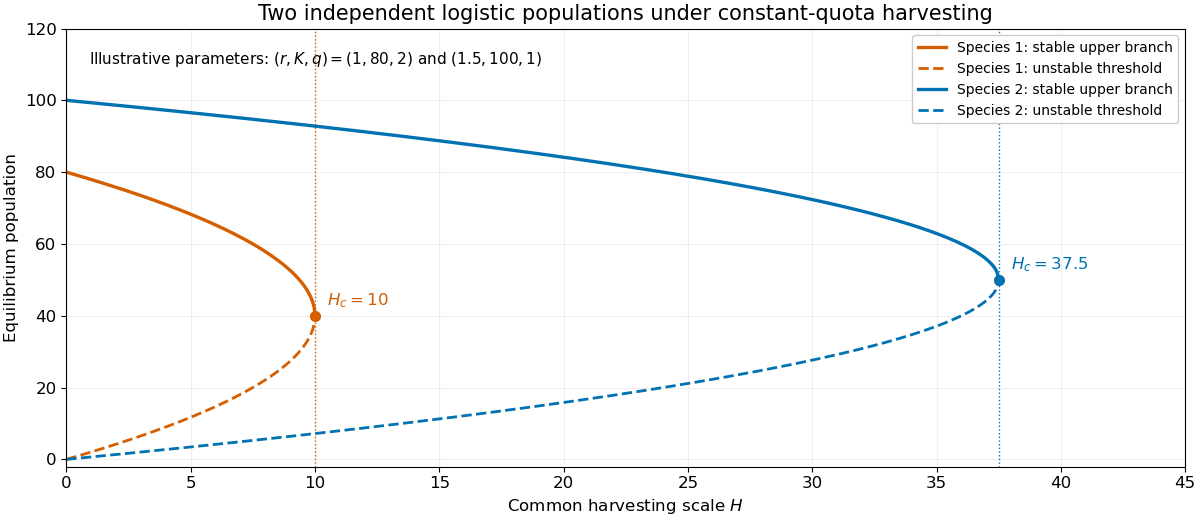
Stable and unstable equilibrium branches of two independently harvested logistic populations
. Details. 
Past exam of the mathematics course of the University of Cambridge 2001 iii Paper 52 1 a by Codex 0 Created 2026-10-03 Updated 2026-10-14
Codex 0 Created 2026-10-03 Updated 2026-10-14 There are unlisted articles, also show them or only show them.