The SIR model is a mathematical model of an epidemic that follows three groups: a susceptible compartment whose members can acquire infection, an infectious compartment whose members can pass it on, and a removed compartment whose members neither acquire nor pass on infection. The letters stand for susceptible, infectious and recovered or removed. Here we study the simplest closed, constant-parameter version, with homogeneous mixing and no births, deaths, migration or waning immunity. A person who leaves the infectious compartment never returns to the susceptible compartment in this version.[ref]
https://ocw.mit.edu/courses/1-022-introduction-to-network-models-fall-2018/fe3c864fd7d2d45ed7fe65e601d9c69e_MIT1_022F18_lec20.pdf. Amir Ajorlou, MIT Lecture 20: Epidemics, slides 18 and 24
The appeal of the SIR model is that one can explain a rise and fall in the infectious compartment without changing anyone's behavior: fewer opportunities for new infection eventually reverse the growth. The SIR first integral even determines the SIR infection peak without computing its time. These are useful deductions from explicit assumptions. The stipulated numbers below illustrate the mathematical model; they are neither estimates for an actual disease nor a forecast or medical advice.
Kermack and McKendrick's 1927 paper, "A contribution to the mathematical theory of epidemics", in Proceedings of the Royal Society A, is an early foundation for the SIR model. Its DOI is
10.1098/rspa.1927.0118, also recorded in the Royal Society's archive of contemporary referee reports.[ref]https://doi.org/10.1098/rspa.1927.0118. Kermack and McKendrick, original 1927 paper
[ref]https://catalogues.royalsociety.org/CalmView/Record.aspx?id=RR%2F35%2F131&src=CalmView.Catalog. Royal Society archive: contemporary referee report and publication record
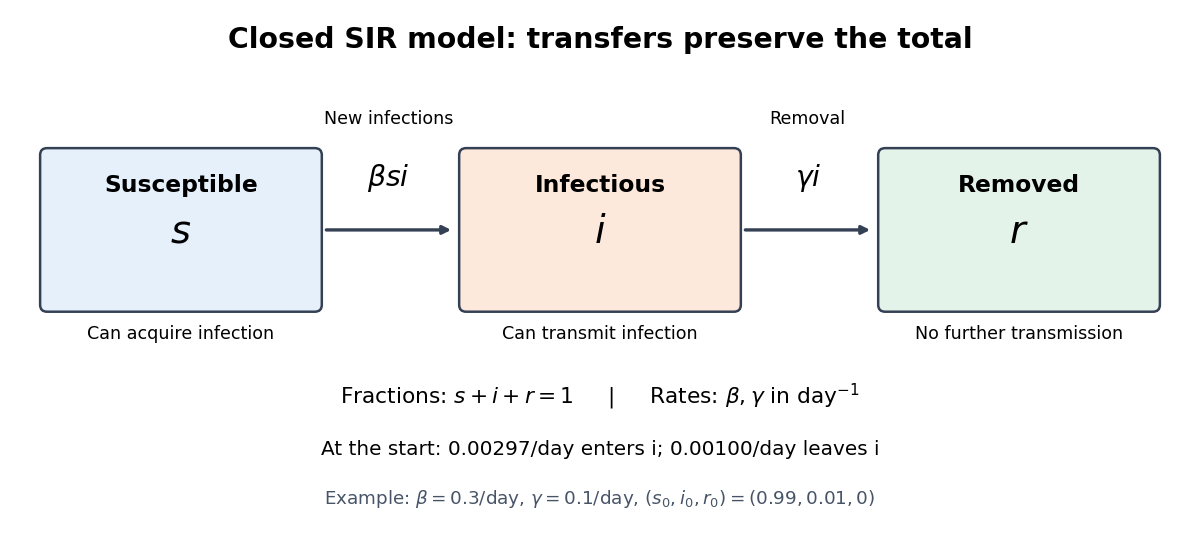
Transfers between the three compartments of the SIR model
. The SIR model equations transfer a fraction per day from the susceptible compartment to the infectious compartment, and a fraction per day from the infectious compartment to the removed compartment. Each arrow contributes a loss to one group and an equal gain to another, giving conservation of population. Details.
The susceptible compartment consists of people who can acquire infection. In the closed SIR model, is their count and their fraction of the fixed total . Membership expresses the assumptions of the mathematical model, rather than measuring the strength of an individual's immunity.
The infectious compartment consists of people currently able to transmit infection. In the closed SIR model, is their count and their fraction of the fixed total . The SIR model has no separate delay between acquiring infection and entering the infectious compartment; the SEIR model adds such a stage.
The removed compartment consists of people permanently excluded from both acquiring and passing on infection in the SIR model. Its count is and its fraction is . Removal can represent regained health with lasting immunity, or another permanent exclusion from acquiring or passing on infection; it need not mean being healthy again. Here there are no deaths. In a variant that counts deaths within , conservation of population would concern the original cohort, rather than the number currently alive.[ref]
For frequency-dependent transmission, the closed SIR model is a system of ordinary differential equations for the fractions :Here is the coefficient of frequency-dependent transmission, and is the recovery rate, interpreted more generally as the removal rate. Both have units of inverse time. With a constant recovery rate, the associated individual time in the infectious compartment has an exponential distribution with mean ; the SIR model does not require every person to spend exactly that long there. The fractions themselves have no units.[ref]
For counts , , , the same SIR model equations readThe factor keeps the same in both descriptions. Dropping it while keeping these units would fail dimensional analysis. Some existing SIR model variants use the unnormalized mass-action infection convention instead, including the SIR susceptible-recovered identity; their coefficient is in the notation used here.
Adding the SIR model equations gives , a short proof of conservation of population. Nonnegative starting fractions stay nonnegative: the outflow from either the susceptible compartment or the infectious compartment vanishes when that group is empty, while . Thus the susceptible compartment can only shrink and the removed compartment can only grow.
For a concrete initial value problem, stipulateAt the start, the flow into the infectious compartment is of the total per day, and the flow into the removed compartment is of the total per day. Hence per day. If , these correspond to model rates of and people per day, and net growth people per day. A rate need not be an integer count of events on any particular day.
For this SIR model, the basic reproduction number isIt describes one introduced member of the infectious compartment in an otherwise wholly susceptible compartment. The instantaneous reproduction number at the actual starting state is , obtained by freezing the current conditions and the current susceptible compartment's fraction. More generally it is in this SIR model. The basic reproduction number is a ratio of two rates, so it has no units; is a different quantity, the initial removed compartment's fraction.
While , its instantaneous relative growth isInitially this equals . Freezing gives the early exponential growth approximation with measured in days. It must fail as the susceptible compartment shrinks. An epidemic invasion threshold occurs at ; if , the deterministic SIR model stays at even above that threshold.
For , the SIR model equations have the first integral of an ordinary differential equationHere is the natural logarithm. A short proof outline is to use the chain rule and substitute the SIR model equations:The SIR first integral gives directly from , so it describes the curve in a phase portrait even before its time parametrization is known.
If and , the infectious compartment initially grows. The SIR model equations give its unique later maximum whenBefore this SIR infection peak, ; afterward it is negative because the susceptible compartment keeps shrinking. Substituting into the SIR first integral givesFor the stipulated initial value problem,Thus about of the modelled population belongs to the infectious compartment simultaneously at the SIR infection peak. This is a peak of the infectious compartment, not of incidence, whose flow is . If , the maximum is already at the start and the interior SIR infection peak formula does not apply.
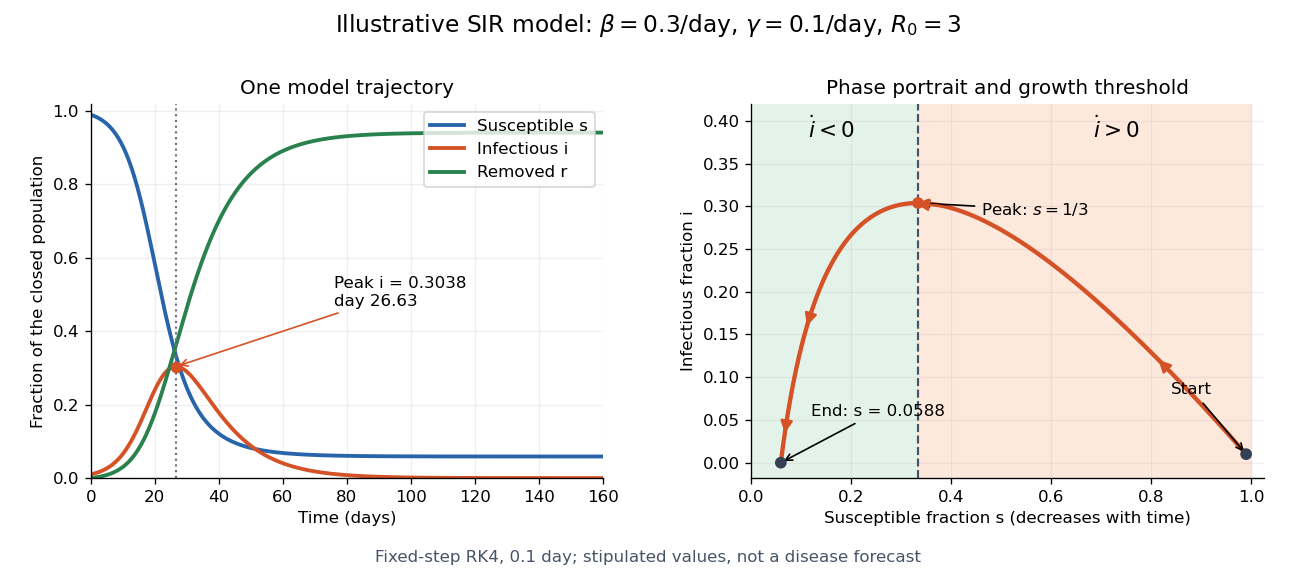

The numerical solution of a differential equation puts the SIR infection peak at about day with , agreeing with the SIR first integral to within . The accompanying generator checks nonnegative fractions and conservation of population without clipping or rescaling. For steps , and day, the largest differences between successive numerical trajectories at shared times are approximately and . Their ratio is , close to the factor expected when a fourth-order Runge-Kutta method's step is halved.
For the closed SIR model with , the infectious compartment's fraction approaches . One proof outline uses the bounded, increasing removed compartment's fraction: since , the total time-integrated is finite. The bounded derivative from the SIR model equations prevents indefinitely recurring spikes, so tends to zero.
For , the final size relation for an epidemic follows by dividing the SIR model equations for and while , giving . Integration then yieldsThis also follows from the SIR first integral and conservation of population. For the stipulated initial value problem, solveThe bisection method givesAbout of the original population remains in the susceptible compartment. The is the final removed compartment's fraction, including the initially in the infectious compartment. The newly acquired infection during the modelled period accounts for of the total population, not . Dividing by instead gives the proportion of initially susceptible compartment members who acquire infection; its denominator must be stated.
At the SIR infection peak, the flow into the infectious compartment only balances its outflow; it does not stop. Further infection explains why the final susceptible compartment's fraction is well below . Also for and finite : the closed SIR model does not require everybody to acquire infection before its infectious compartment empties in the long-time limit.
Here and weight susceptibility and infectiousness of a farm with animals, with size distribution and recovery rate . The rank-one next-generation matrix has reproduction number . Susceptibility proportional to size preferentially depletes large susceptible farms. Infectivity heterogeneity alone leaves an exactly homogeneous aggregate SIR trajectory for representative initial infections. When both weights equal size, the second rather than first size moment governs invasion.
In this discrete-time SIR model, each infected vertex is infectious for one step, can infect each susceptible neighbour with probability , and is then permanently removed. The adjacency matrix of a graph describes the possible transmissions. If the initial removed set is empty, eventual removal and ever becoming infected are the same event.
The conditional union bound gives in a discrete SIR epidemic on a graph. Iteration bounds the infection vector at step by . Each vertex is infected at most once, so summing the probabilities in time gives the displayed bound. Powers of the adjacency matrix of a graph count walks, which can overcount impossible reinfections without invalidating the upper bound. Initially removed individuals must be counted separately when bounding all eventual removals.
When , summing the adjacency-matrix bound for a discrete SIR epidemic gives the displayed Neumann series bound on the expected total infected count . For an undirected graph, the adjacency matrix of a graph is a symmetric matrix, so its Euclidean operator norm equals its spectral radius. The Cauchy-Schwarz inequality then yields for initially infected vertices.
The displayed condition and the resolvent bound for a discrete SIR epidemic imply . The Markov inequality then makes in probability. A sufficient special case is a sublinear initial infected count with a fixed positive gap . The inequality at each finite population size alone does not control a shrinking gap or an initially macroscopic outbreak.
The deterministic SIR model with initial susceptible count grows initially exactly when . Its basic reproduction number is under unnormalized mass-action infection. If that ratio is at most one, decreasing prevents later infectious growth.
For the closed deterministic SIR model with , , infection rate and recovery rate , division of the two flow equations gives . Population conservation then expresses in terms of .
The stochastic SIR model is a continuous-time Markov chain with infection jump at rate and recovery jump at rate . The state space consists of nonnegative integer compartment counts with conserved total population.
With one initial infectious individual, two events require an infection as the first event. If it occurs at time , its density is and the next total event rate is . Integrating this density times the chance of another event before a fixed horizon gives the two-event probability.
A chain-binomial epidemic model uses discrete time, with conditionally independent binomial distributions for infection and recovery counts given the current compartments. It requires valid probability parameters; replacing by is a small-step approximation.
Articles by others on the same topic
There are currently no matching articles.