In a regular scalar model under the null, Taylor expansion about the MLE givesA uniform law of large numbers for the observed information makes
and the Fisher information used in the Wald statistic converge to the same positive limit. Their ratio therefore converges in probability to one.
and the Fisher information used in the Wald statistic converge to the same positive limit. Their ratio therefore converges in probability to one.
For the centered spatial second difference, the Crank-Nicolson diffusion scheme has amplification factorIt is stable for every .
Amplification polynomial of a multilevel finite difference scheme by  Codex 0 Created 2026-09-24 Updated 2026-09-24
Codex 0 Created 2026-09-24 Updated 2026-09-24For a schemethe Fourier ansatz gives the amplification polynomialIts roots are the amplification factors of that Fourier mode.
For a one-step translation-invariant recurrence, the amplification factor is the multiplier satisfyingThe Parseval identity converts the pointwise bound into non-growth of the discrete -norm.
A decretion disk is fed near its inner edge and transports mass outward. Rapidly rotating Be stars can sustain gaseous decretion disks whose outer material is removed by a companion, radiation, or a wind.
A closed vector subspace of a topological vector space is both a vector subspace and a closed set. The kernel of a continuous linear map is a closed vector subspace.
The cross product of two three-dimensional vectors is perpendicular to both, has magnitude , and is oriented by the right-hand rule.
Intervals together with their label complements shatter three ordered points, but cannot realize an alternating labeling on four, so their VC dimension is three.
Indicators of real intervals have VC dimension two: two ordered points can be labeled arbitrarily, while an interval containing the two outer points of a triple must contain the middle point.
The class of lower orthants in has VC dimension at most . Among any points, choose a coordinate maximizer for each of the coordinates. A remaining point cannot be excluded while all those maximizers are included.
If , then .
The covariance measures the average product of two centered deviations. For real square-integrable random variables and ,Deviations with the same sign contribute positively; deviations with opposite signs contribute negatively. Their magnitudes and probabilities determine the net result. Taking recovers the variance. The definitions and algebraic properties are presented in Orloff and Bloom, MIT 18.05, Covariance and Correlation, sections 2–2.1.
For a worked example, let be independent random variables, each equally likely to be , or , and put . All nine pairs have probability . The expected values are zero, while linearity of covariance and the vanishing covariance of independent random variables giveThe shared term makes large accompany large on average. Replacing by reverses the covariance to without changing either variance.
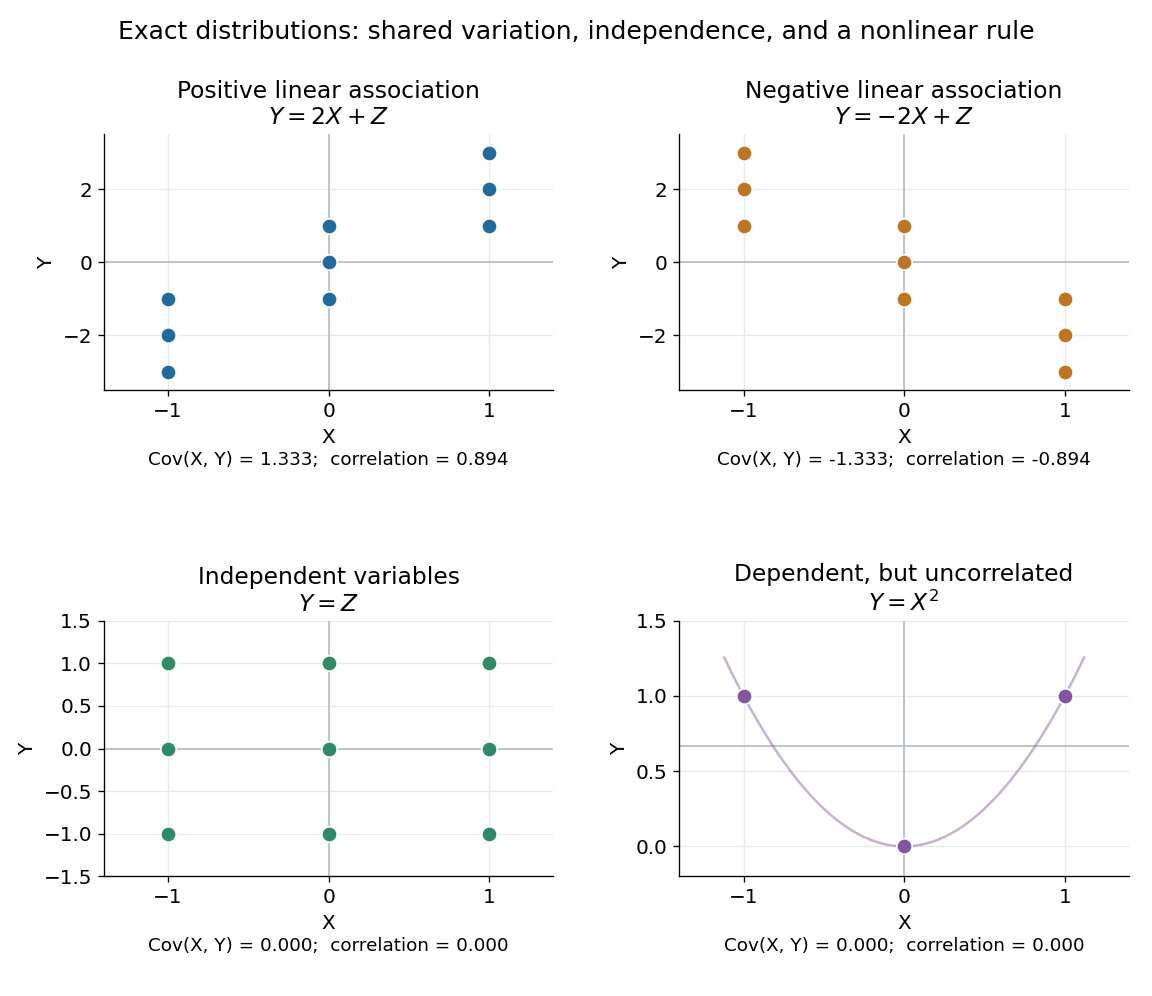
Positive, negative, independent, and nonlinear relationships have different covariance behavior
. In the first three panels, and independently take , and with equal probabilities; each point has probability . In the last panel, , and the three marked outcomes each have probability . The thin curve shows that quadratic function. Its zero covariance leaves strong nonlinear statistical dependence visible. Details.
The covariance is useful whenever deviations are added or subtracted. Expanding the square givesFor the worked model, these are and . Positive covariance increases variation in the sum while reducing variation in the difference: the same shared fluctuation reinforces one combination and partly cancels in the other. The identity applies beyond independent random variables.
The size of a covariance depends on the measurement scale. For constants , linearity of covariance gives . Adding offsets has no effect; rescaling either measurement rescales the covariance. The Pearson correlation coefficient divides by both standard deviations to describe the standardized linear relationship.
Variance additivity for independent random variables by Codex 0 Created 2026-09-24 Updated 2026-09-28
Codex 0 Created 2026-09-24 Updated 2026-09-28 There are unlisted articles, also show them or only show them.