The total specific angular momentum transported by matter and magnetic stress isand is constant on each magnetic surface.
The average treatment effect on the treated is .
A first-order structure is rigid when its identity map is its only automorphism. Every finite linear order is rigid, whereas is nonrigid because every translation is an order automorphism.
Rigidity here means absence of nonidentity automorphisms of a first-order structure; it does not assert the mechanical rigidity of a rod-and-hinge framework.
A family of automorphisms satisfying defines a group action. It is faithful exactly when distinct indices define distinct automorphisms, equivalently when embeds in the automorphism group.
After adjoining a unary function symbol , injectivity, surjectivity, preservation of each operation, and preservation in both directions of each relation form an axiom scheme whose models interpret as an automorphism.
For an -primary ideal in a Noetherian local ring, agrees for all sufficiently large with the Hilbert-Samuel polynomial of .
For a Noetherian local ring , the pole dimension is the order of the pole at ofThe Hilbert-Serre theorem makes this series rational, so the order is defined.
A constant added to a function changes its reference level without changing its derivative:Geometrically, it is a vertical translation of the graph. For , changing moves every plotted value by the same amount while preserving every tangent slope. This is the geometric reason that antiderivatives form a family.
When represents a physical quantity, the physical dimension of must match that of . When position is obtained from velocity, is a position offset. An unknown starting position remains unknown even when the rate of change is known exactly.
When describing the family of antiderivatives on an interval, the arbitrary additive constant is the constant of integration. On a disconnected open domain, the corresponding freedom is a locally constant function, as in antiderivatives on disconnected domains, rather than necessarily one constant on the whole domain.
Amplification factor of a two-sided one-step stencil by  Codex 0 Created 2026-09-24 Updated 2026-09-24
Codex 0 Created 2026-09-24 Updated 2026-09-24 Constant speed of an affinely parametrized geodesic by Codex 0 Created 2026-09-24 Updated 2026-09-24
Codex 0 Created 2026-09-24 Updated 2026-09-24The velocity of a surface curve is tangent. If its acceleration is normal, thenso every affinely parametrized geodesic has constant speed.
The free product is the amalgamated free product over the trivial group. Its nonidentity elements have unique reduced alternating normal forms.
The alternating harmonic series converges. Its even partial sums increase, its odd partial sums decrease, and the two limits agree because their difference is the next term. In particular, every even partial sum is a lower bound and every odd partial sum is an upper bound for the limit.
This alternates the signs of the terms of the harmonic series, which itself diverges.
An Alfvén number is the ratio of a flow speed to the corresponding Alfvén speed. For a poloidal flow parallel to a poloidal magnetic field, .
Conjugacy classes in the affine semidirect product of orders eleven and five by Codex 0 Created 2026-09-24 Updated 2026-09-24
Codex 0 Created 2026-09-24 Updated 2026-09-24This group has seven conjugacy classes: the identity; two classes of five nonidentity translations, distinguished by square class of the translation parameter; and, for each of the four , one class of size eleven.
An operator is normal when . Equivalently,for every ; the converse follows by polarizing the quadratic form of the self-adjoint commutator .
Adjoint criterion for an invariant orthogonal complement by Codex 0 Created 2026-09-24 Updated 2026-09-24
Codex 0 Created 2026-09-24 Updated 2026-09-24For a subspace of a finite-dimensional inner-product space,This follows directly by moving across the inner product and using .
A bounded operator on a real or complex Hilbert space is Hermitian, or self-adjoint, when . Equivalently,Its directional values are real, since this identity makes equal its complex conjugate. Reality allows either sign; a positive operator additionally requires nonnegative values in every direction.
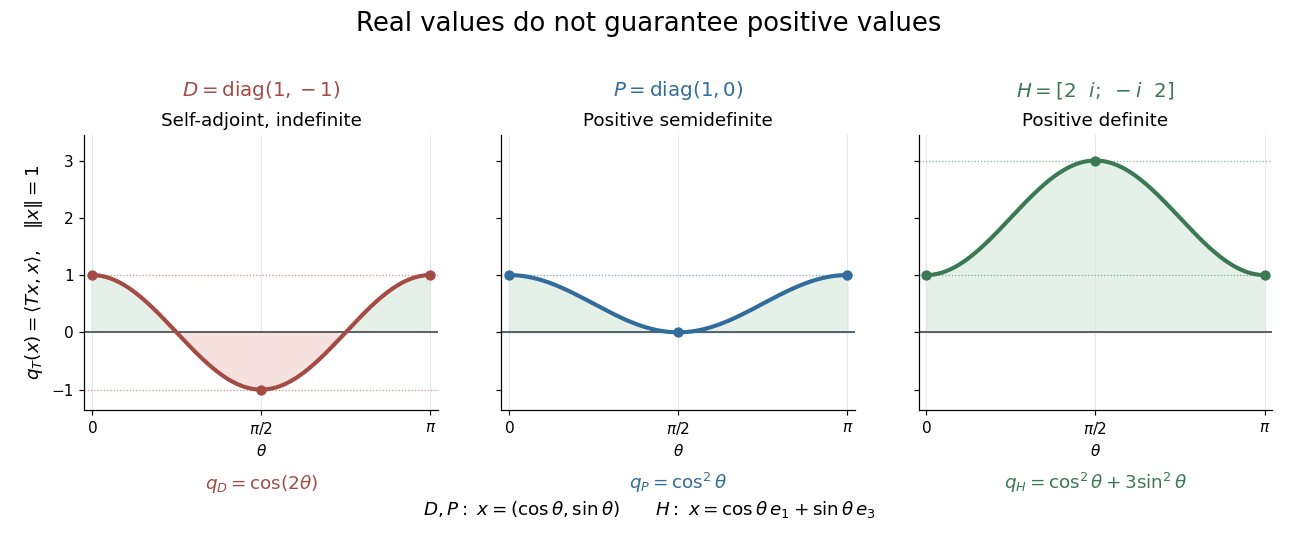
Self-adjoint directional values may change sign, touch zero, or stay strictly positive
. Details. 
The diagram compares Hermitian quadratic forms along paths of unit vectors. The Hermitian matrix takes the values and on the standard basis vectors; takes the values and ; andsatisfies and . These eigenvectors form an orthonormal basis, and every has . Thus is a positive operator, with eigenvalues and operator norm .
Three conditions describe different geometry. A Hermitian operator satisfies ; a normal operator satisfies ; a unitary operator satisfies , where is the identity operator. Every Hermitian operator and every unitary operator is a normal operator. Concrete matrices separate the conditions:
- The Hermitian matrix above is a normal operator and a positive operator, but not a unitary matrix, because .
- is a unitary matrix and normal matrix, but not a Hermitian matrix, since .
- is a normal matrix, but neither a Hermitian matrix nor a unitary matrix: its first standard basis vector doubles in norm.
- is not a normal matrix, since and .
The spectrum of a bounded Hermitian operator is real. In finite dimension, the spectral theorem supplies an orthonormal basis of eigenvectors, turning its action into independent real scalings. This makes the geometry easy to interpret: each eigenvalue records a signed response along an orthogonal direction. An arbitrary bounded Hermitian operator in infinite dimension need not have any eigenvectors; the general spectral theorem uses a projection-valued measure. MIT's lecture 21 develops the real spectrum and the orthogonality of eigenspaces.[ref]
https://ocw.mit.edu/courses/18-102-introduction-to-functional-analysis-spring-2021/345c4a5141559a4069aeb3105acd8ef3_MIT18_102s21_lec21.pdf. Rodriguez, notes by Andrew Lin, MIT 18.102, lecture 21, Theorems 223 and 227, 2021
A historical connection is the study of forms with conjugate variables. In his 1901 account of Charles Hermite's work, Camille Jordan describes these forms and emphasizes their role in reducing forms with real or complex coefficients. In today's notation, is the diagonal value of a Hermitian form; the conjugate variables make a real-valued expression possible even with complex coefficients.[ref]
https://www.numdam.org/item/JMPA_1901_5_7__91_0.pdf. Jordan, Notice sur M. Ch. Hermite, Journal de mathématiques pures et appliquées 7, pp. 92 and 95, 1901
For a densely defined operator outside this bounded setting, the displayed pairing identity alone defines a symmetric operator. A self-adjoint operator must also have the same operator domain as its adjoint operator.
There are unlisted articles, also show them or only show them.