The Graph Laplacian of the complete graph has eigenvalue zero on the constant vector and eigenvalue on the -dimensional subspace whose coordinates sum to zero.
For finite graphs , the homomorphism density is the probability that a uniformly random map is a graph homomorphism. For bipartite graphs with prescribed vertex classes, the random map is chosen separately and uniformly into the corresponding classes.
The chromatic polynomial turns a graph coloring problem into a counting problem: how many choices remain when adjacent vertices must have different colours? For a finite simple graph and a positive integer , is the number of proper vertex colorings using a fixed, distinguished palette of colours. A colouring need not use every available colour, and exchanging two palette colours generally gives a different colouring. Although is a polynomial, its values at arbitrary noninteger arguments are not counts of colourings.
Consider the three-vertex path graph ----. Choose in ways, then in ways, then in ways: and may agree because they are not adjacent. The multiplication principle givesAdding the edge makes the three-vertex complete graph . Now must avoid both preceding colours, soWith three available colours, the path graph has 12 colourings, whereas the triangle has 6. With two colours the counts are and : the extra constraint makes the triangle impossible to colour.
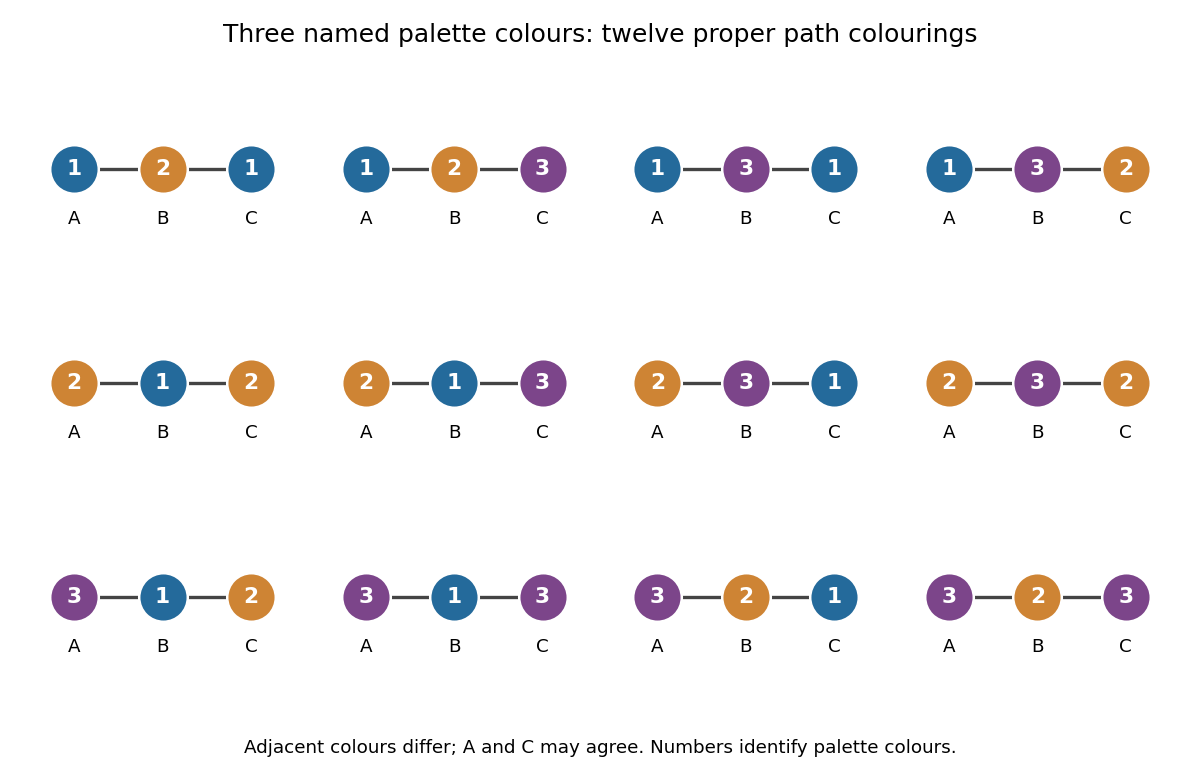

For a nonempty graph, the chromatic number records only the first positive integer for which . The chromatic polynomial also counts the choices for every larger palette. For the path the chromatic number is , and for the triangle it is . Counting assignments also gives a useful interpretation for scheduling: if adjacent vertices represent tasks that must use different slots, the chromatic polynomial counts the valid assignments to named slots. Adding a conflict edge can only remove assignments.
The chromatic polynomial also remembers some of the graph's structure. For a simple graph with vertices and edges, its leading terms are ; its degree of a polynomial gives the number of vertices, and its next coefficient gives the number of edges. It does not determine the graph completely. A four-vertex path graph and a four-vertex star graph are not related by a graph isomorphism, but both are trees and have chromatic polynomial .
The early connection to map colouring appears in George D. Birkhoff's article [ref]
https://www.jstor.org/stable/1967597. A Determinant Formula for the Number of Ways of Coloring a Map, Annals of Mathematics 14 (1912–1913), pp. 42–46
. For a derivation of the counting recurrence and its leading coefficients, see Paul Johnson's MAS 341 lecture on chromatic polynomials.The edge chromatic number is the least number of colours required to colour edges so that incident edges receive different colours.
For a nonempty finite simple graph , the chromatic number is the least positive integer for which has a proper vertex graph coloring with at most colours. To establish an exact chromatic number, give a colouring using that many colours and explain why fewer cannot suffice. A colouring alone gives only an upper bound.[ref]
Mathematics for Computer Science by Eric Lehman and others. Lehman, Leighton and Meyer, Mathematics for Computer Science, Definition 11.7.1
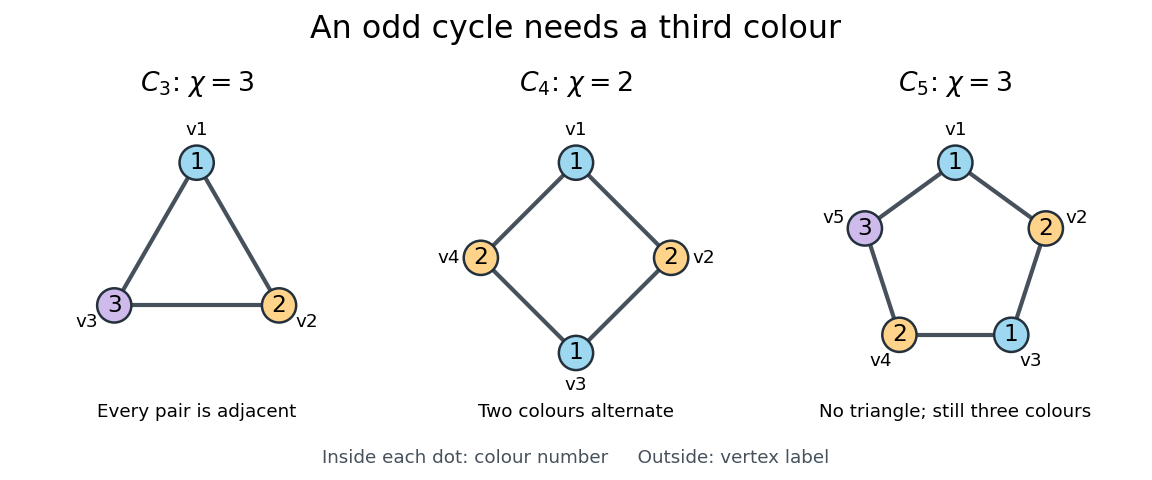

These small graphs show why the chromatic number measures more than the presence of triangles in a graph:
- The cycle graph , also the complete graph , has chromatic number three. Every pair of vertices is adjacent, so three distinct colours are necessary and sufficient.
- The cycle graph has chromatic number two. Around the graph cycle, the assignment is proper, and a single colour would violate every edge.
- The cycle graph has chromatic number three. With two colours, alternation around the graph cycle would force the first and fifth vertices to have the same colour despite their joining edge. The assignment works. Thus a triangle-free graph can still require more than two colours.
- The complete graph has chromatic number : all vertices are pairwise adjacent, so each must have its own colour.[ref]
For a cycle graph of even length, alternating two colours closes consistently; for an odd cycle, it does not, and a third colour on the final vertex suffices. More generally, the two-colourability criterion for bipartite graphs says that exactly when is a bipartite graph, and the odd-cycle characterization of bipartite graphs identifies the obstruction as an odd cycle. A nonempty graph with no edges has chromatic number one; a bipartite graph with at least one edge has chromatic number exactly two.
In the pairwise-conflict scheduling model of graph coloring, is the least number of interchangeable slots needed. This turns a drawing into an optimization question: how many groups of compatible activities are unavoidable? Greedy coloring constructs a valid grouping quickly, but its number of colours can exceed the chromatic number.
An undirected graph is connected when every pair of vertices is joined by a finite graph path. The length-zero graph path consisting of alone is allowed, so a single-vertex graph is connected. We use the term here for nonempty graphs; conventions for the graph with no vertices vary. Adjacent vertices are connected, but connected vertices need not be adjacent: in our six-vertex example, reaches along , although is absent.
Allowing walks instead of graph paths gives the same test for a connected graph. Whenever a finite walk revisits a vertex, delete the intervening closed portion; repeating this leaves a graph path with the same endpoints. This simple shortening argument explains why revisiting locations cannot help decide reachability.[ref]
https://ocw.mit.edu/courses/6-1200j-mathematics-for-computer-science-spring-2024/mit6_1200j_s24_lec13.pdf. MIT, Connectivity and Trees, Theorem 1
Connectivity can conceal fragile connections. Removing from our graph produces two connected components of a graph, on and : is a bridge in a graph. Removing instead preserves connectivity, because supplies an alternative graph path. If edges represent communication links, this calculation says precisely which single link failure separates the two groups. It is a conclusion about this model, independent of the lengths in its drawing.
A tree is a nonempty connected graph without a graph cycle; equivalently, each pair of vertices has exactly one graph path between them. Delete and from our example. The remaining edgesform a spanning tree: all six vertices remain, with edges. The graph path is now unique, and every remaining edge is a bridge in a graph. Adding back creates exactly one graph cycle, . Thus graph cycles express alternative routes, while a tree retains just enough connections for reachability. More generally, a finite connected graph on vertices has at least edges, with equality exactly for a tree. One proof repeatedly removes an edge on a graph cycle, preserving connectivity, until a spanning tree remains.[ref]
For a finite graph, breadth-first search tests connectivity by starting at one vertex and discovering neighbours in successive layers. Starting at , the layers in our example are , , , . Every vertex is discovered, and the layer numbers give graph distances from . Recording one discovery edge for each new vertex constructs a spanning tree. This turns an existence question into both a concrete route and a certificate of connectivity.
For a positive-definite matrix , the conjugate gradient method chooses mutually -conjugate search directions. Starting with and , it usesand with
.
.
Exact line search for a positive-definite quadratic by  Codex 0 Created 2026-09-24 Updated 2026-09-24
Codex 0 Created 2026-09-24 Updated 2026-09-24For with positive definite and residual , exact line search along usesThe objective error contracts by
Stochastic gradient descent updates parameters using an unbiased or approximate gradient computed from one observation or a mini-batch rather than the complete data set.
Inverse theorem for the Gowers U3 norm over a finite field by Codex 0 Created 2026-09-24 Updated 2026-09-24
Codex 0 Created 2026-09-24 Updated 2026-09-24For fixed prime , a one-bounded function on with norm at least has correlation bounded below in terms of and with a quadratic phase, with the usual nonclassical formulation in small characteristic.
A quadratic phase on is a function , where is a quadratic form and . Its third multiplicative derivative is one, so its norm is one.
The Fennoscandian Ice Sheet covered northern Europe during the last glacial period and produced ongoing uplift around the Baltic region after retreat.
There are unlisted articles, also show them or only show them.