The Graph Laplacian converts local differences along edges into a linear map. Throughout this section, is a finite undirected graph with no self-loops or repeated edges, and each edge has weight one. In a fixed order of vertices, let be the adjacency matrix and the degree matrix. The combinatorial Graph Laplacian isThus the value at a vertex is compared with its neighbours. Every row sums to zero, so : a constant vector produces no differences. This definition and the associated Graph Laplacian quadratic form are developed in Spielman's authored survey.[ref]
https://www.cs.yale.edu/homes/spielman/PAPERS/SGTChapter.pdf. Spielman, Spectral Graph Theory, Sections 16.3.1–16.3.2
For the three-vertex path graph , the vertex degrees are , and in that orderDirect multiplication gives three eigenvectors and their eigenvalues:The constant eigenvector has eigenvalue zero; the other two describe progressively stronger neighbour disagreement. Dividing these eigenvectors by , respectively, gives an orthonormal basis. The four-vertex cycle graph is already worked out under circulant matrix, where Fourier diagonalization of a circulant matrix gives its eigenvalues.
Every formula here uses without degree normalization. For comparison, Chung's treatment uses the degree-scaled matrix , with a convention for isolated vertices; its eigenvalues must not be substituted into the examples here.[ref]
For a finite undirected graph without self-loops, give each edge a symmetric nonnegative weight . In the weighted graph, set for an edge and zero otherwise, and with all other entries zero. The Weighted graph Laplacian isEach edge appears once in the quadratic form. For the path graph with weights and ,The Weighted graph Laplacian is still a positive semidefinite matrix. Its kernel consists of vectors constant on each connected component of a graph after zero-weight edges are removed: an edge of weight zero imposes no constraint. In an electrical network, taking the weights to be electrical conductances makes the total power dissipated by Joule heating when gives the voltages at the vertices. This physical interpretation explains why stronger connections penalize disagreement more heavily.[ref]
https://www.cs.yale.edu/homes/spielman/PAPERS/SGTChapter.pdf. Spielman, Spectral Graph Theory, Section 16.3.2: resistor networks
The degree matrix is the diagonal matrix whose th diagonal entry is the degree of a vertex . For a finite simple graph, , where is its adjacency matrix. For a Weighted graph Laplacian, use the sum of incident edge weights instead of the number of incident edges.
Assign a real value to each vertex. The Graph Laplacian quadratic form measures disagreement across edges:This makes the Graph Laplacian a positive semidefinite matrix. The energy is small when neighbours have similar values, even if distant vertices have very different values; it depends on connections rather than where the graph is drawn. In the three-vertex path graph, take . Thenand the two edges contribute and .
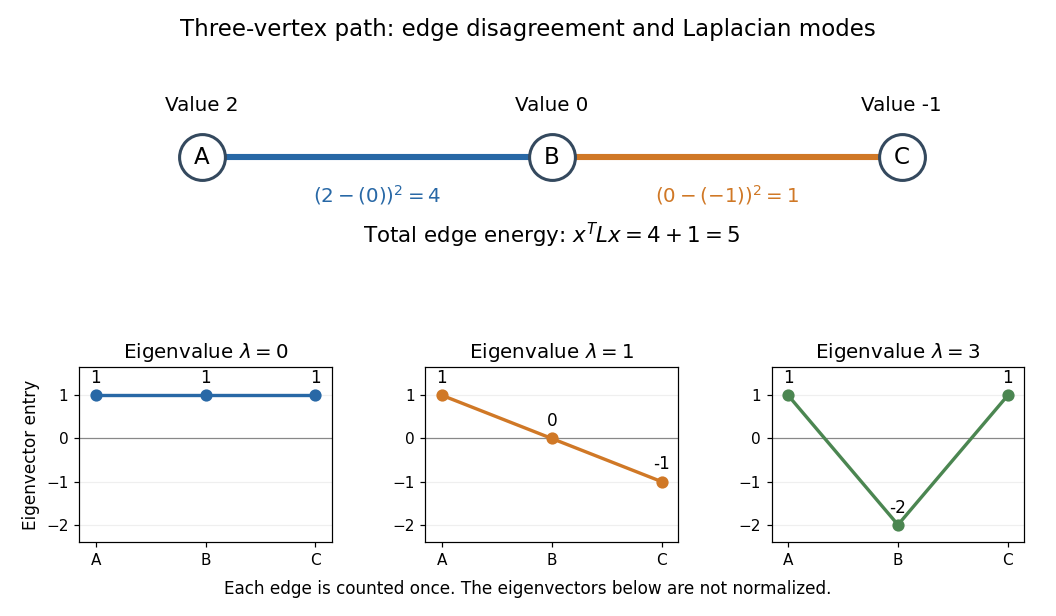
For a short proof, expand . Each edge contributes through the degree matrix and through the adjacency matrix, yielding . The sum over unordered edges has no factor ; a sum over all ordered pairs does:Equivalently, let be an oriented incidence matrix, with one row per edge. Then records endpoint differences and , independently of the chosen orientations. This translates a local comparison into a global quadratic form and makes its nonnegativity visible.
The kernel of the Graph Laplacian consists exactly of vectors constant on each connected component of a graph. Indeed, implies , so the Graph Laplacian quadratic form forces equality at the endpoints of every edge; equality then propagates along graph paths. Conversely, these equalities make every entry of zero. Thus the dimension of the kernel, equivalently the multiplicity of the zero eigenvalue, counts the connected components of a graph.
For the disconnected graph with just two edges, and , in order ,The two displayed vectors form a basis of the kernel. The other two eigenvectors and each have eigenvalue two, so the full list of eigenvalues, including multiplicities, is . Separate connected components of a graph allow independent constant levels; a single global constant is only one of these possibilities.
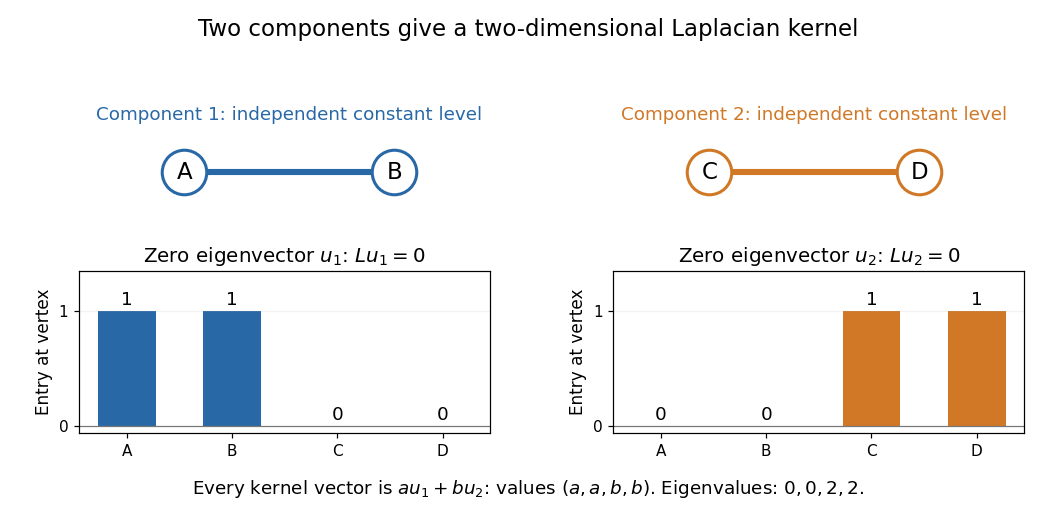
Two disconnected edges give two independent zero eigenvectors
. Details. The continuous-time diffusion model on a finite undirected graph uses the Graph Laplacian in the ordinary differential equationAcross each edge, the higher value sends an amount proportional to the difference to the lower value. The two contributions cancel in the sum over vertices, giving conservation of mass:If the entries represent masses, start with nonnegative entries; signed entries can instead describe deviations from a common level. For the three-vertex path graph, the initial vector is an eigenvector with eigenvalue one, so the exact solution isMore generally, an eigenvector with eigenvalue decays by . The spectral theorem for real symmetric matrices supplies an orthonormal basis of these eigenvectors, and the kernel of a graph Laplacian identifies the surviving terms. On a nonempty connected graph,The limiting value is the original arithmetic mean. On a disconnected graph, each connected component of a graph converges to its own original arithmetic mean. The same matrix therefore measures neighbour disagreement, detects disconnected regions and governs relaxation toward agreement.
The Graph Laplacian of the complete graph has eigenvalue zero on the constant vector and eigenvalue on the -dimensional subspace whose coordinates sum to zero.
Articles by others on the same topic



The Laplacian matrix is a representation of a graph that encodes information about its structure and connectivity. It is particularly useful in various applications such as spectral graph theory, machine learning, image processing, and more.