Let have degree at most , and let each contain distinct elements. The Alon-Tarsi coefficient formula isIt follows by applying Lagrange interpolation successively in each variable.
Hermite interpolation prescribes values and finitely many derivatives of a polynomial at distinct points.
The degree of a nonzero polynomial is the largest exponent of a monomial with a nonzero coefficient. Thus has degree three, while any nonzero constant polynomial has degree zero. The zero polynomial is treated separately in degree statements.
Over an integral domain, polynomial degrees add under multiplication: for nonzero factors, because the product of their leading coefficients cannot vanish. Under addition, cancellation may lower the degree: . This explains why degree is reliable for counting factors and bounding polynomial roots, but cannot always be inferred from the degrees of summands alone.
An irreducible polynomial is a nonconstant polynomial that cannot be written as a product of two nonconstant polynomials over its coefficient field. Over a general integral domain, neither factor may be a unit.
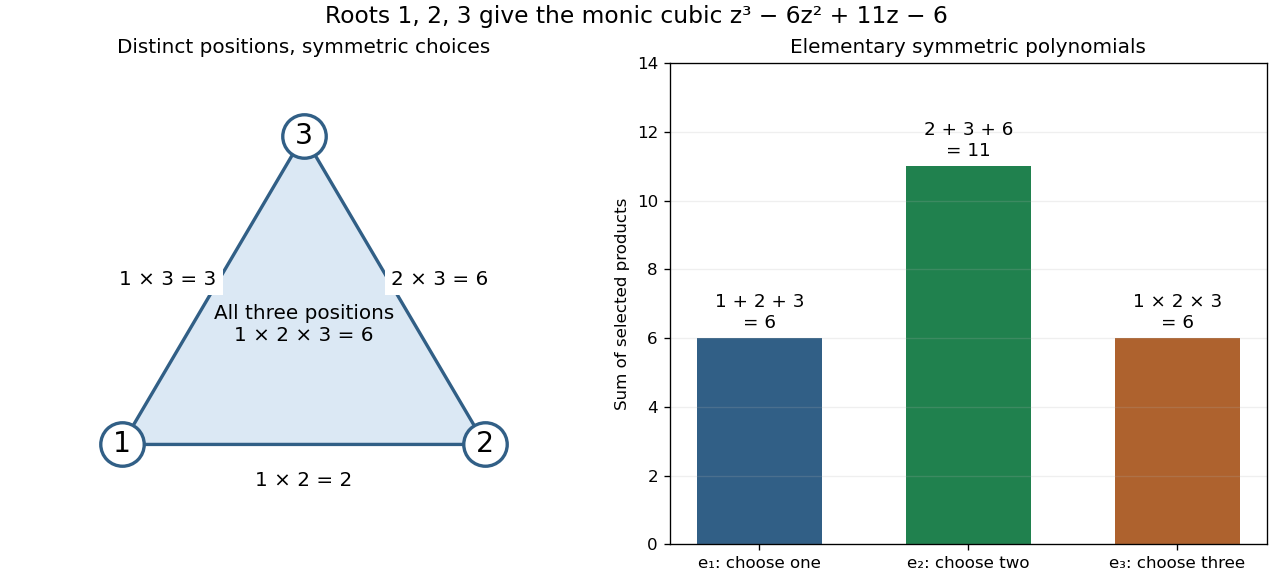
The th elementary symmetric polynomial adds every product obtained by choosing distinct positions from :The conventions are and for . The positions must be distinct, but their values may coincide. Each permutation of the variables merely rearranges the summands, so this is a symmetric polynomial.
For , , , we obtain , , and . Expanding the product givesIn general, . Thus the coefficients of a monic polynomial collect elementary symmetric polynomials of its roots of a polynomial, with alternating signs. These are the Vieta formulas.[ref]

The resultant of two univariate polynomials is the determinant of their Sylvester matrix. It vanishes exactly when the polynomials have a common root over an algebraic closure, and a nonzero resultant gives Bézout identities between the two polynomials.
A root of a polynomial is a scalar satisfying in the chosen field or ring. For over the real numbers, the distinct roots of a polynomial are and . The second has multiplicity of a root two, so there are three roots when counted with multiplicity.
The domain matters. has no real polynomial root, but has the two complex number roots . The fundamental theorem of algebra guarantees a polynomial root in the complex numbers for every nonconstant complex polynomial, and complete factorization counts its degree of a polynomial many roots with multiplicity of a root. It does not promise that those roots are real or that they have a simple expression.
Interplanetary dust consists of small solid particles orbiting within a planetary system and responding to gravity, radiation, plasma, and collisions.
A debris disk is an optically thin circumstellar population of dust and larger solid bodies maintained mainly by collisions.
Planetary system dynamics studies the orbital evolution of planets, planetesimals, and dust under gravity, radiation, collisions, and dissipative forces.
A Stefan problem is a moving-boundary problem in which a phase boundary moves as latent heat is released or absorbed. Temperature satisfies a heat equation in each phase and the Stefan condition supplies the interfacial energy balance.
A planetary surface energy balance equates absorbed short-wave radiation and heat supplied from below with reflected short-wave radiation and emitted long-wave radiation. With incident flux , Bond albedo , conductive upward flux , and emissivity ,
Temperature scaling of thermal photon number and energy densities by  Codex 0 Created 2026-09-24 Updated 2026-10-14
Codex 0 Created 2026-09-24 Updated 2026-10-14Changing variables to in the Planck distribution giveswhere and are temperature-independent constants.
The infinite pigeonhole principle says that if an infinite set has a partition of a set into finitely many parts, at least one part is an infinite set. Equivalently, assigning infinitely many objects to a finite number of boxes forces some box to contain infinitely many objects. For example, separating the natural numbers into their two residue classes modulo forces at least one class to be an infinite set; here both are, as the lists and show.
Proof outline. A union of finitely many finite sets is a finite set. If all the parts were finite sets, their union could not be the original infinite set.
The assumption of finitely many parts is essential. With one box labelled by each natural number, assigning to box puts exactly one object in every box. Infinitely many objects and infinitely many boxes therefore need not produce even a shared box. The infinite pigeonhole principle is useful whenever finitely many labels organize an endless collection: one label must keep occurring infinitely often, providing an infinite set on which that label is constant.
There are unlisted articles, also show them or only show them.